Alessandro Vasapolli : At the edge of memory.
Alessandro Vasapolli’s work cannot be apprehended as a simple production of images: it constitutes an inquiry into the very conditions of visibility. For him, photography is neither a record of reality nor a decorative gesture, but a field of experimentation where perception, matter, and time come into friction.
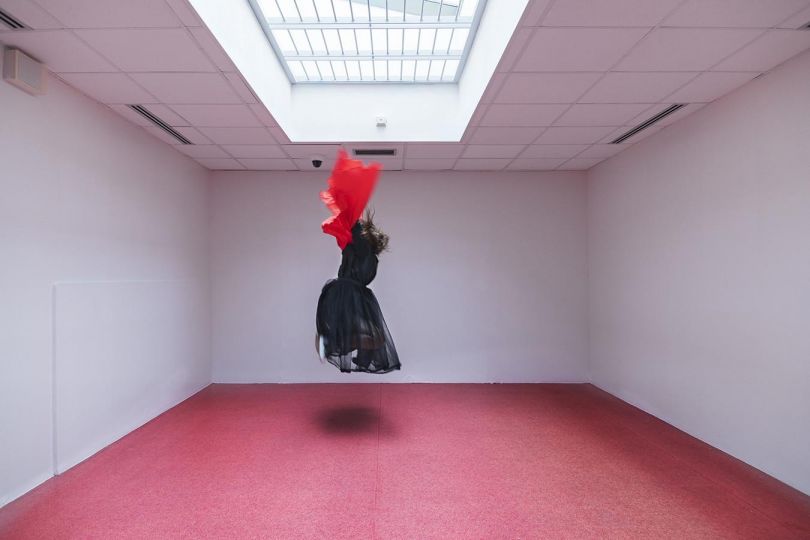
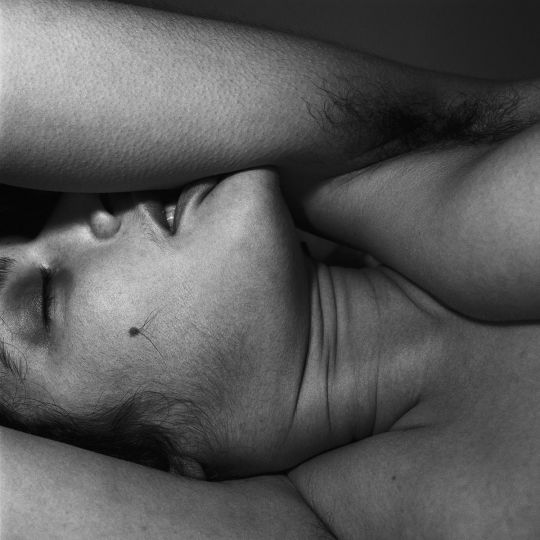
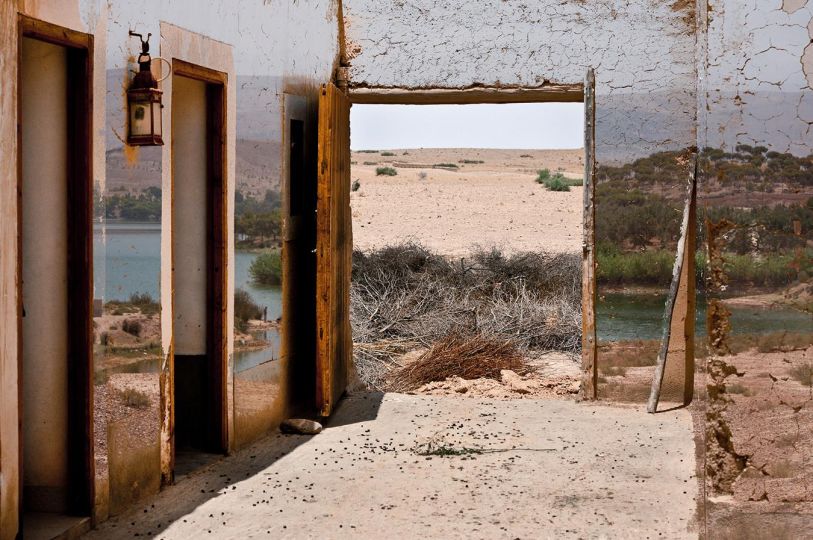
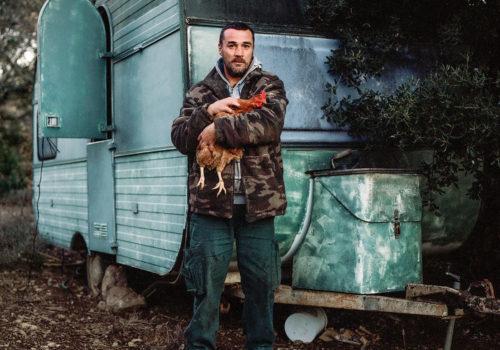
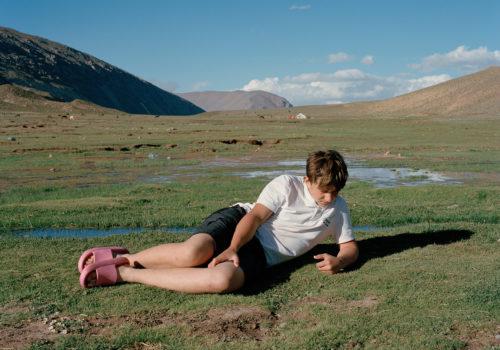
Trained in an Italian tradition attentive to light and formal construction, he nonetheless displaces classical codes to test their limits. His series whether depicting suspended figures, bodies in motion, or nearly abstract surfaces always seem to probe a threshold: the moment when an image ceases to be descriptive and becomes a phenomenon. The subject is never presented frontally; it emerges in a vibration, a diffraction, a chromatic tension. What strikes one first is the materiality of his photographs. He delegates nothing to chance or digital automation. He designs his own filters, develops specific chromatic systems, and controls the printing process as if in an intimate laboratory. This refusal of corrective post-production is not mere purism: it is a theoretical stance. The image must arise from the light itself, not from a subsequent artifice. It is the result of a deliberately conceived, almost architectural, apparatus. In certain series, movement particularly of the body becomes a field for analyzing time. The figure does not dance to be represented; it serves to decompose space, to fragment visual continuity. Elsewhere, female silhouettes appear as presences at once revealed and withdrawn: the eye seeks a face, an identity, but encounters a form of eclipse. This absence is constitutive of the work, compelling the viewer to complete, project, and doubt.
Vasapolli belongs to that generation of artists who consider photography a conceptual medium without sacrificing its sensuality. Color, for him, is never illustrative: it functions as energy. It disrupts immediate reading, introduces unease, sometimes even a form of optical vertigo. One does not simply “look” at his images; one traverses them. His oeuvre subtly dialogues with the history of experimental photography from the avant-gardes to contemporary explorations of abstraction while asserting a singular signature. It reminds us that seeing is never neutral, that every image is a construction, and that reality, far from being given, is negotiated.
To discover Alessandro Vasapolli is to accept slowing down. It is to consent to the resistance of the image. And in that very resistance, something is revealed: a photography that does not show the world, but teaches us to perceive it differently.
Your first photographic trigger?
Alessandro Vasapolli : Ever since I was a child, I was mesmerized by cameras by what felt, at the time, like a kind of magic: the ability to capture whatever stood before me. I was lucky to travel extensively with my parents, and during those trips I discovered the quiet fascination of looking through a viewfinder. Framing a scene, choosing what to include and what to leave out, offered me a first glimpse of how images shape our imagination. That simple act of composing the world became my earliest trigger, the moment I understood that photography was not just about recording reality, but about deciding how to reveal it.
A photographic memory from your childhood?
A.V. : Although it’s not strictly photographic, one of my most vivid early memories comes from my father’s Super 8 films. As a young man he had travelled with his parents to some of the most remote and adventurous places, recording everything with a small camera. Some evenings, when I was a child, he would take out the projector and screen those films onto a large white sheet we kept at home. I was fascinated by the whole ritual the whir of the reels, the soft fluttering of the images. I was witnessing something undeniably real, yet transformed: those scenes belonged to our family’s history, but on the screen they seemed to come from somewhere else entirely, suspended in a dimension between memory and fiction. That ambiguity left a deep impression on me.
The camera of your childhood?
A.V. : When I was a child, before having a camera of my own, I used to steal my father’s. It was a small Panasonic compact he had bought in a little shop in New York during one of our first trips together. As a teenager, I was eventually given my first Panasonic Lumix still a compact, but no longer entirely automatic. Then, for Christmas when I was eighteen, I received my first DSLR: a Canon 400D. That camera changed everything. With it, photography stopped being a simple curiosity and became an obsession—one intense enough to keep me awake at night.
The one you use today?
A.V. : Today I use a wide range of cameras, from medium and large format film to a high-resolution digital DSLR. My current project involves a custom-built 4×5 view camera fitted with a digital back—a hybrid tool that allows me to work with the precision and intentionality of large format while embracing the possibilities of contemporary imaging technology.
The man or woman of image who inspired you?
A.V. : I have always been deeply drawn to the work of the earliest photographers. Perhaps unintentionally—limited as they were by the technology of their time—their images depict the world in ways our eyes could never truly witness. Artists such as Alfred Stieglitz, Hugo Henneberg, and Eduard J. Steichen opened my imagination to the idea that photography can reveal realities that lie just beyond ordinary perception.
At the same time, I find profound inspiration in painters like Toulouse-Lautrec, Pierre Bonnard, and Édouard Vuillard for their use of color. I also admire Zao Wou-Ki for the lyricism of his abstraction, as well as movements such as Orphism, which explored light, rhythm, and color in ways that resonate strongly with my own sensibility.
The image you would have liked to take?
A.V. : Probably the next one I will make. The desire to do better each time is what keeps me moving forward.
The one that moved you the most?
A.V. : The photographs that have moved me the most are Robert Capa’s images from Omaha Beach on June 6, 1944. Those eleven surviving frames—blurred, chaotic, almost dissolving—convey the terror and humanity of that moment with an unmatched intensity. I have always admired Capa’s courage: he stood in the water, under fire, to show what the world could not see.
And the one that made you angry?
A.V. : I see images every day that make me angry for all sorts of reasons—so many, in fact, that I’ve lost count.
Which photo changed the world?
A.V. : The very first one ever made: Joseph Nicéphore Niépce’s “View from the Window at Le Gras”. That fragile, grainy image marked the birth of a new medium. From that moment on, our way of recording, remembering, understanding the world was transformed forever and nothing has been the same since.
And which photo changed your world?
A.V. : When I was finishing university, I became obsessed with the idea of altering the camera’s own perception of color. For centuries, photographic tools have evolved toward an increasingly anthropomorphic ideal, striving to replicate human vision as faithfully as possible. I wanted to move in the opposite direction: to modify the camera itself so that it could authentically record a reality shaped by a different perceptual logic. The goal was never manipulation, but the opposite: to create a straight, unaltered photograph that revealed the world through a new, non-human way of seeing. For years I worked on this idea, refining the technique with no real success. Then one night—very late, around one or two in the morning—while experimenting in the studio, everything suddenly aligned. After what felt like the billionth attempt, the system finally worked. The resulting photograph was just a test, nothing more. And yet it changed everything for me. From that moment on, it transformed the way I make images, and I have never gone back.
A key image in your personal pantheon?
A.V. : Any shot from the “Time” chapter of my long-term cycle “Dance Notes”. In these pictures, at first glance, the dancer herself is no longer visible; only a set of black lines remains, tracing her movement through time—a distilled map of her trajectory rather than her form.
We often assume—almost instinctively—that a photograph captures an “instant.” Yet humans do not possess an organ dedicated to perceiving time; we infer its passage only through changes in space.
In “Time”, by bending the camera’s usual way of seeing, I inverted this natural order. Instead of using space to understand time, the photograph allows us to see the flow of time directly, and then, with a certain mental effort, to reconstruct space from it. The dancer’s movement becomes a temporal map: time made visible, space made inferential.
This image is important to me because it marked the moment when I understood that photography could go far beyond representation of space. It could explore structures of experience—time, perception, continuity—that we normally consider intangible. “Time” redefined the direction of my work, and it continues to guide the research I am pursuing today.
What interests you most in an image?
A.V. : I look at an extraordinary number of photographs every day, and an image can be compelling for many different reasons which, from my point of view, could ultimately be summed up into three categories: the story it carries, the innovation it introduces, or simply its beauty-whether that beauty is attractive or unsettling. In other words the three fundamental pillars through which I evaluate any photograph are: its content, its technical construction, and its aesthetic value. It’s the interplay between these three elements that determines whether an image resonates with me.
What details do you look for in a face, a landscape, or an object?
A.V. : In my work, I actually try to avoid details. I believe that photographs should preserve a sense of wonder, and that this feeling is heightened when the image leaves space for the viewer’s imagination. When we are not given every element explicitly, we instinctively begin to complete the picture with our own mind—making the experience more intimate and personal.
Showing too many details would break that delicate magic; it would close the door instead of inviting the viewer in. For me, an image is most powerful when it suggests rather than describes, when it leaves room for interpretation rather than providing all the answers.
Elliott Erwitt once said: “Color is descriptive. Black and white is interpretive.” Do you agree?
A.V. : I couldn’t disagree more with Erwitt—and yet, in a way, I also completely agree with him. His statement is rooted in a simple fact: we do not see the world in black and white, so monochrome photography inevitably becomes an interpretation of reality. If, hypothetically, we were born seeing only in greyscale, and color appeared to us only through photography, the opposite would be true.
This paradox is precisely what motivated me to develop my technique. I wanted to free color from its purely descriptive role and allow it to become interpretive—or rather, to make it “real” according to a perceptual logic that is not human. From a color point of view I aim to produce images that are unmanipulated yet grounded in a chromatic reality different from ours. In this sense, color ceases to describe the world and instead becomes another way of experiencing it.
Can technique, in your opinion, ever take precedence over emotion in photography?
A.V. : Technique is fundamental to my work, but it should always remain in service of the other two pillars that define a photograph for me: its content and its aesthetic value. The ultimate aim of my images is to evoke a sense of wonder—in the sense of allowing us to see the world through a perspective that exceeds the limits of our biological perception. Our senses define our everyday experience of reality, but they also constrain it; through photography, I try to momentarily bypass those constraints and offer a glimpse of what lies just beyond them.
Technique is what enables this shift in perception, but it is never the final goal. There must be a balance. If technique takes the lead, the photograph becomes an exercise rather than an experience. When it supports the idea and the visual impact without overshadowing them, it fulfils its proper role: a servant, not a protagonist.
Is beauty in photography, for you, purely aesthetic?
A.V. : It’s always a negotiation between the conceptual content of the image and its visual representation. Beauty emerges from that balance—from the way an idea, a structure, or an intention is articulated through form. As with most aspects of photography, it’s a compromise rather than a single, isolated quality.
What elements can make silence visible in a photograph?
A.V. : I guess, in my work, silence often comes from subtraction rather than description. When details disappear, when recognizable forms dissolve into traces, when the image opens a space the viewer must complete with their own imagination, a kind of visual quietness emerges.
For me, silence is not the absence of action but the suspension of noise the moment when an image stops explaining and begins suggesting, when it invites contemplation rather than demanding interpretation.
Does the uniqueness of a photograph come from the moment or from the staging? Can a photograph be truer than reality?
A.V. : To me, the answer is: it depends. One of the great strengths of photography is its extraordinary versatility. In reportage, for instance, staging a situation would undermine the very foundation of the image. But in a studio, staging is not a flaw it is a prerequisite. The entire set must be constructed for the photograph to exist, and therefore the “staged” nature of the image becomes an integral part of its identity.
I personally work in the studio, and during pre-production I am a complete control fanatic: I paint the backgrounds myself, develop the algorithms that determine the color system, build the optical filters I use, and craft every technical and scenic element of the set. But on the day I shoot, I become the opposite. I work with complete freedom, allowing the events within the frame to emerge on their own. Often, I even pretend for hours to still be running tests, just to keep my subjects spontaneous. In staged photography, what matters most is not the ability to capture “the decisive moment,” but the ability to create the right conditions for the image to generate itself. I see the set as a kind of alchemical cauldron: every element must be prepared with precision, but the magic must happen on its own.
As for whether a photograph can be “truer” than reality, I find the question itself problematic. Our idea of reality is built on our senses—portals to the world, but also limitations. My work seeks to surpass those limits by altering the camera’s perception, revealing a different yet entirely objective reality. In this sense, perhaps a photograph can be truer than what we ordinarily perceive. Or perhaps the notion of “truth” in relation to reality is too unstable to hold. From my point of view, once we accept that our senses cannot define reality in any absolute way, the premise of the question begins to dissolve.
Can a photograph change our perception of an event?
A.V. : Absolutely—and in many different ways. Broadly speaking, photography has always had the power to shape, clarify, or even overturn our understanding of events. An image can go beyond words or even expose the gap between what is said and what truly happened, becoming evidence, contradiction, revelation.
In my own work, this question sits at the very center of what I do. By altering the camera’s way of “seeing,” I aim to reveal aspects of reality that are normally inaccessible to us. In that sense, a photograph can absolutely change our perception of an event, because it can present a form of truth that is different from the one we are used to experiencing. It can open a new way of looking at something we thought we already understood.
Is photography a testimony or a form of manipulation?
A.V. : In my practice, I strive for photography to remain a form of testimony. My images involve no manipulation whatsoever—they are exactly as they emerge from the camera. For me, any form of post-production would undermine the authenticity of the photograph and, more importantly, the “other” reality I am trying to reveal. The entire purpose of my process is to enable the camera to perceive the world differently, so that the final image is a straight document of that alternative perception.
More broadly, though, I think that today there is an excessive emphasis on post-production. The line between photography and digital construction has become so blurred that it is often difficult to tell when an image ceases to be a photograph and becomes something else. This does not diminish its artistic value, but personally I would no longer call it photography—it becomes a form of mixed art.
What makes a good photo?
A.V. : For me, a good photograph is the result of a balanced interplay between its three fundamental pillars: content, technical construction, and aesthetic value. When these elements support one another rather than competing, the image acquires clarity, intention, and presence—and that’s when it truly works.
According to you, what is the necessary quality to be a good photographer?
A.V. : In my experience, the essential qualities are determination and an unfailing sense of curiosity. Determination allows you to keep refining your vision, even when the process is long or uncertain; curiosity keeps you open to new ways of seeing, thinking, and experimenting. Together, they form the foundation of any meaningful photographic practice.
How do you choose your projects?
A.V. : When an idea comes to me, I immediately start thinking about how it could be translated into a photographic form. If I sense that it has the potential to evolve then I pursue it—regardless of the complexity involved or the time it may take to realise it.
How would you describe your creative process?
A.V. : My best ideas tend to come to me in three specific moments: while I’m running long distances, driving alone, or taking solitary walks. For reasons I can’t fully explain, these are the moments when I manage to detach myself from what surrounds me and focus entirely on my thoughts. Once an idea appears, an “investigative” phase begins, during which I explore how it might be translated into something concrete.
From there, the constructive and experimental stages follow—usually far more complex and time-consuming than I initially expect. I’ve learned this the hard way, which is why I now automatically schedule twice the amount of time I think a project will require. The process is long, but it’s in that extended space of trial, error, and discovery that the work truly takes shape.
An upcoming project that’s close to your heart?
A.V. : Last year I was selected for a residency at the Department of Physics, Cosmology and Particle Physics at New York University. There, I developed an optical apparatus that allows me to photograph subjects as if they were moving at relativistic speeds—close to the speed of light. The aim is to make visible, for the first time in a photographic image, the phenomena that occur at those velocities: length contraction, the relativity of simultaneity, and other effects predicted by special relativity.
I am now completing the project, and I can’t wait to finalise it, as I believe it represents a significant step forward in my research. It will allow me to show phenomena that exist in our everyday world yet remain entirely imperceptible to our senses, and I am genuinely excited to reveal them through an artwork. In many ways, this project opens a new chapter in my exploration of spacetime perception—another attempt to push the camera beyond its anthropomorphic limits and reveal realities that lie just outside the boundaries of human experience.
The person you would like to photograph?
A.V. : I honestly wouldn’t know… I’m open to suggestions.
The one you would like to be photographed by?
A.V. : Albert Watson, without hesitation. And if he happens to be reading this, he’s more than welcome to get in touch should he, for any mysterious reason, feel inclined to photograph me.
An indispensable photo book?
A.V. : I’m actually a lot more fond of cinematography books. That said, there are a few, classic, photographic titles that were important to me: “The Camera” and “The Negative” by Ansel Adams, and “Feininger’s Darkroom Techniques” by Andreas Feininger. As for cinema, several books have been extremely useful in shaping my understanding of light, tools, and on-set practice: “Motion Picture and Video Lighting” by Blain Brown, “The Grip Book” by Michael G. Uva, and the “Set Lighting Technician’s Handbook” by Harry C. Box.
What is the last photo you took?
A.V. : I’m not entirely sure—but since we recently got a Border Collie named Fiocco, I can say with almost complete certainty that it was a photo of him.
In terms of social networks, are you more into Instagram, Facebook, TikTok — and why?
A.V. : I only use Instagram—and even that, very sparingly.
What changed in photography since the success of social media?
A.V. : I’m not an expert on social media so I can’t offer a definitive assessment. But it seems to me that the most significant shift has not occurred within photography itself, but in the way photographs are used. In private life, images were once primarily a means of storing our memories; today, they are often a way of showing ourselves to others.
As for art, I don’t believe social media is the ideal place to engage with it.
An Instagram account to follow absolutely?
A.V. : I have no clue.
What is your point of view about A.I.?
A.V. : From an artistic perspective, the current fear surrounding A.I. reminds me of the reaction painters had when photography was first invented. Many were terrified of losing their role, yet history showed that photography did not replace painting—it simply expanded the landscape of visual expression. I feel something similar today. An image generated by A.I. is not, technically speaking, a photograph, no matter how “real” it may appear, so I don’t see an inherent overlap.
Of course, it becomes a different matter when someone fraudulently presents an A.I.-generated image as a photograph, but deception has always existed.
Color or B&W?
A.V. : I have a deep appreciation for black and white, but absolutely color.
Daylight or artificial light?
A.V. : Since I work in the studio, artificial light is essential. Natural light can certainly be used in a studio environment, but it is far too variable to offer the precision I need. Part of the beauty of studio work, for me, lies in creating every single element of the photograph. Light is the first condition that makes an image possible—so why relinquish control over it?
Which city do you think is the most photogenic?
A.V. : I have a double first place: Rome and Paris. And although I’m Italian, I might lean slightly toward Paris—simply because I lived there for eight years and probably had the chance to explore it in much greater depth.
The city, the country or the culture you dream of discovering?
A.V. : I’m a great lover of nature, so my dreams tend to point toward places rather than cities: I would love to explore the Amazon, the Arctic, and to return to Africa.
The place you never get tired of?
A.V. : Varigotti, in Italy. It’s a small fishermen’s village in Liguria with just a handful of inhabitants in winter, and my family has had a house there since I was a child. There is quite literally nothing—but perhaps that’s exactly why I never tire of it. Whenever I can, I go back.
The image that represents for you the current state of the world?
A.V. : Perhaps an early photograph from a cloud chamber—the scientific device in which traces of charged particles, including cosmic rays, become visible as thin, unpredictable lines drifting through a supersaturated vapor. Those images have always struck me as a metaphor for the world we live in today: increasingly complex, shaped by dynamics we cannot immediately see, and often difficult to predict. In many ways, it feels like an apt visual analogy for the present.
According to you, what is missing in today’s world?
A.V. : Too difficult a question… but in my “own” little world, what’s missing is surely the time to do all the things I have in mind.
If God existed would you ask him to pose for you, or would you opt for a selfie with him?
A.V. : I’d ask him to pose. Photography is my greatest love, but I prefer to stay behind the camera.
Your favorite drug?
A.V. : I don’t use drugs — I’m already wild enough on my own.
The best way to disconnect for you?
A.V. : I have a small boat in Varigotti, and my favourite way to disconnect is to take it out and lose myself far out at sea.
Your latest folly?
A.V. : My projects are already quite crazy, and between the ones I’m working on and the ones I’m planning, I don’t really have room for any additional follies.
Your greatest professional extravagance?
A.V. : As I’m a mad perfectionist, I ended up creating a full in-house printing lab in my studio. I bought the largest fine-art printer available and spend countless hours calibrating it with a spectrophotometer. I even dedicated an 80-square-metre room solely to printing and framing my works. It may sound eccentric, but for me it’s the only way to maintain absolute control over every detail of the final image.
The job you would not have liked to do?
A.V. : Any job that is highly repetitive—or any job in which I wouldn’t have creative freedom.
What question gets you off track?
A.V. : The simplest questions are always the ones that throw me off balance.
What was the last thing you did for the first time?
A.V. : For my projects I always end up having to build all sorts of things using techniques I’ve never tried before. Most recently, I started learning TIG welding to construct part of a metal device, and I set up an electroplating system in my darkroom to produce other components I needed. There’s always a new skill to acquire along the way.
Your biggest regret?
A.V. : Like everyone, I have plenty—but the most recurring one is that every morning I set my alarm very, very early to make the most of the day, yet since I sometimes struggle to fall asleep, there are days when I simply can’t get up. It’s a small but persistent regret.
If you had to start all over again?
A.V. : If I knew from the beginning where my research would eventually lead me, I would probably focus on it straight away—skipping the long “exploratory” phase that, as for everyone, marked my early years in photography. Yet that phase was fundamental to my path, so in the end I wouldn’t truly want to erase it.
If I could organize your ideal dinner party, who would be at the table?
A.V. : Simply with my lifelong friends.
What do you like people to say about you… after?
A.V. : On my father’s tombstone it says “Creative in Rationality.”
On mine, I would like it to say “Rational in Creativity.”
The one thing we absolutely must know about you?
A.V. : That I have a wonderfully obsessive-compulsive streak—just enough to make my work possible, and my life occasionally complicated.
A last word?
A.V. : Come see my shows!