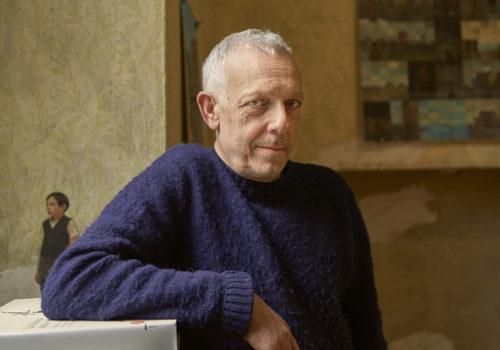
I met Paolo Ventura during his recent opening in Turin and was immediately drawn to his work. The unique blend of elements that seem to evoke childhood memories, combined with the way Ventura invites us into his own world, made me want to learn more about his background and artistic approach. So, enjoy the read, and let your imagination take flight…
Nadine Dinter: Your work draws us into a world all its own, one that weaves together theater, photography and performance. Please give us a short introduction of yourself as an artist.
Paolo Ventura: I started young – I was around 25 years old – as a fashion photographer. At the beginning, I wasn’t actually that interested in photography. I had studied art at the Brera Academy in Milan, although I never finished my studies, and almost by chance I began taking photographs.
Very quickly, I became a fashion photographer and worked in fashion for about ten years. Then, at a certain point, I decided to completely change my direction. I wanted to become an artist and create my own work. Photography became the medium through which I could do that.
By then, I had developed a real interest in photography, but I wanted to turn the camera away from the outside world – away from the street and visible reality and direct it toward my inner world instead. To do that, I began building complex dioramas and worked exclusively with them.
I imposed a rule on myself: every work had to be created on a table. The table became the stage of a small theater. On that stage, I could transform everything whenever I needed to. It’s actually very simple: the table became a stage, and the stage allowed me to create any story I wanted, much like in the theater.
Photography, however, works differently from theater. In theater, there is movement and continuous action, while photography freezes a single instant, a fragment of a larger narrative. My images are never the entire story, just one suspended moment within it.
I often work from storyboards. I write stories first and then create the images, so in many ways my process is very close to theater.
I also tend to use myself as the protagonist of these stories. My cast is very small: essentially myself, my wife, and my son. Sometimes I create small clay figurines and use them instead. But that’s fundamentally my cast.
In your images we keep encountering certain recurring figures wooden marionettes, puppets, and yourself in costume and character. Did you grow up in an artistic household? Are these figures symbols of something from your childhood that you want to preserve?
PV: Yes, I think I partly answered this before, regarding the presence of dolls and of myself in my work.
I grew up in an artistic family. My father was a very famous children’s book author in the 1960s and 1970s, well known internationally for his distinctive style of illustration. I also have a twin brother we are identical twins and he was extremely talented at drawing. Another one of my brothers was also very gifted in drawing. I was the only one who felt I lacked that kind of talent.
Perhaps that is one of the reasons why, unconsciously, I chose photography as my medium. At the beginning, I thought photography was a more direct way to express something without requiring a specific technical gift. Of course, that was a misunderstanding photography demands just as much sensitivity and vision but initially it felt like a different path, one that also distinguished me from the rest of my family. They had very little interest in photography. For them, a photograph was mainly a document, a witness to something real, nothing more.
Growing up as an identical twin was also quite complicated. We were constantly confused with one another. People would always ask: “Which one are you?” You grow up wanting to feel unique, to be recognized as yourself, but that was rarely possible.
My father, however, used to make extraordinary costumes for us during Carnival. They were incredibly elaborate and beautifully crafted. I remember in particular one costume where I was dressed as a Roman soldier and my brother as a Visconti soldier from Milan’s Renaissance. For the first time, it was completely clear who was who.
We loved these costumes so much that we continued wearing them even outside Carnival. I have a photograph of myself with my grandmother at a playground, and it was obviously not Carnival season perhaps winter or summer yet we were still dressed in those outfits. Looking back, we must have seemed like rather eccentric children.
The costumes were amazingly detailed: leather armor, metal helmets, wooden swords. My father was an extraordinary craftsman, and also a very unusual man though that is another story.
I think this experience deeply influenced my idea of creating characters. In my photographs, I almost always represent myself, but I am never truly myself in an everyday sense. I wear costumes, makeup, painted faces. The person in the image is not who I am in daily life, and yet it is profoundly me.
In a way, those characters reveal something more truthful than ordinary reality. They are not the everyday version of myself, but they are perhaps the real me.
Your current installation Edicola Acrobatica (Acrobatic Newsstand) on Piazza San Carlo, in the heart of Turin, brings an old newsstand back to life, selling rare and art books. The small structure is draped with silky orange curtains and flanked by wooden cut-out acrobats. What was the genesis of this project, and what emotions do you intend to evoke?
PV: Yes, the project in Turin is connected to a festival called Exposed, which is taking place in the city right now. The municipality of Turin asked the festival organizers to involve not only indoor exhibition spaces, but also the public spaces of the city itself. They offered artists several locations, and my exhibition was installed under the arcades of Piazza San Carlo, one of the central squares in Turin.
At both ends of the square there are two newsstands. One is still active, while the other has been closed for years. Unfortunately, newsstands are disappearing everywhere one closes every day. So the city asked me whether I might want to do something with this abandoned kiosk.
I immediately thought it was a wonderful opportunity. It’s such a small, poetic structure, and for a few weeks we were able to give it a new life.
Together with the Libreria Marini in Rome an extraordinary bookstore specializing in rare, used, and contemporary photography and art books we transformed the kiosk into a small bookshop. We sold my books alongside books by other artists and photographers.
I also loved the circular shape of the newsstand because it reminded me a little of a circus ring. Since my exhibition under the arcades was dedicated to acrobats and circus performers, it felt perfectly connected to the atmosphere of the show.
What moved me most was the reaction of people. Seeing these closed newsstands has become such a sad image in many cities, so people were genuinely happy to see one come back to life, even temporarily.
In the end, it was a very simple idea: perhaps these spaces can still exist, not necessarily to sell newspapers anymore, but to offer other kinds of printed material books, images, paper objects, things connected to culture and imagination.
What visual world did you grow up with? And are there artists from any period who have been lasting touchstones for you?
PV: As I mentioned before, my father was an illustrator and a children’s book author, so I grew up surrounded mainly by children’s books, but also by photography books that he used as references for his work.
For a long time, I myself had very little interest in either art or photography. That interest arrived quite late in my life, when I was already an adult. Because of that, I never really had idols or artistic heroes while growing up.
Today, of course, art is extremely important to me, and I follow many artists and movements that I love. I am very drawn to Italian abstract painters from the 1930s, ’40s, and ’50s, and also to the New German Objectivity of the 1920s and ’30s. I love certain periods of particular artists rather than following one artist entirely.
For example, I am very fond of the early work of Giorgio de Chirico, especially the paintings he made before the First World War. I also admire Luigi Veronesi, the Italian abstract artist who was close to Kandinsky.
But overall, my relationship with art came relatively late. As a child and even as a teenager, my interests were elsewhere. I was much more passionate about history especially modern history and about cinema rather than visual art.
I remember that, as a young person, I never bought art books or photography books. The first photography book I ever bought was by Irving Penn, and by then I was already an adult.
Your work brings together photography, architecture, painting, and performance. How do you think about your practice do you identify as a photographer, a contemporary artist, or something else entirely?
PV: I don’t really know how I would define myself. I consider myself a contemporary artist, but mostly I see myself as a photographer. Photography is important to me because it is the main medium I use in my work.
For me, the word “photography” already contains a lot. It is a broad term, full of possibilities, and in that sense it feels sufficient on its own. I am a photographer more than anything else I would say that.
At the same time, I also work as a contemporary artist, and sometimes I could even say as a painter. But honestly, I don’t think too much about labels or definitions.
Until a few years ago in Italy, ID cards included one’s profession, and mine simply said “photographer.” That felt completely right to me. Photographer that’s enough.
For the exhibition Rooms / Stages at the Newton Foundation, you present your celebrated series Der Sturm alongside a new in situ installation. Can you tell us more about it?
PV: Yes, exactly. There is a work called Der Sturm, which I’m very connected to as it’s my first black-and-white story at the beginning of my career.
Then there is another idea that came back when I visited the Newton Foundation last winter. Matthias Harder, its curator, told me about the project for the upper lobby, and brought up a body of work of mine called Short Stories. These are small photographic narratives, almost like miniature theater pieces.
For Short Stories, I build a very simple stage: I paint a backdrop and construct a small wooden floor, like a tiny theater set. On this stage, I perform in front of the painted background, using costumes, and I create short narratives composed of three or four images.
One of these stories is The Vanishing Man: a Jewish man in a black coat who disappears into the city. It is based on a simple visual trick I paint part of a wall in front of the backdrop so that the figure appears to walk into the city and then vanish. It is a very direct illusion, but effective: the character literally dissolves into the space.
When Matthias and I discussed the Newton Foundation project, he told me that when Helmut Newton was looking for a place for his foundation, he was shown several buildings. At a certain point, he saw the actual building and said: “This is the one,” because it was the last building he had seen from the train when he fled Germany in 1938.
Matthias suggested that this was a very symbolic story and asked if I could respond to it. I actually proposed something slightly different: instead of The Vanishing Man, I could create an homage to Helmut Newton by reconstructing a similar stage, but with the foundation itself as the backdrop.
In this version, the figure in a way both me and Helmut disappears behind the building, into the city. It becomes a meditation on disappearance, memory, and exile.
And with the stage set inside the foundation itself, the idea is that people too could symbolically “vanish” into the space, if they wish.
Your work operates on so many levels visually and narratively. How do you actually work? What does your process look like when you begin a new piece?
PV: Yes, it’s true. In general, when I start a body of work, I need to have a kind of story first.
Usually, before the images come, I write the story down in very short sentences. In this way, I can begin to create the images. So the text comes first, and then the images, and they develop together. But I don’t follow a linear order.
I don’t start from the beginning and move step by step to the end. Instead, I might write just one fragment for example: “a man is walking in the street, and he sees a river.” That could be in the middle of the story.
For me, what matters is having that one image or moment. From there, I can build what comes before and after it. I move back and forth, and I assemble everything later. Sometimes, almost magically, a story emerges.
It’s a slightly anarchic way of working.
Do you travel for research? More broadly, where does your inspiration come from, especially when it comes to filling in the historic layers of a story?
PV: Actually, I don’t travel much. I don’t really like traveling I prefer to stay in one place. My main source of inspiration is working in my city, Milan, or wherever I happen to be living at the time.
Most of my time is spent where I live, and I think walking is the key part of it. I walk a lot, and that is probably my main source of inspiration. Ideas come from many different things: concentrated thoughts, distracted or “lost” thoughts, observing houses, looking at people.
Another important source of inspiration for me is simply sitting in a bar. I spend a lot of time in bars. I like to watch life passing in front of me entering a kind of concentrated and unconcentrated state at the same time. In that condition, just observing what happens in front of me often generates ideas.
Which of your series/artworks is closest to your heart, and why?
PV: The Automaton is the series closest to my heart. It was the last series I created before leaving New York. I lived there for a long time my son was born there, I got married there, and it was the place where my passion became my profession, where what had been a hobby turned into real work.
That series was completed at the end of my time in the city, and it is strongly connected to that period of my life. I like that time very much.
Another series I am very attached to is Short Stories, which I made when we moved back to Italy, to Anghiari, a small town in Tuscany. That was also a very important and beautiful period for me.
In a way, the works I prefer are not necessarily those I judge as “best” in an objective sense, but the ones that are linked to the moments in my life when I created them. I don’t usually like my work while I am making it; I tend to be very critical in the first moment. Only later do I understand it differently.
That said, I want to mention that the work I did for the Newton Foundation is, for me, one of the key works of my career.
What is your advice for the new generation of artists?
PV: It’s difficult. I don’t really have advice for artists, because the world has completely changed.
In a way, I would like to be 20 years old now, because I think it’s a fantastic time to be an artist. The world is challenging, but also full of possibilities.
One of the major differences compared to when I was in my twenties is that today it is much easier to show your work internationally. Especially in photography, you can now submit to grants or institutions online. When I was young, we had to travel physically and bring our work everywhere Amsterdam, Berlin, Paris, New York carrying it with us, almost like a camel loaded with work.
But I don’t really have advice. I would almost need advice for myself. I could say the usual things “be yourself,” “trust yourself,” “believe in what you do” but these kinds of phrases don’t really change anything. They don’t guarantee success, or even satisfaction.
So, I don’t know. I really don’t know.
Maybe go to the bar often, walk a lot that is my own way of doing things. But I’m not even sure that counts as advice. It’s just what I’ve always done.
Perhaps I was just lucky to grow up in a slightly dysfunctional family. Maybe that helps you become more aware of your inner world, your obsessions, your interests makes you more connected to your irrational or unconscious side. But even that, I don’t know if it is an advice.
So, in the end, I have no real advice to give.
For more information, visit: https://www.paoloventura.com/ and follow the artist on Instagram: @paolo.ventura
Solo shows:
The Lost Magpie and Other Affairs, Jaeger Art, Berlin
Through 4 July 2026
Edicola Acrobatica, Piazza San Carlo, Torino
Through 4 June 2026
Group exhibition:
Rooms / Stages, Newton Foundation Berlin
Through 15 November 2026