Payram: Bearing the Weight of the Image
Payram does not photograph to produce images, but to bear their weight. His work distances itself from the instantaneous, the commentary, and visual seduction. It stems from an inner necessity, forged by exile, history, and a keen awareness of what it truly means to look. For him, photography is never decorative: it is a silent act of stance. The choice of black and white is more a commitment than a style. Large-format photography imposes a slow rhythm, directness, and responsibility. He works the material of the image as one would handle fragile memory: with slowness, precision, and restraint. What interests him is not the spectacular subject, but what persists — a blurred presence, a trace, a moral tension inscribed in the print itself. From the intimate to the political, no hierarchy is imposed. A portrait of a pregnant woman, an image of famine, a territory ravaged by war — all arise from the same gesture: to look without detour, without pathos, without staging. Technical mastery is never a display of skill, but a necessary condition for emotion to emerge — a contained, almost austere emotion, that seeks neither approval nor shock. Payram does not choose his projects: they impose themselves on him as urgencies. Photographing thus becomes an act of fidelity — to those who are no longerhere, to those erased by history, to a demanding idea of justice. The silence, ever-present in his images, is not an absence of discourse but a form of resistance to the noise of the world. This questionnaire revisits the formative images, the irreversible absences, the radical choices, and the doubts that traverse his work. It paints the portrait of a photographer for whom every image engages not only a gaze but an ethical responsibility.
Represented by Galerie Maubert – 20 rue Saint Gilles, Paris 3e
https://www.galeriemaubert.com/
Your first photographic awakening?
Payram: My older brother, who was passionate about chemistry.
A photographic memory from your childhood?
Payram: Hanging around movie theaters in Tehran, looking at the film stills displayed in the windows.
The camera from your childhood?
Payram: A Lubitel 2, a 6×6 camera.
The one you use today?
Payram: A Philips & Son, a 20×25 cm large-format camera from the 1960s.
The photograph that moved you the most?
Payram: The photograph of the Tank Man at Tiananmen Square.
And the one that made you angry?
Payram: Images of starving children in Gaza.
A key image in your personal pantheon?
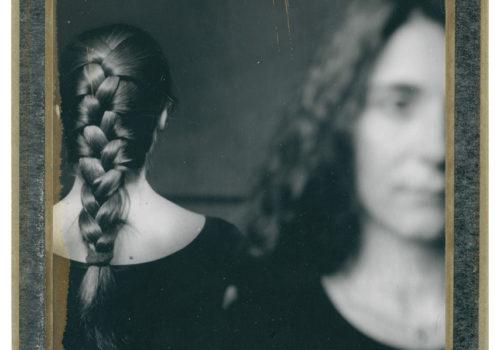
Payram: A portrait of my wife Fati, blurred and pregnant.
What interests you most in an image?
Payram: The materiality of the print.
Elliott Erwitt said: “Color is descriptive. Black and white is interpretive.” Do you agree?
Payram: I prefer this statement by Walker Evans: “Color photography deals with banal subjects, black and white deals with the noble subject.”
In your opinion, can technique sometimes take precedence over emotion in photography?
Payram: Mastering technique leads us toward emotion.
What elements can make silence visible in a photograph?
Payram: By definition, silence accompanies photographs.
In your view, what quality is necessary to be a good photographer?
Payram: Having a fresh eye.
How do you choose your projects?
Payram: My projects choose me.
An upcoming project that is particularly close to your heart?
Payram: Return to Syria: a photographic project to witness the devastation after a decade of war.
The person you would like to photograph?
Payram: Orson Welles.
The person by whom you would like to be photographed?
Payram: Richard Avedon.
An essential photography book?
Payram: American Photographs by Walker Evans.
The last photograph you took?
Payram: A few photographs of my son during one of his concerts.
Color or black and white?
Payram: Black and white.
Natural light or artificial light?
Payram: Both.
Which city do you find the most photogenic?
Payram: Bukhara, Uzbekistan.
The city, country, or culture you dream of discovering?
Payram: Japan.
The place you never tire of?
Payram: My garden.
In your opinion, what is missing in today’s world?
Payram: Justice.
Your best way to disconnect?
Payram: Reading.
The job you would not have liked to do?
Payram: Taxi driver.
Which question unsettles you the most?
Payram: All those in your interview that I didn’t answer.
Your greatest regret?
Payram: Not having photographed the Tehran bazaar when I was fifteen.
If I could organize your ideal dinner, who would be at the table?
Payram: My father.
The one thing we absolutely must know about you?
Payram: Exile.