Rafael Fuchs : The Unfettered Gaze
Few photographers have navigated the often-opposing territories of contemporary image-making with such ease. Rafael Fuchs occupies a singular position at the crossroads of documentary photography, portraiture, performance, and photographic experimentation. His journey, which takes him from Tel Aviv to New York, defies conventional categorization, reflecting a practice in which the image is never treated as an end, but rather as a means of investigating reality. Whether photographing figures of power, urban transformations, or the invisible fractures within our societies, he has developed a body of work driven by a constant imperative: to reveal what lies beneath appearances, where collective history intersects with personal experience. For Rafael Fuchs, photography remains, above all, a human experience. His images carry the memory of places, bodies, and stories while questioning our relationship to time, identity, and representation. Beneath the apparent diversity of his subjects runs a single obsession: understanding what connects individuals to their environment and exposing the fragile tensions that shape our era.
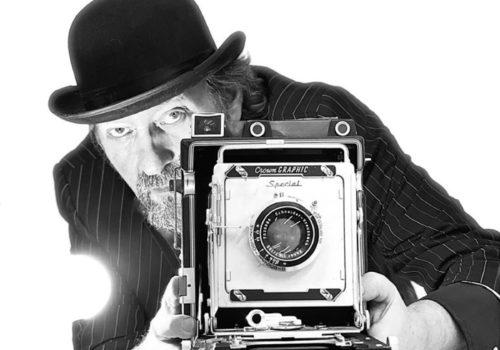
For this Questionnaire, an exercise in introspection as much as revelation, Rafael Fuchs sets aside the camera and stepped into the frame himself. The answers that follow offer an unexpected counterpoint to his work: that of an artist for whom curiosity remains a method, doubt a virtue, and photography a way of inhabiting the world. Together, they sketch the portrait of a man whose work has continuously explored the many facets of the human condition.
Website : www.rafaelfuchscontemporary.com
Instagram : @fuchsprojects
Your first photographic trigger ?
Rafael Fuchs : I was a tour guide in Sinai desert back in the late 70s-early 80s, and after about one year of doing that I bought a camera and started taking photographs during my trips, although I wasn’t considering myself as a nature photographer. I was more interested in visual or situational contradictions that I came across, as, for instance: One time I saw a twirling sand in the wind approaching us, and it turned out to be a caravan of camels with its Bedouin owner leading them by riding in a Mercedes-Benz car along the way next to them. So, I took photographs of him in the car. At the same period, I was also taking portraits as my friends as well as self-portraits.
The man or woman of image who inspired you?
Rafael Fuchs : I’d say that Robert Frank was a big inspiration with his ability to capture pivotal and meaningful moments of real life in a seemingly “casual” way, as well as Helmut Newton with his portraiture and fashion work.
The image you would have liked to take?
Rafael Fuchs : I’ll answer it in 2 ways. An image that another photographer took:
There are quite a lot of iconic images (in my eyes) that I would have liked to take.
One of them is the image of «Daryl Hannah With Baby”, Los Angeles by Helmut Newton, 1987 photographed for Vogue. Such an incredible moment of drama/contrast. The beautiful actress with her indifferent expression, the crying baby on her lap, the pastoral landscape (malibu, LA), the colors of magenta, blue and green, and the seagulls in the sky.
The image that I never took:
A last portrait of my mother, before she passed away, 2009.
She was in the hospital in Tel Aviv in a bad shape (as my brother informed me), and I was in NY, about to shoot a big campaign project that involved a few models/actors, and I couldn’t cancel or postpone it. I was hoping that my mom would hold on to life, but by the time the assignment was over my she was in Heaven. Her last words to me over the phone were: Don’t worry about me, just keep doing what you love to do.
The one that moved you the most?
Rafael Fuchs : “Colored Entrance” by Gordon Parks, 1956. It is a photo of a seemingly casual afternoon outing of a young elegantly dressed African-American woman and her niece standing in Mobile, Alabama, under a vibrant neon sign: “Colored Entrance”. This moment captured is an example of overt discrimination during the segregation era.
And the one that made you angry?
Rafael Fuchs : The photograph of the liberated inmates of Buchenwald Concentration Camp in Barrack 56 of the Little Camp. April 16, 1945. Photographed by Harry Miller. It’s really devastating to see the inhuman condition of the prisoners held by the Nazis.
My father was an inmate in Buchenwald for 3.5 years, and he survived. He escaped during the final, chaotic days of the camp’s evacuation, as the Americans troops were approaching the camp, and was provided care by them.
Which photo changed the world?
Rafael Fuchs : Unfortunately, no picture changed the world, yet, and there is, still, a lot of acts of violence, horrors and injustice all around. Although, some images did make an impact with the perception of wars, as “The Terror of War” by the photographer Nick Ut, June 8, 1972. The photo depicts 9-year-old Phan The Kim Phúc running naked and screaming in pain after being severely burned on her back by a South Vietnamese napalm attack that went wrong in Trảng Bàng, Vietnam. The image became one of the most iconic and powerful symbols of the war, influencing global public opinion and anti-war movements.
And which photo changed your world?
Rafael Fuchs : I remember, when I was a kid, that my older brother brought back from his trip in the USA the poster from the movie “Easy Rider” that depicts Peter Fonda and Denis Hopper riding their Harley Davidson bikes in the desert in the USA. It made an impact on me and was inspiring me to be freer with my actions/ thoughts, and to travel to the USA after I was done with my BFA studies at Bezalel Art Academy in Jerusalem, and stay in NYC till these days.
What interests you most in an image?
Rafael Fuchs : The photo has to be alluring for me, in a way that it doesn’t give me a complete answer or conclusion. There must be a certain enigma, an expression that is intriguing and not clear, a hue of colors that is unsettling, a composition that goes a bit off the predicted structure, or an action/ expression that cis not completely clear.
What is the last photo you took ?
Rafael Fuchs : A portrait of a woman sitting in front of me in the Subway. She was a fierce looking heavy-set African American woman with a pink training pants and a matching pink colored T-shirt with the word “Harlem” printed on it. It was a very NY moment. I gave her my business card, first, and asked for a permission to take her photographed. She agreed, and I took 4 photos of her with my iPhone. She was really sweet, and told me she lives, actually, in New Jersey.
A key image in your personal pantheon?
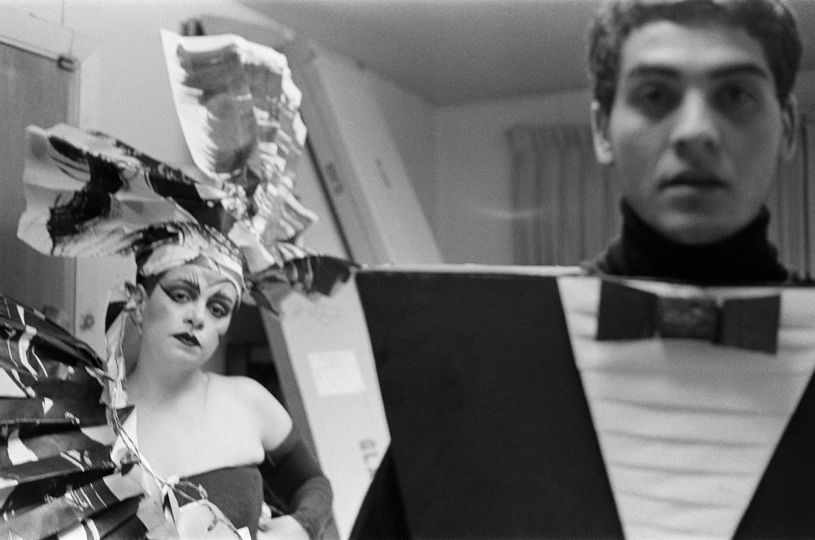
Rafael Fuchs : “Off The Roof”, 1983, The self-portrait I took while serving as a soldier in a war-time, in a war zone, Lebanon. The series is titled «Hope For Peace”, and It was during my obligatory reserve service for the IDF (while I was a photography student) during a war I didn’t understand the reasons for. I did the self-portraits in a theatrical way to express the absurdity of war, and my feeling of anxiety, disassociation and fear. I used theatrical make-up (mostly white, and some red), being influenced by Sankai Jukoh, the Japanese Butoh dance company. The series was picked by the influential curator Francois Hebel, who included it in the exhibition “Jeunes Creations” that he curated in Fnac, Montparnasse, Paris in 1984.
A photographic memory from your childhood?
Rafael Fuchs : Again, I’ll answer it in 2 ways:
A physical scenery that was embedded in my memory: The pond in Gan Meir Park in Tel Aviv with the water lilies.
It was near where I grew up , and near my elementary school. The park was the place where we used to play, do outdoors sport classes, and also had an outdoor stage for performances.
A photographic memory from the newspapers:
Rafael Fuchs : “Paratroopers at the Western Wall “ , a photograph by David Rubinger taken on 7 June 1967. Shot from a low angle, the photograph depicts three Israeli paratroopers framed against the Western Wall in the Old City of Jerusalem, shortly after its capture by Israeli forces in the Six-Day War. It was then widely pirated and was circulated in many newspapers and other publications, therefore became well known.
According to you, what is the necessary quality to be a good photographer?
Rafael Fuchs : I am referring to a portrait photographer: to be able to engage with the people being photographed in a way that they are not intimidated, and to elevate them to a point where they can open up display their vulnerability.
What makes a good photo?
Rafael Fuchs : When it makes the viewer stop and take a long look at it .
It could be something alluring…either a person , or a sill-life, or food, or landscape, or anything that attracts us. On the other hand, It could be also something haunting/scary/appalling, that is affecting our senses and brain.
The person you would like to photograph?
Rafael Fuchs : Julian Assange . I’ve been intrigued by him for long time. I always learn something from the subjects that I take portraits of. For example, It could be a little tip that Burt Reynolds showed me…the inside soles in the shoes he was wearing, to make him look taller. Or a cooking advice from Morimoto, the Iron Chef, who told me that it’s important to always clean the surface where we prepare the food, as we move from one ingredient of the meal to another. I can’t even imagine what stories I would hear from Julian Assange, would I be able to photograph him
An indispensable photo book?
Rafael Fuchs : “The Americans” by Robert Frank. I love how he unveiled a more complex, gritty, and often lonely portrait of American life, highlighting racial inequality, political tension, and the stark realities beneath the surface of the “American Dream”
The camera of your childhood?
Rafael Fuchs : I started taking photographs when I was in my early 20s. It was an analog Nikon 35 mm. Then, when I enrolled to Bezalel art school I bought a used twin -lens analog Yashica Mat 124G medium format.
The one you use today?
Rafael Fuchs : Sony Alpha ; and my iPhone. Also, going back to the roots of my photography journey, and getting a Yashica twin-lens 120 analog camera next week !:)
How do you choose your projects ?
Rafael Fuchs : Whatever is close to my heart. For instance, portraits and urban landscape in my neighborhood, Bushwick, in Brooklyn, NY, which prompted me also to self-publish a few books. A lot of times I meet people in the street. One book is titled” Bushwick Forever”, and its personal chronicles of the evolution of Bushwick, Brooklyn, from 2005 to 2011 during the.”early period of gentrification,” when I was documenting street life, industrial landscapes, and the emerging art scene before it became a major global cultural hub. The other book which came later is: “Bushwick Women Are Beautiful”. It’s a series of Portraits of women that I did during the changing phase of Bushwick. (2005-2019). The title is a homage to the great street photographer Garry Winogrand. I also like to do compilations of portraits that I take as various assignments for magazines or record labels and create exhibitions with this material, as I did “ICONS” in 2023 , “LUMINARIES” in 2024 and “Chemical Attraction” in 2025.
How would you describe your creative process?
Rafael Fuchs : I manifest the idea of: “It takes two to tango”. First, I do research about the person who I’m about to take the portrait of. (When it’s an assignment.) It might give me sone ideas. Most important thing is to be open to a conversation with the him/her/they, and hear their own ideas about the photo shoot. I step in to the photo session with some relevant props based on the research/conversation and that are related to the story we’re trying to convey, although I accept that the session might take us in a direction that we didn’t expect…and that is the beauty of creating art. Although when I photograph a stranger (that might become a friend), there’s not much I know about them ahead of time.It’s just the first impression that I get.
An upcoming project that’s close to your heart?
Rafael Fuchs : After having 3 solo shows in the past 3 years of portraits of Icons that I photographed in the mid 90s-early 2000s, I am stepping back in time into my archives and finding incredible materials of my earlier period in NYC, starting in 1985.
It’s portraits of friends, some downtown celebrities as well as night life and urban landscape. I hope to create a book/exhibition with this material. At the same time I’ve been working continuously on mixed-media works (paintings on my photographs that are printed large scale.) Some I’ve shown in my exhibition “Chemical Attraction” in 2025.
Your favorite drug?
Mmm…I don’t do many drugs…Just a bit weed occasionally (is it considered a drug anymore? 🙂 These days the hybrid weed is so strong that just a couple of whiffs are getting me so invigorated, and I can’t stop taking pictures. Everything looks like a part of a movie to me, and I feel compulsive to document it.
The best way to disconnect for you ?
Rafael Fuchs : Instagram browsing that leads me sometimes to stand-up comedy posts or other short videos about nature, animals, birds or the science of the body or the universe. Although, since I follow a lot of photography related profiles (galleries, artists, institutions,) my “disconnect” mode turns to be research! 🙂
What is your relationship with the image ?
Rafael Fuchs : It takes me back to the time, place and person (people) that are in the photograph. Makes me appreciate the different experiences that I had during my life. It becomes a part of me, another memory and a layer that have been shaping my life, and that I have been carrying with me since this image was taken,
Who would you like to be photographed by ?
Rafael Fuchs : I’d like to be photographed by Albert Watson, since his high-contrast, sculptural portraits of men, often capturing them with an intensity that has become iconic.
Your latest folly?
Rafael Fuchs : Wearing a pink wig at the birthday party of my daughter who asked me to take photographs. The wig was a part of the accessories that were offered to the guests, so it wasn’t unconventional during the celebration.
An image to illustrate a new banknote?
Rafael Fuchs : Images from my new “Palm Series”. Composing two separate images with photoshop, and altering it with Instagram filters, then blowing it up and painting on it.
The job you would not have liked to do ?
Rafael Fuchs : Any 9-5 job
Your greatest professional extravagance?
Rafael Fuchs : Buying photography books. Also self-publishing in a print per demand method which is not profitable, but I like to see my work grouped in a book form.
What question gets you off track?
Rafael Fuchs : “Did you meet him /her in person” ? when I show a portrait that I did of a famous person.
What was the last thing you did for the first time?
Rafael Fuchs : Mmmm…I can’t recall. I guess I’m not adventurous lately.
The city, the country or the culture you dream of discovering?
Rafael Fuchs : St. Tropez, France. Ko-Phi-Phi, Thailand. Stockholm, Sweden.
The place you never get tired of ?
Rafael Fuchs : The beach. Any beach. Gimme beach. (Tulum, Rio De Janeiro, Tel Aviv, Lanikai)
Your biggest regret ?
Rafael Fuchs : I tend to forgive myself, understand the reasons that led to an unfortunate event, so I try to avoid regretting, cause there was no other way.
In terms of social networks, are you more into Instagram, Facebook, Tik Tok or Snapchat and why?
Rafael Fuchs : Instagram is my favorite. It’s colorful regarding Tik-Tok, form the beginning, I didn’t like the sound at the end of the posts, and also I didn’t like the name itself: Tik-Tok (it sounds juvenile).
Color or B&W?
Rafael Fuchs : Color.
Daylight or artificial light?
Rafael Fuchs : Both.
Which city do you think is the most photogenic?
Rafael Fuchs : Can I mention towns ? Any town on the Alma coast seems to be photogenic. I haven’t been there, yet. As of cities: Prague is photogenic.
If God existed would you ask him to pose for you, or would you opt for a selfie with him?
Rafael Fuchs : Haha…this question make me laugh. I’d ask him to pose; then I’d ask to do a selfie with him.
If I could organize your ideal dinner party, who would be at the table?
Rafael Fuchs : Scarlett Johansson. There’s something about her that intrigues me.
The image that represents for you the current state of the world?
Rafael Fuchs : It has to be an A.I. image, and there should be combat airplanes, tanks and soldiers equipped with advanced gear with a tropical background, to show how paradoxical is todays world.
According to you, what is missing in today’s world?
Rafael Fuchs : TIME. People giving you more time is missing.
We are getting used to reduced attention span.
If you had to start all over again?
Rafael Fuchs : I don’t know any other way
What do you like people to say about you?
Rafael Fuchs : That I am brilliant.
The one thing we absolutely must know about you?
Rafael Fuchs : That my humor is my protective shield.
A last word ?
Rafael Fuchs : Be humble and respect others.