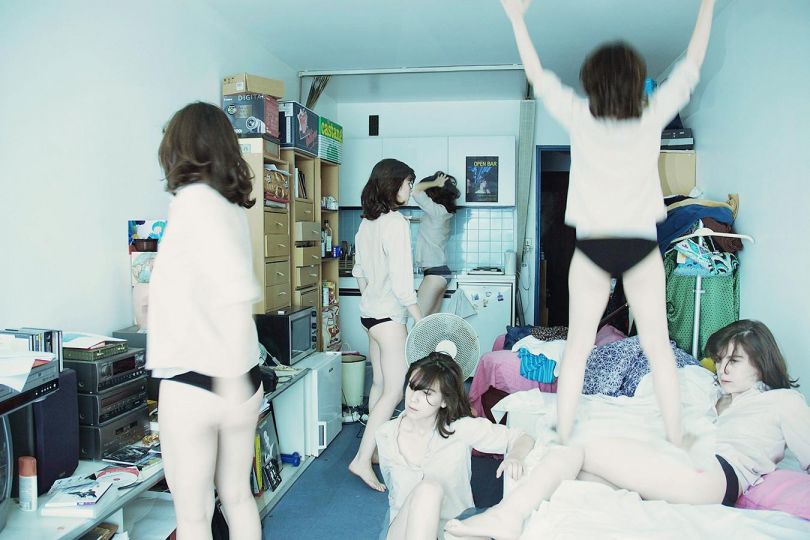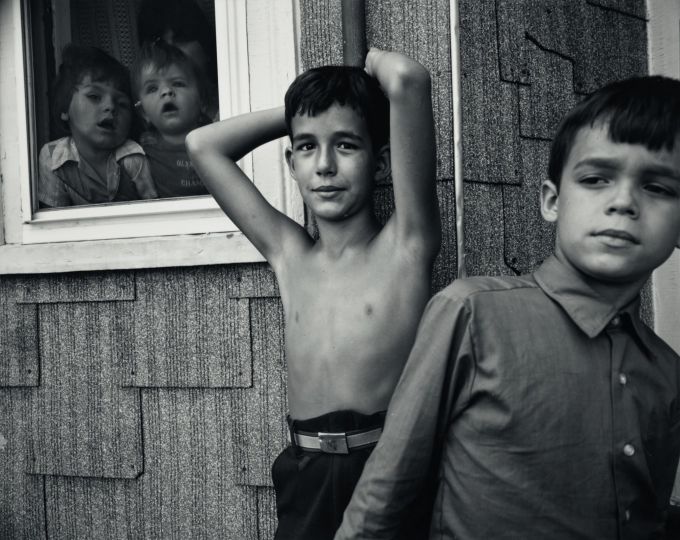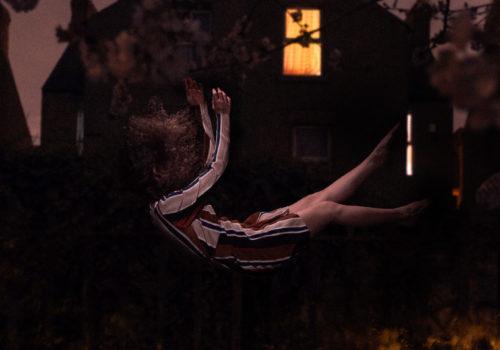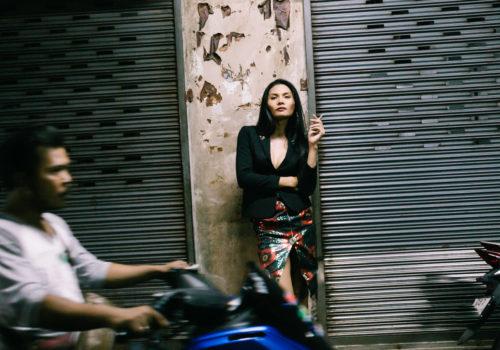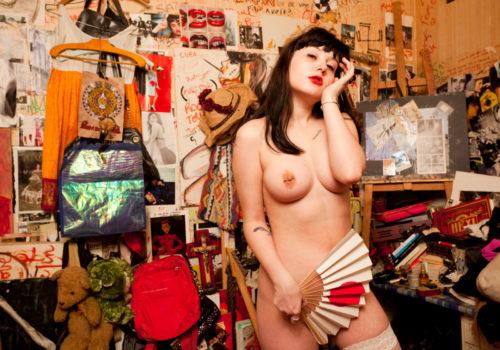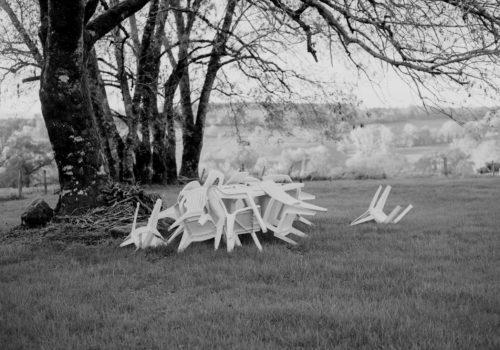
Between Strasbourg, Arles, and the Vosges, three young photographers have come together under the banner of the collective Le Matin rose. Without waiting for the art world to open its doors to them, they took matters into their own hands, organizing workshops, exhibitions, and screenings to give a new generation of artists a space for expression.
Your collective is a little over three years old. What brought you together?
Séléné Brault: We were all in a photography BTS (two-year degree), and we said to ourselves: “we’re friends, let’s stay together after the program and not give up on this idea of working as a group, of talking to each other about images.”
Arthur Perrin: From the very beginning, the collective was very important for me. I arrived as a photographer in a city where I didn’t know anyone. And it was really Le Matin rose that pushed me, that gave me the energy to keep up my personal practice.
Mélina Rard: We even wanted to make it a rule to have this framework. And also not to close ourselves off—to do things with other photographer friends. For me, it was more like a desire for later. But Arthur pushed us: “we can do this now, let’s do it now!”
You live in Strasbourg, Arles, and the Vosges. How do you manage to work as a collective?
Mélina Rard: That’s kind of Le Matin rose’s motto: we’ve never really been together in one place. But we do meet regularly online and schedule moments to see each other in person. When that happens, it’s amazing how much progress we can make. Maybe if we saw each other more often, the collective wouldn’t work!
After your first projects in the form of collages in Marseille and then in Lyon in 2023, you organized a photo screening in Arles in 2024. How did that idea come about?
Mélina Rard: We met up in Arles in the spring, and I had suggested doing a screening in my garden. Little by little, we thought we could make it something bigger. It almost got out of our hands! But we wanted to keep it outdoors, accessible. It ended up taking place at the community venue La Verrerie.
Arthur Perrin: Instead of just showing our own photos and those of our friends, we said: “why not make an open call?” We received more than a hundred submissions. We had to make a selection, and we chose 12 projects that moved us and worked well together.
Mélina Rard: It was limited to young photographers who had never exhibited before. Choosing was very difficult but incredibly interesting—it was great to see all the topics people were working on.
What form did this event take?
Arthur Perrin: It became a Projection Night. We put together a long screening, about an hour, outdoors, with projects from Le Matin rose, from friends who applied, and from other photographers we didn’t know. There were exchanges, discussions, and project presentations. It created connections.
Mélina Rard: After that, we asked ourselves if we should launch another call for projects, and in the end, we got an offer to exhibit those 12 photographers in an exhibition space: Le Refuge de la création in the Vosges.
Séléné Brault: We showed three images per photographer inside the refuge, and we also wanted to highlight local work, so Arthur’s series on the Vosges forest was exhibited outdoors.
Arthur Perrin: That gave us a chance to show another perspective on the Vosges forest, beyond wildlife photography very common in the region. We felt that people were touched by it.
Séléné Brault: Part of our role on site was also to explain the projects’ intentions, to talk about other forms of photography.
Mélina Rard: From the start, we’ve been asking ourselves: who do we want to show our photos to? Why are we doing this? How can we make our images accessible? In Arles, for example, we’re often facing an audience of insiders. It’s important for us to keep this intention: to open our images to everyone.
This exhibition was called “No More Waiting.” A continuation of what you said earlier: “we can do this now, let’s do it now”?
Arthur Perrin: All the photo projects we presented were created by young photographers dealing with issues related to our generation. The idea is to exhibit right away, without waiting to climb the hierarchical ladder of the photography world. No More Waiting means saying that young photographers have a lot to express about social and environmental issues, and that these topics are just as important as what older photographers present in Arles. It’s kind of like breaking into the world of art and expression. That’s also what we do in our visual education workshops in schools: using images as a way to discuss, experiment, and practice.
Do you feel that the way photography is shared has really changed today?
Arthur Perrin: At least, there are new forms and possibilities. The internet plays a big role in these changes. We received applications for our open call through Instagram, we contacted the venue via Instagram, we promoted everything on Instagram. And then, there’s the collective: individually, nobody knows us, but with Le Matin rose, we’re an entity that allows us to organize exhibitions, projects, and workshops.
What about the future?
Mélina Rard: We’d like to continue developing school workshops with Séléné. Also take time to refocus and imagine a real collective project. But while staying open, to share things with other photographers outside the collective. And in the long run, having a space of our own would be amazing!
More information