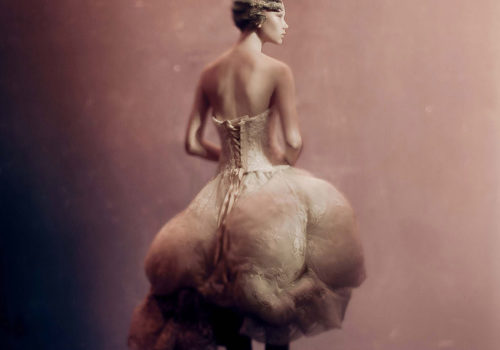
An entire world comes to life before, during, and after fashion shows. Armed with her camera and flash, Sonia Reveyaz photographs the fashion crowd. The 27-year-old photographer recently presented her work at Point Éphémère, showcasing images produced during the Paris fashion shows. Much like some of the outfits she captures, her photographs are colorful and extravagant.
And these characters are precisely what Sonia Reveyaz observes so carefully, always searching for the detail that will make her press the shutter. We met with this dynamic photographer whose work sits at the intersection of artistic and sociological observation.
How were the Fashion Weeks you photographed?
I attended the Fashion Weeks in Paris this year. As soon as I got the schedule, I selected the shows that interested me the most. I do not go to Chanel, Dior, or Louis Vuitton shows. They are overcrowded and there is too much security. I prefer to focus on more emerging designers. The atmosphere is very friendly and people are usually happy to pose. I am especially drawn to colorful and creative brands.
What makes you decide to take a picture?
It is the scene unfolding in front of me. The moment itself. It is the presence, the aura of the person in front of me. If they catch my eye. As soon as a style is a bit extravagant or opulent, it immediately draws my attention.
In your work, you constantly use flash. Why?
There is not a single photograph without flash. I strongly associate flash with fashion photography. It brings out the colors, facial features, details, and textures. It is extremely important to me. It is really part of my artistic identity. I like what is visible, what is aesthetic, shiny, and colorful. I am also drawn to these more or less high-society environments. These are worlds that attract me and that are not always photographed. I like to immerse myself in these environments and show what happens there.
Do you feel comfortable in these environments?
Yes, because I am there as a photographer and that is usually appreciated. In these circles, people generally enjoy being photographed. I do not always explain my approach, since I tend to focus on details and situations. At first, I photographed horse races, which was a world I did not know at all. I remember the women who dressed up with large hats for the occasion. I found it fascinating. At the beginning there is always a small degree of symbolic tension, but over time I get used to it and blend into the environment. In these circles people are used to being photographed. In more working-class environments, it is more complicated. People are less accustomed to being photographed. It is interesting to observe this difference depending on social background.
Is there a sociology of the image?
A photograph is a historical archive. For me, it is very important to document a specific moment in time and to think that it may be analyzed years later. Fashion Week is constantly evolving. Each edition includes around sixty shows. It reflects overconsumption and the constant pursuit of the perfect look. It is a world driven by images and marketing.
You often refer to the notion of social class. How does this appear in your work?
Each time I attend an event, I try to identify the detail that signals a particular social background. When I was photographing markets in the south of France, I noticed that many men wore caps and sunglasses. I created a series focusing on these accessories. At horse races, I saw that many men wore ties decorated with small horses. Each time, I try to capture these recurring details. They also reveal something about the event itself. I also try to capture attitudes and sometimes step back from the details to photograph the overall atmosphere. Society and social classes can be observed through objects, details, and body language.
You photograph fashion enthusiasts, but what is your own personal style?
I mainly wear second-hand clothes. I enjoy thrift shopping, there is a kind of game in it. The fabrics are often of better quality and these clothes can be kept for many years. For the opening of the exhibition, a fashion show was also organized, featuring around thirty models wearing second-hand outfits.
More information