Lorenzo Tugnoli : Raw gazes
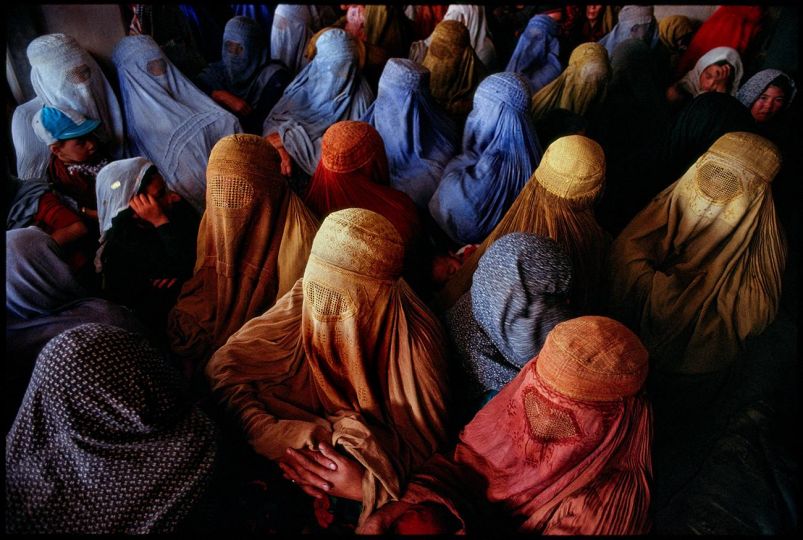
You don’t look at a Lorenzo Tugnoli photograph you are drawn into it. Quietly, almost cautiously, as if crossing an invisible line. Nothing is forced. Nothing is loud. A muted light settles, dust lingers in the air, a gaze drifts without asking to be acknowledged. In Tugnoli’s world, reality does not shout, it breathes, sometimes heavily, always insistently, drawing the viewer into a slower, deeper form of attention.
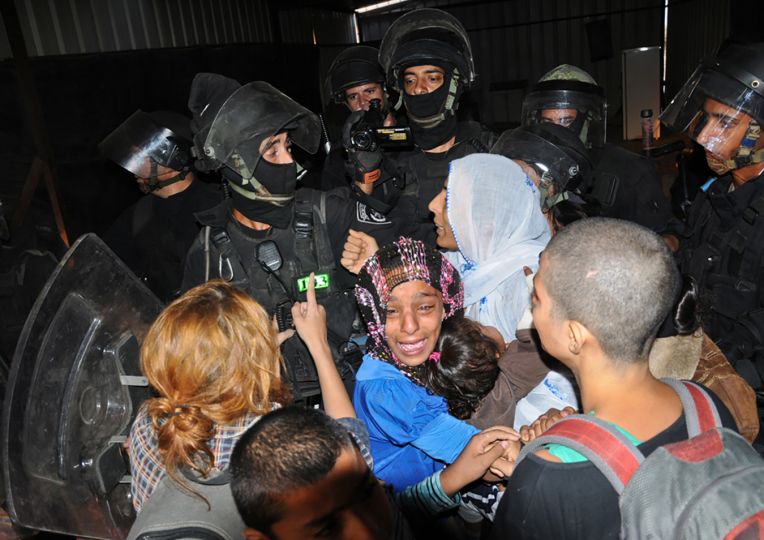
His images are shaped by conflict, yet they resist its spectacle. The violence is there, embedded in fractured walls, emptied rooms, interrupted lives — but what remains is something else: a suspended stillness. A child stands motionless. A hand rests against a cracked surface. A lone figure crosses an uncertain landscape. Each frame exists in a fragile in-between, caught somewhere between rupture and persistence, between what has been lost and what endures.
Tugnoli does not chase events; he observes their aftermath. His photography is not about illustrating war, but about tracing its human imprint subtle, enduring, often invisible. There is a precision to his compositions, a clarity of intent, yet nothing feels constructed. The images unfold with restraint, guided by presence rather than intrusion. He moves closer, waits, listens and in that proximity, something essential takes shape.
What emerges is a form of visual language that is both rigorous and deeply empathetic. These are not images that explain; they are images that resonate. They create space for ambiguity, for reflection, for emotional engagement. The viewer is not overwhelmed, but implicated, invited to remain, to look longer, to absorb what cannot be immediately understood.
And then, almost imperceptibly, light returns. It grazes a surface, defines a contour, reveals a presence. Even within devastation, there is a quiet resistance a gesture, a softness, an unexpected grace. This tension, between the harshness of reality and the subtlety of perception, defines Tugnoli’s work. It is where his images hold their power.
To engage with Lorenzo Tugnoli’s photography is not to consume information, but to experience a shift in perception. The event is no longer distant, no longer abstract. It becomes tangible, intimate, undeniably human.
Website: www.lorenzotugnoli.com
Instagram: @lorenzotug
Your first photographic trigger?
Lorenzo Tugnoli : I was with a group of masked Zapatista guerrilla fighters in the south of Mexico. Looking at the foggy mountains from the back of a canvas-covered truck I thought, this is what I want to do. I stopped my career as a physics student and dedicated myself to photography full time.
A photographic memory from your childhood?
L.T. : Me blowing the candles on my 9th birthday. I never remember the real moment, I only remember it because of a picture I saw, from the point of view of the camera.
The camera of your childhood?
L.T. : My father’s old Canon TX, indestructible, amazing camera.
The one you use today?
L.T. : Leica Q3.
The man or woman of the image who inspired you?
L.T. : At a very early age I got hold of a Henri Cartier-Bresson book. At the time I didn’t know what made those pictures so powerful, it was just a feeling. Then I spent a lot of time photocopying pictures of different photographers, drawing on them to understand their structure.
The image you wish you had taken?
L.T. : Any image from Alex Majoli’s Afghanistan work.
The one that moved you the most?
L.T. : Paolo Pellegrin’s work in Lebanon.
And the one that made you angry?
L.T. : Israeli soldiers’ selfies inside destroyed Palestinian homes in Gaza.
Which photograph changed the world?
L.T. : Photography’s role is not to change the world.
And which photograph changed your world?
L.T. : Telex Iran photo book by Gilles Peress.
A key image in your personal pantheon?
L.T. : Winterreise photo book by Luc Delahaye.
What interests you most in an image?
L.T. : Its light.
What details do you look for in a face, a landscape, or an object?
L.T. : Its lyricism.
Elliott Erwitt said: “Color is descriptive. Black and white is interpretative.” Do you agree?
L.T. : No, it is impossible to take a photo without giving our interpretation of what is in front of us. In your opinion, can technique sometimes take precedence over emotion in photography? Technique is a channel. As photographers we need to be aware of how the machine (the camera) will “see”, we need to learn how to operate the machine to get what we want. Once the technique is there it needs to be forgotten to be free, it needs to be part of us like a jazz player is not thinking about scales anymore during a solo.
Is beauty in photography, for you, purely aesthetic?
L.T. : Photography is a language, the formal rigour of an image is a way to make it cleaner and more effective, just as a well written novel conveys its content more efficiently.
What elements can make silence visible in a photograph?
L.T. : The rigorous organisation of the frame and the intentional positioning of the photographer.
Does the uniqueness of a photograph come from the moment or from staging?
L.T. : The uniqueness of a photograph comes from the photographer.
Can a photograph be truer than reality?
L.T. : Reality is a concept that lives inside our heads, as is truth. As photojournalists we should know that we are always building an ultimately fictional world, we need to use this fiction well and make it look as close as possible to what we think “truth” is.
Can a photograph change our perception of an event?
L.T. : The photograph is the event. It makes it.
Is photography a testimony or a form of manipulation?
L.T. : It is both, photographs change according to how they are contextualised.
What makes a good photograph? I am still trying to understand this, maybe one day I will find out.
L.T. : In your opinion, what quality is necessary to be a good photographer? The photographers that I admire, and that I had the pleasure to meet, are all extremely intelligent people. People who have a deep awareness of their position in the history of photography and in the panorama of photography today. They are fiercely independent and aware of where they want to be. They work really hard, try to leave their area of comfort and do not work to please a client but their vision.
How do you choose your projects?
L.T. : Ideally the project should choose me. I choose subjects that are right for me, that have a strong relation with my experiences. So projects on which I can say something meaningful and situations or subject matter where I know I can give my best as a photographer.
How would you describe your creative process?
L.T. : I think it is really important to be in the world. Photography and photojournalism are born in an act of presence in the field. In between travels there has to be a moment of elaboration and summary of the work, a lesson learned list in order to do better work in the next trip. But it is really important to have moments of freedom otherwise it can become repetitive and formulaic.
An upcoming project that is particularly close to your heart?
L.T. : Returning to live and work in Lebanon.
The person you would like to photograph?
I will choose a place instead: Gaza.
The person by whom you would like to be photographed?
L.T. : I don’t need to be photographed.
An essential photography book?
L.T. : Chaos by Josef Koudelka.
What is the last photograph you took?
L.T. : I was in north east Syria to photograph the change of hands of the area previously under the control of the Kurdish militants.
On social media, are you more Instagram, Facebook, TikTok — and why?
L.T. : Instagram, it is (or used to be) about photographs.
What has changed in photography since the rise of social media?
L.T. : We see images in an extremely small size.
An Instagram account everyone should follow?
L.T. : Everyone who is interested in photography should look at photo books not only follow accounts.
What is your view on AI?
L.T. : It is extremely helpful for research, to gather technical knowledge, help with writing (especially for someone who is not an English native speaker like me). What counts in cultural production are ideas, AI does not produce new ideas, just scrambles old ones, I am personally not scared of it.
Color or black and white?
L.T. : Black and white.
Natural light or artificial light?
L.T. : Natural.
Which city seems the most photogenic to you?
L.T. : Kabul.
The city, country, or culture you dream of discovering?
L.T. : Myself.
A place you never tire of?
L.T. : Syria.
The image that, for you, represents the current state of the world?
L.T. : Any portrait of Donald Trump.
In your opinion, what is missing in today’s world?
L.T. : Peace.
If God existed, would you ask Him to pose for you, or would you opt for a selfie with Him?
L.T. : I would not take a photograph but strike a conversation.
Your favorite drug?
L.T. : Light.
Your best way to disconnect?
L.T. : Movies.
Your latest madness?
L.T. : Having a son.
Your greatest professional extravagance?
L.T. : A career as a photographer is a professional extravagance.
A profession you would not have liked to pursue?
L.T. : I only pursued photography and I am really happy about it.
Which question unsettles you the most?
L.T. : How long do we have to work in a country before we have the authority to say something about it? Are my images supporting an imperialist take on the story? How much are the images that I saw influencing the way I am representing the situation in front of me?
If you had to start all over again?
L.T. : I would take the same decisions but maybe try to go through my professional growth a bit quicker. I am a really slow learner and I would have liked to be at this stage of my career a bit younger.
If I could organise your ideal dinner, who would be at the table?
L.T. : Josef Koudelka, Gilles Peress, Luc Delahaye and Alex Majoli.
What do you like people to say about you… after you’re gone?
L.T. : That I cared about my subjects.