
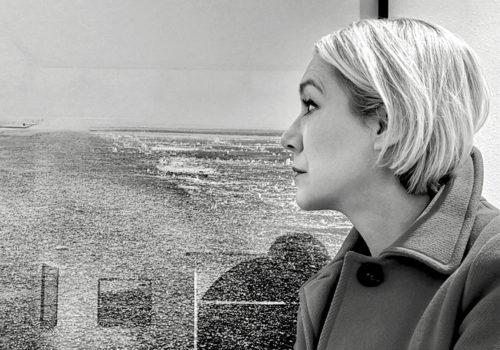
I first met Kirstin Buchinger a while back when she was working on her book about Marianne Breslauer. As we got to talking, I learned about her myriad pursuits, which form a fascinating intersection of history, photography, and fashion. This month, ahead of her new exhibition project, I am delighted to share some of her insights with all of you. Enjoy the read.
Nadine Dinter: You are one of the few people known for wearing so many hats –curator, author, speaker, and even AI-photographer. Which came first, and how do you divide your time among these different roles?
Kirstin Buchinger: Research came first – the attempt to understand how images shape historical memory and, more fundamentally, how they disappear from it. Or more precisely: how they are made to disappear. Everything else developed from that: writing, curating, speaking. The work with AI-generated images came much later, almost as a counter-experiment – an attempt to approach the same questions through different means.
I do not divide my time evenly. The projects dictate the rhythm. Research phases tend to be long and concentrated, while exhibitions condense into shorter, more strategic moments. The artistic work runs alongside this – less as a separate field than as a space of experimentation.
Let’s start with the Yva Archive. When did you found it, how did you first encounter her work, and what was your approach to assembling such a substantial collection?
KB: The archive did not begin as a collection, but as a problem: the fragmentation and distortion of Yva’s work. Much of what survives is misattributed, removed from its context, or reduced to a marginal position within other narratives. The approach was therefore reconstructive. It involved tracing images back to their original contexts – magazines, studios, networks – and reassembling a body of work that no longer exists in its original form.
The archive is less a repository than an intervention in the writing of photographic history.
In 2025, you published the book Yva und ihre Zeit (Yva and Her Time). Many of us know Yva as Helmut Newton’s mentor – she trained him at her Berlin studio between 1936 and 1938 – but tragically, she did not survive the Nazi regime. How long did it take you to trace the life and work of this brilliant yet largely forgotten photographer?
KB: Several years – although duration is not the decisive factor. The real difficulty lies in the nature of the sources: there are hardly any self-testimonies, no coherent estate, and large parts of the work have been lost. What remains are traces: publications, networks, indirect references. Reconstructing a life from this material requires resisting the temptation to fill gaps with narrative.
These gaps are not accidental. They are the result of persecution and destruction. The reconstruction remains fragmentary – and it is precisely in this fragmentation that its historical accuracy lies.
Much of your work focuses on artists and photographers from the 1920s and 1930s, such as Marianne Breslauer, Yva, Atelier Binder, the Jacobi sisters, and Erwin Blumenfeld. Why did you choose to focus on this specific era, and how has that interest evolved over the years? Is there a personal connection for you as well?
Because this is the moment in which modern visual culture takes shape – and is then deliberately dismantled. Berlin in the 1920s is not a backdrop, but a production machine for images that continue to shape our understanding of modernity. A significant number of the actors involved were classified as “Jewish” after 1933 and removed from the very structures they had helped to build – regardless of how they understood themselves. What matters is this shift: from an open, urban culture of production to a system that defines belonging and enforces exclusion.
My work is concerned with this discrepancy between erasure and persistence.
Following the book’s publication, you are currently working on a comprehensive group exhibition titled Photopolis 1919–1945: Berlin’s Lost Photographic Culture and Its Afterlife. Could you give us a brief overview of what to expect?
KB: Photopolis reconstructs Berlin as a photographic system not as a collection of individual artists, but as a dense network of studios, publishers, agencies, and clients. In the 1920s, a visual modernity of remarkable precision and speed emerges here a city that produces itself through images.
After 1933, this system is not simply interrupted, but systematically dismantled. Many of its central actors disappear from view, while their visual languages continue to circulate appropriated, displaced, and later often depoliticized.
The “afterlife” of images is therefore not a quiet process. It is a form of overlay in which presence and absence remain simultaneously visible.
How do you navigate working with external foundations, the heirs to photographic archives, or the estates of largely forgotten photographers like Yva?
KB: With caution – and with critical distance. Estates are not neutral entities; they are shaped by selection, omission, and often by retrospective narratives. Particularly in cases of fragmented transmission – frequently the result of persecution and loss – there is a tendency to smooth over these ruptures. The work begins by undoing such simplifications and restoring the contexts that have been historically destroyed.
What’s your advice for people who find vintage photographs at flea markets or in antique stores and want to get them appraised?
KB: First: skepticism. Most finds are not what one hopes they might be. This also applies to typical objects such as vintage postcards – for example, Ross cards, which frequently appear at flea markets or on eBay. They are historically interesting, but generally serial products rather than unique works.
The more fundamental issue, however, lies elsewhere. Photography continues to be defined to a large extent through the object – through vintage prints, materiality, and the notion of the “original.” This object fetish often obscures what is actually at stake: the conditions of production, circulation, and historical context in which images were made. In the case of the 1920s and 1930s in particular, this leads to distortions. Prints are often valorized precisely when they were produced under conditions of exclusion and constraint, while earlier and more central parts of an oeuvre – especially those created before 1933 – are lost or remain invisible.
Context is therefore decisive. Without it, a photograph is often merely an object. Only through contextualization does it become a historical document. Any appraisal that ignores these conditions remains speculative.
If you were to summarize the approach or working methods of all these amazing photographers you’ve researched, is there a common thread that unites them?
KB: Not a style.
What they share is a specific situation: a highly professionalized, experimental photographic culture embedded in media, fashion, and urban life. These contexts were largely destroyed after 1933. The actors disappear; the images remain. This separation between image and authorship is one of the central problems in their reception today.
Speaking of photographers… you also work as an AI photographer, which seems like the complete opposite end of the spectrum. What’s the challenge for you in oscillating between curating and writing about historical figures, and creating futuristic AI imagery?
KB: The opposition is less pronounced than it might appear. In both cases, the question is how images are produced under specific conditions. Historical research reconstructs lost contexts. Working with AI reveals how images are generated from an existing visual memory.
My own visual language is shaped by this research not through direct quotation, but on the level of structures. Compositions, bodily postures, lighting, and iconographic constellations developed in the photographic culture of the interwar period reappear in transformed ways – sometimes only as an echo.
This is not a conscious return. Rather, it points to the persistence of visual patterns, even when their historical contexts have long been destroyed. Working with AI makes these latent continuities visible. It shows that images possess a form of memory that exceeds individual intention.
It remains crucial, however, not to conflate the two: AI images are not history. But they reveal how history continues to operate within images.
What do you enjoy doing in your free time?
KB: There is not much of it. And when it exists, it is deliberately unstructured usually outdoors, walking in the woods with my dog. Perhaps that is the only place where images do not have to be produced.
Text and Interview by Nadine Dinter
For more information, check out the artist’s IG accounts @yvaarchiv and @kiki_karnstein as well as the website https://yvaarchiv.de/yva/


