Ellie Davies : Inner forests
Discovering Ellie Davies photograph is to step into a forest of sensations, where every ray of light, every reflection on the water, every lingering mist transforms the landscape into an intimate, almost sacred space. It is not just a landscape we encounter : it is a state of mind, an invisible architecture of time and memory, where reality blends seamlessly with imagination, and nature becomes both mirror and interpreter of our emotions.
In her work, the forest is never merely decorative. Trees, streams, and clearings bear the imprint of time and the stories we project onto them. Natural elements do more than frame the scene: they converse with the viewer, inviting contemplative stillness and poetic reflection. Mist becomes a threshold, light becomes a language, and every leaf, shadow, and flicker of water emerges as a fragment of memory, a vibration of the inner world that the artist renders tangible. Her approach is neither documentary nor illustrative; it is profoundly sensitive and conceptual. Davies constructs images that read like visual poems, where composition, the rhythm of forms, and the subtlety of light orchestrate both emotion and thought. Her interventions in the forest — delicate, ephemeral, perfectly integrated — create a rare balance between formal rigor and instinctive spontaneity. Photography becomes a space for contemplation, inviting the viewer to slow down, inhabit the image, and perceive, through nature, the fragile and mysterious intensity of the world.
What sets her work apart is the ability to reveal the sublime in the ordinary, to bring the invisible to light, and to transform every landscape into a sensitive, poetic narrative. Her photographs do not simply show; they translate what we feel and sense: a world at once tangible and mysterious, intimate yet universal, where wonder arises as much from what is revealed as from what is suggested.
Site Web : www.elliedavies.co.uk
Instagram : @elliedaviesphotography
Your first photographic trigger?
Ellie Davies : My mum’s side of the family are painters and artists and my dad was always taking photographs and loved cameras. Even back in the 80s when documenting life in such details wasn’t as common as it is today his passion for photography combined with my mum’s love of painting triggered my lifelong desire to be an artist.
A photographic memory from your childhood?
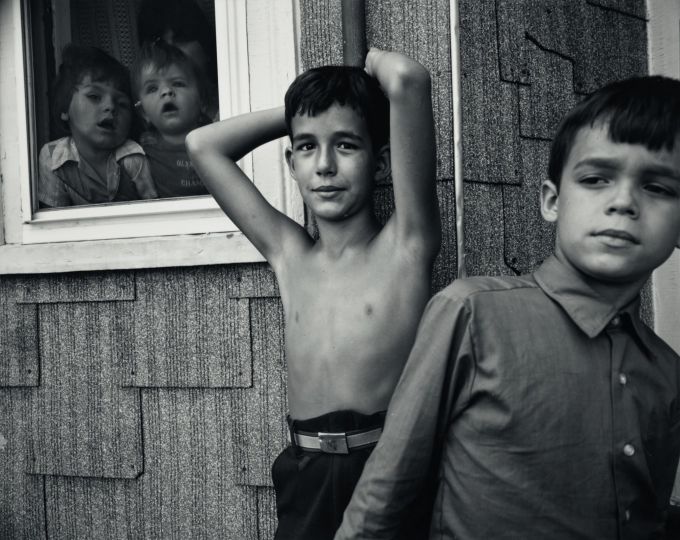
E.D. : My dad’s best friend was a photographer called Tony Boxall, a member and fellow of the Royal Photographic Society. He had a black and white darkroom in the garden where he developed his best known work documenting a travelling Romani community in the UK in the 1960s. Decades later he published a book about this project called Gypsy Camera – a collection of intimate portraits of warm family life amidst great poverty. Tony formed a trusting relationship with the Vincent family, allowing him to record a vanishing way of life. He was hugely passionate about this project, following this usually private community through many challenges and changes in their lives including council efforts to remove them from their travelling lifestyle and into conventional housing, breaking up families and displacing many. It was my first experience of photography being used to raise awareness of an otherwise underrepresented culture and his work stood in stark contrast to the way this community was often pictured in the press. Tony treasured the fact that Jim Vincent was buried with a copy of Tony’s book in his coffin. As a child I adored Tony and loved listening to him talk about his work and watch him in the darkroom. The deep red glow of the safelight and the smell of chemicals, the alchemy of the image appearing as it swirled in the developer bath … this all contributed to my early interest in photography.
The camera of your childhood?
E.D. : My dad’s 35mm Leica R4 with several prime lenses, wonderful! I was allowed to use it only under his supervision. I loved the deep clunking sound of the shutter and the manual wind-on, the leathery smell and solid compact body. He used to say that it was a classic war photographer’s camera of choice. I still have it.
The one you use today?
E.D. : A Pentax 645Z and various lenses. This camera was released in 2014 and was the first more affordable medium format camera on the market. It was a big outlay for me at the time, but it’s been well worth it and although it’s now discontinued it still holds its own in terms of image quality and portability.
The man or woman of image who inspired you?
E.D. : Francesca Woodman, Cindy Sherman, Gem Southam, Chrystel Lebas.
The image you would have liked to take?
E.D. : One of my favourite images and one that got me thinking about making landscape photography.. “Between Dog ans Wolf- Untitled 10-2005” by Chrystel Lebas.
The one that moved you the most?
E.D. : I remember first seeing Richard Billingham’s ‘Ray’s a Laugh’ series at the Sensation exhibition at the Royal Academy in London in 1997. I had just left school and hadn’t ever seen images that were so raw and unflinching, and particularly shocking because Billingham was portraying his own family.
And the one that made you angry?
E.D. : The Terror of War, showing a young girl running naked from a napalm attack during the Vietnam War in 1972. The photo was taken by AP photographer Nick Ut and won a Pulitzer prize. Children are the innocent victims of war.
Which photo changed the world?
E.D. : Ansel Adams’s landscape photographs helped change XXth century perceptions of photography into a respected art form. His landscapes brought the wild places of the US to everyday people and helped promote conservation, the creation and protection of National Parks and changing policies towards landscape and nature in the US. His work inspired generations of photographers to view photography as a medium for social and environmental change.
A key image in your personal pantheon?
E.D. : Andy Goldsworthy’s Ice Arch (1982). My parents bought his Parkland book in 1994 and I was blown away. My sister and I spent the cold spells that autumn fishing ice out of the pond and attempting to recreate in miniature his ice arches and icicle formations. It definitely sparked my interest for working in nature.
What details do you look for in a face, a landscape, or an object?
E.D. : I often look for symmetry, a coherence between elements and interesting light.
Elliott Erwitt once said: “Colour is descriptive. Black and white is interpretive.” Do you agree?
E.D. : I definitely agree with this from a practical point of view, but my professional life working in colour has taught me to explore the interpretative possibilities that are also present in colour photography. I strive to leave the narrative open enough for the viewer to reach their own conclusions by making gentle suggestions rather than giving overpowering instructions from within the image.
Can technique, in your opinion, ever take precedence over emotion in photography?
E.D. : For me, narrative and therefore the emotion and mood of the image are the most important elements in how the viewer experiences it. I don’t think technique can produce this alone, but both have a place and an important role in the way the image is received.
Is beauty in photography, for you, purely aesthetic?
E.D. : No, for me beauty is a way for the viewer to reach into the image, to experience it more deeply, and for the artist to reach out of the image to make it more accessible and to allow the viewer into the narrative. Beauty is an important element of the communication that happens between artist and viewer, and a useful tool in the way I like to work with images.
What elements can make silence visible in a photograph?
E.D. : Lighting and space within the image make silence visible. I love to shoot landscapes and forests in low light; rainy, overcast ‘bad’ weather gives a moody flatness that for me brings silence and a space that can be filled with the viewer’s own interpretation, be that a brooding dread, a sense of calm, a feeling of uncertainty or a deep connection… it’s about what the viewer brings with them into a space that is not too prescriptive.
Does the uniqueness of a photograph come from the moment or from the staging? Can a photograph be truer than reality?
E.D. : An image can crystallise our perception of a particular ‘reality’ and convey it to the viewer in a way that may resonate as truer than reality. However, I believe an image is always a version of an event and it can provide an impression of truth, but this is only one version of what we perceive as ‘real’.
Can a photograph change our perception of an event?
E.D. : Absolutely.
Is photography a testimony or a form of manipulation?
E.D. : Both.
What makes a good photo?
E.D. : That’s a huge question, I can only answer from a personal perspective when making my own work. I know a good photo is happening for me when the nebulous idea I am trying to portray suddenly takes form within the image in an elegant way that makes me feel a sort of buzzing excitement of recognition. All photographers will know this feeling.
According to you, what is the necessary quality to be a good photographer?
E.D. : Learning to really look.
How do you choose your projects?
E.D. : They come gradually, I make lots of notes in my sketchbooks – ideas, words, poems, phrases. Visual references in the form of sketches and descriptions of the ideas I want to explore, how the light might be, the types of landscape I’d like to work in. Often the threads of ideas travel through several years and iterations, ideas coalescing together and taking shape, until I suddenly feel the urge to start creating the images.
How would you describe your creative process?
E.D. : When I actually begin to make the photographs I like to work alone. I carry a relatively small camera, tripod, a couple of lenses on my back so that I can walk and be self-sufficient. To begin with I sit quietly and absorb the atmosphere of the place before starting work; the wildlife, the light, the weather. Each series happens slowly, often over a year or two. It’s a process of collecting ideas that slowly crystallise into something more concrete and I enjoy the evolution of the ideas and of the imagery as I make pictures, editing, seeing what I like and what works, before making more. The unexpected but welcome accidents and discoveries are the most interesting and exciting part of the creative process. I try to stay open and flexible as they come along, allowing the series to change direction or alter as I learn about each new subject.
An upcoming project that’s close to your heart?
E.D. : I’ve just finished and launched my new series ‘Ebb and Flow, 2025’. I spent the last two summers making this work on the ridgeways and high ground along the south coast of Dorset where I live in the UK. The Ridgeways are composed of chalk, originally formed on the floor of a warm, shallow sea, where countless microscopic marine organisms accumulated over time. Their remains built up, eventually compacting and solidifying into chalk. The Ridgeways are part of the Purbeck Monocline, a large geological fold created by ancient tectonic forces — probably related to the formation of the Alps. These movements caused the chalk layers to tilt steeply and, in some places, even overturn, at sites like Lulworth Cove. The South West Coast Path and the South Dorset Ridgeway are ancient trails that stretch along these high grounds from Dorset to Cornwall. For millennia these natural elevated byways have been critically important to local people. With expansive views across the Jurassic landscape to the sea beyond, these routes still evoke the ancient communities who used them as vantage points and safe trails through hostile lands and as sacred destinations for religious rites and burials. Long barrows, burial mounds, stone circles and the hillforts of Chalbury and Maiden Castle date from the Neolithic to the Bronze Ages, rivalling Stonehenge and Avebury in historical importance. Standing in these ancient locations the past feels tangibly close, but even in these protected landscapes human impact can be seen everywhere; farm runoff and sewage outflows, plastic on the beaches and nets on the shore, these pollutants move from land into rivers and from rivers to the sea. Man-made environmental pollutants move through different landscapes, a sometimes visible and often invisible cross-contamination from one ecosystem to another. With swirling and unnatural looking cloudscapes these images contain intentionally artificial forms which are out of place against the backdrop of ancient natural landscapes. Made by throwing, pouring and scattering organic liquids into bodies of water – rivers, streams, ponds, the sea and even shallow homemade vessels in my garden – the motion of the waters they entered drew out tendrils and created swirling shapes. These false clouds are suspended and stretched across the sky, appearing caught on the wind or carried by the tide; thunderclouds, mists and storms that don’t belong. They foreshadow the ecological concerns of the climate emergency.
The person you would like to photograph?
E.D. : I don’t photograph many people other than friends and family but I love unusual faces, beauty in non-conformity. If I can take a photograph of someone I love and show them in a way they like, I really enjoy this.
The one you would like to be photographed by?
E.D. : Richard Avedon, just to see him at work.
An indispensable photo book?
E.D. : Land and Environmental Art by Jeffrey Kastner and Brian Willis, Phaidon.
What is the last photo you took?
E.D. : Photos of the sky outside my house with incredible scudding clouds, research for my new series.
In terms of social networks, are you more into Instagram, Facebook, TikTok and why?
E.D. : I prefer the image-heavy nature of Instagram, but if I could go back to a world without social media I would do in an instant.
What changed in photography since the success of social media?
E.D. : The sheer volume of images we consume and our attention spans for each.
An Instagram account to follow absolutely?
E.D. : @art2life_world. This painter talks in beautiful and heartfelt ways about colour and how to use it in painting.
What is your point of view about A.I.?
E.D. : Very interesting and also scary, I’m yet to decide.
Colour or B&W?
E.D. : Colour.
Daylight or artificial light?
E.D. : Daylight.
Which city do you think is the most photogenic?
E.D. : Florence.
The city, the country or the culture you dream of discovering?
E.D. : China.
The place you never get tired of?
E.D. : My garden and the sea, I can’t choose.
The image that represents for you the current state of the world?
E.D. : The changing climate, exemplified by images of shrinking glaciers in Switzerland by Matthias Huss who visited the Rhone Glacier 35 years ago and again in recent years, documenting their retreat due to warmer summers in the alps.
According to you, what is missing in today’s world?
E.D. : Compassion.
Your favourite drug?
E.D. : I do love a pint of beer, but any more than one and I really feel it the next morning. Gone, sadly, are the days of big nights out.
The best way to disconnect for you?
E.D. : Gardening or swimming in the sea.
Your latest folly?
E.D. : I’m not particularly extravagant, but I do love a new bit of kit so probably my iPhone, upgraded for the camera functions.
Your greatest professional extravagance?
E.D. : Too many cameras.
The job you would not have liked to do?
E.D. : Barrister.
What question gets you off track?
E.D. : Talking about plants.
What was the last thing you did for the first time?
E.D. : I visited Edinburgh last week where we took our son up to see Andy Goldsworthy: 50 Years at the National Galleries of Scotland. I can’t believe I haven’t explored Edinburgh before now, it’s such a fantastic city. The exhibition was wonderful!
Your biggest regret?
E.D. : I regret not asking my dad more about his childhood and early life before I no longer had him here to ask.
If you had to start all over again?
E.D. : I would spend more of my 20s and 30s rock climbing and less time partying. I would focus my efforts on becoming an artist earlier in my life, it’s what I always wanted, but it wasn’t until later in my 20s that I could see a way to go about it.
If I could organize your ideal dinner party, who would be at the table?
E.D. : Marina Abramovic, Fay Godwin, Johnathan Elkins and Michael Palin and Bruce Parry.
What do you like people to say about you… after?
E.D. : I haven’t thought that far ahead…
The one thing we absolutely must know about you?
E.D. : I’m a very private person so it’s hard to think of one thing everyone must know about me, perhaps this tells you more about me than giving an answer.