The place of the dog in urban tumult and street photography
In the urban tumult, at the heart of hurried flows, honking horns, and anonymous crowds, the dog occupies a unique place. Both an intimate companion and a public figure, it moves through the city like a link between private space and the collective scene. Its presence, both discreet and expressive, makes it a privileged subject of street photography, where it reveals social dynamics, urban rhythms, and human emotions.
The dog, mediator between humans and the city
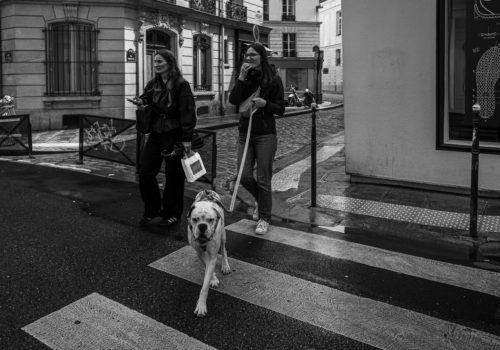
In the city, the dog almost always accompanies. Connected by the leash, it materializes a visible bond between two existences. In the anonymous density of metropolises like Paris, New York City, or Tokyo, it individualizes the silhouette of its owner. It attracts the gaze, provokes a smile, sometimes an interaction. It humanizes public space.
In the accelerated flow of the city, the dog introduces a different temporality. Where bodies hurry, it stops, sniffs, observes. It slows down movement, imposes a pause. This tension between speed and suspension becomes a valuable visual material for the photographer, revealing the coexistence of contradictory rhythms in urban space.
An expressive and unpredictable subject
Street photography relies on the moment and the unexpected. The dog fully embodies this spontaneity. Its gestures escape social conventions: it pulls, freezes, diverts attention. This indocility introduces a lively dimension, sometimes comic, always sincere.
Photographers like Elliott Erwitt have made the dog a central motif. For him, the animal becomes a discreet mirror of the human condition: plays on scale, visual parallels, tender irony. The dog is not just a subject, but a revelator.
Similarly, Henri Cartier-Bresson, master of the decisive moment, knew how to integrate the presence of animals as an element of balance and tension in the composition. The dog thus becomes both a graphic form and a narrative presence.
The dog as a reflection of social transformations
The growing presence of the dog in the city reflects a profound evolution in our societies. It is no longer just a domestic animal, but a full member of the emotional circle. Dedicated parks, welcoming public spaces, specialized accessories: all signs of a redefinition of the bond between humans and animals.
Street photography records these transformations. Dogs dressed, carried, placed on terraces, or observing the world from a doorstep: all indications of a need for closeness and relationship in often impersonal urban environments.
A figure of contrast and poetry
In the mineral universe of the city — concrete, glass, signage — the dog introduces an organic presence. It becomes a living form within a system of lines and structures. Its mobility contrasts with architectural fixity, its sensitivity with the neutrality of the façades.
It can underline the scale of a place, break the rigidity of a composition, or simply introduce a presence. It brings a sensitive dimension to the urban landscape, transforming the scene into a human experience.
Conclusion
In the urban tumult, the dog is never just a background character. It is a mediator, a revealer, a sensitive presence. For street photography, it is a subject of exceptional richness: unpredictable, expressive, and deeply connected to humans. Through it, the city ceases to be just a space for movement to become a theater of attention, connections, and shared moments.