Daniel Angeli : The insatiable eye of the 20th Century
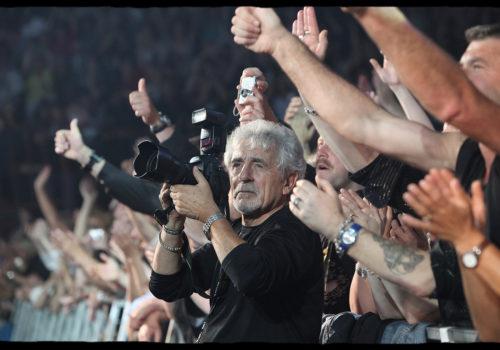
Daniel Angeli is not just a photographer; he is the archetype of the paparazzo turned cultural icon, an observer of the private lives of the powerful and celebrities who shaped the French media imagination. His work goes beyond simple reportage; it captures an era, behaviors, and closed-off worlds that only a keen eye could penetrate.
The photographer excels in the art of the decisive moment, but not only in the Cartesian sense of Cartier-Bresson. For him, the photographic spark comes from subtle observation, camouflage, and an intimate understanding of gestures and attitudes. His images of Johnny Hallyday, Édith Piaf, or Romy Schneider are not mere portraits: they capture the fragility behind fame, the tension between public exposure and private space. Angeli navigates this boundary with almost surgical precision.
One of the most fascinating aspects of his work is his ability to combine journalistic constraints with aesthetic rigor. He began with complex cameras like the Rolleiflex, where every setting — shutter speed, aperture, light — demanded mastery and anticipation. The transition to digital did not make him less technical but gave him new creative tools. Yet Daniel Angeli is not just a technician; he is a narrator of popular intimacy. His photography is a social and cultural chronicle, where celebrity becomes the prism through which we read the times. He redefined the notion of the paparazzo by introducing patience, discretion, and a personal ethic: he never photographs children and avoids certain intrusions, demonstrating a subtle balance between ethics and journalistic necessity. Critically, his work raises questions about photographic truth in an age dominated by immediacy. Daniel Angeli shows that photography can be simultaneously a tool of memory, a source of fascination, and a vehicle for social critique. His images do not merely capture a moment; they tell stories, fix contemporary myths, and give viewers access to the intimacy of the public world without ever betraying the subject. In short, he embodies a profoundly unique approach to photography: between intuition, audacity, and ethics, he has transformed the pursuit of the perfect shot into a true narrative art, embedding each image in collective memory and the cultural history of the 20th century.
Your first photographic spark?
Daniel Angeli: I started surrounded by photographers, but most were fashion photographers. I wanted something else. I wanted the streets. The real, the raw.
What made you want to go out into the streets?
Daniel Angeli: I was fired from Jour de France. They sent me to Dalmas, the largest agency of the time. There, I discovered photographers covering war, cinema, politics. One of them was shooting on film sets that fascinated me.
Any inspirations when you started?
Daniel Angeli: James Andanson, probably. He was very skilled, especially in approaching people shaking hands as if he knew them. But one day at the Gstaad Palace, I saw Marcel Dassault completely ignore him. That’s when I realized charm alone wasn’t enough.
A photo you wish you had taken?
Daniel Angeli: There are so many. I often dreamed of being a set photographer on some films, like Scorsese’s. But honestly, my regrets are rarely artistic: they’re mostly about missed shots that could have paid off big time! It was almost an addiction, this chase for exclusive photos.
A photo that moved you deeply?
Daniel Angeli: Yes, one of a little girl sinking in the sand, surrounded by photographers. I couldn’t have taken it. Like the tragedy of Romy Schneider’s son some took photos at the morgue. I could never have done that.
A photographic memory from your childhood?
Daniel Angeli: My first major moment: Édith Piaf. Dalmas’s editor sent me to photograph her during what was rumored to be her last album recording. I arrived without a car or motorcycle, got a few shots from behind. Her husband noticed me and let me in. Piaf, tiny, was on a platform. I asked her to “pretend to sing.” She replied: “I don’t know how to pretend.” And she sang Je sais comment. I took my photos trembling. It was magical.
A work of art you’d like to own?
Daniel Angeli: A Van Gogh. I’ve worked a lot in his region, and his story deeply touches me.
Qualities needed to be a good photographer?
Daniel Angeli: It depends on the job. For a paparazzo, the first quality is discretion. Knowing how to disappear. When you’re perched in a tree and no one sees you, that’s when you get the real shots. Because as soon as people know they’re being photographed, they perform.
Who would you like to photograph you?
Daniel Angeli: Patrick Demarchelier. A charming, simple man who gave me a real lesson: always work with a 50mm, “what the eye really sees.” And above all, keep both eyes open while shooting one to frame, the other to see what’s happening around.
An essential photo book?
Daniel Angeli: Mine! (laughs) A 32-kilo tome on my twenty years with Johnny, sold in a flight case like musicians use.
Your first camera?
Daniel Angeli: A Rolleiflex. The most demanding camera in the world. Everything was manual: shutter speed, light, aperture… Today, a digital camera does it all automatically. It’s easier now. Perhaps too easy.
Has digital made life easier?
Daniel Angeli: Yes, though early on, backlight shots were disastrous. We had to adapt.
Your favorite addiction?
Daniel Angeli: Cigarettes. Like Johnny. During a shoot in China, we couldn’t find any, so he chartered a plane to bring some! We smoked a pack a day.
Could you disconnect?
Daniel Angeli: Never. When Diana came to Saint-Tropez, I couldn’t sleep. In Saint-Barth, I was supposed to photograph my son but ended up with a series that went worldwide.
Your greatest quality?
Daniel Angeli: Kindness, I guess. But others are the judges.
A professional folly?
Daniel Angeli: Renting a helicopter in Saint-Barth to survey Johnny and Yves Rénier’s houses. Ruinous! But what a view…
A portrait for a banknote?
Daniel Angeli: A woman’s face. Romy Schneider, perhaps.
If you hadn’t been a photographer?
Daniel Angeli: No idea. I left school early. My father ran the Jimmy’s Club and wanted me to take over, but it wasn’t for me.
The craziest thing in your career?
Daniel Angeli: A same-day round trip to photograph Sarah Ferguson in Saint-Tropez. The images went worldwide and got me sued.
Have you ever been paparazzoed yourself?
Daniel Angeli: Yes. The tables turned. English paparazzi followed me to my daughters’ school!
A place you never tire of?
Daniel Angeli: Saint-Barth, even if it’s expensive now.
Your greatest regret?
Daniel Angeli: Not taking certain photos or seeing ones circulate I never would have taken.
Color or black and white?
Daniel Angeli: Black and white. When I started, color was in its infancy. Black and white shows the naked truth.
Daylight or studio light?
Daniel Angeli: Always daylight. My paparazzo instinct.
Did any of the people you “hid from” become friends?
Daniel Angeli: Often, yes. Yves Rénier, Mathilde Seigner… and Johnny, of course. I spent twenty years with him — friendship and work. He gave me everything.
Most photogenic city?
Daniel Angeli: Paris. Undoubtedly.
Film or digital?
Daniel Angeli: My heart goes to film, though digital has simplified everything. Some modern cameras now recreate the grain of Tri-X film.
If God existed, would you photograph Him or take a selfie?
Daniel Angeli: I’d paparazzi Him, of course! (laughs) And I’m only half-joking: religions cause so much harm. Yet when my daughter had breast cancer surgery, I prayed without realizing it.
Your ideal dinner?
Daniel Angeli: Mathilde Seigner, my heart-sister, and Yves Rénier, my great friend. I miss them both.
An image that sums up the world?
Daniel Angeli: A Jew and a Palestinian shaking hands. That would be beautiful, wouldn’t it?
If you had to start over?
Daniel Angeli: I’d do everything the same. Absolutely everything.
A final word?
Daniel Angeli: Let the wars end. Let’s regain some humanity. I’m over 90, not afraid, but I worry for my children and grandchildren. The world is spinning a little backwards, you know.