Stefanie Dworkin is a Brooklyn and Palo Alto–based photographer, documentary filmmaker, editor, and educator with over 25 years of experience. She has edited more than 50 film, TV, and digital projects—including PBS’s Treasures of New York: The Flatiron Building—and directed or produced numerous documentaries. Her award-winning photography has been exhibited in solo and group shows in New York, Paris, and internationally.
Stefanie has taught filmmaking, editing, and photography at Columbia Journalism School, NYU Tisch School of the Arts, SUNY Purchase, and is on the faculty of the International Center of Photography in New York.
She collaborates with creatives across disciplines and is a member of ASMP-NY, APAG, WPA and PACC.
Web: www.stefaniedworkin.com
Instagram/Twitter: @stefaniedworkin @stefaniedworkin https://www.instagram.com/stefaniedworkin/
Linkedin: Stefanie Dworkin https://www.linkedin.com/in/stefaniedworkin/
Facebook: https://www.facebook.com/stefanie.dworkin
Blue Sky: @photstef.bsky.social
Patricia Lanza : How did you come about to find and produce the photographic series on Coney Island? Discuss your research in preparation, the history of Coney Island, and its connection to the community.
Stefanie Dworkin : In the Winter of 2008, I audited my friend Lawrence Wheatman’s photography class at New York University. Our assignment was to create a body of work for a group show at the end of the semester held at the Soho Photo Gallery in New York City. As I was thinking about a subject for my project, I came across a news article stating that New York’s Coney Island, after decades of disrepair, was about to undergo extensive redevelopment.
The article both upset and intrigued me. I had grown up watching films and seeing photographs of Coney Island, 3,000 miles away in California, and had started making photographs there when I moved to New York in the late 1990s. Primarily interested in capturing its dynamic energy, I focused on street and environmental portraits. My heart sank after reading the article, and I felt compelled to capture what was about to be lost. Run down and frozen in the full 20th-century spectrum of time, old and weathered yet, to me, vibrant with authenticity and story.
Photographers and artists from around the world have made the pilgrimage over the 125-plus years of its existence. It has held a very special place in the hearts of millions since the mid-1800s, when ferries and trains paved the way to its sandy beaches, eventually leading to the development of amusement parks. The combination of technological development, urbanization, new ideas about leisure, and the influx of immigrants into America fueled its transformation into an entertainment mecca, bringing together people with different racial, ethnic, and class backgrounds and transcending social boundaries. This unleashed democratic spirit has, over the years, offered a seductively liberating environment and has been a muse for artists.
Can you describe your method or strategy for approaching the subject, since Coney Island has been the subject of film and photography over decades, since its beginning in the 1880’s?
Stefanie Dworkin : I approached this project on Coney Island from an intuitive and emotional perspective steeped in the notion of memory. I had only been living in New York for 10 years, yet I felt like I had grown up there, spending long summer days on the rides, at the beach, enjoying the fireworks, and eating hotdogs and cotton candy. Coney Island’s energy was in my soul and practically in my memory, compelling me to witness it fully one more time as it stood on the brink of change.
The article stated that such a change would start before Coney Island opened for the Summer season. I knew if I went out in the early Spring, there would be few people, but that appealed to my sense of melancholy, as did the fog and rain of the season.
What is your method for producing images from a technical photography standpoint?
Stefanie Dworkin : While figuring out my story and approach to photographing Coney Island, I came across the Lomography shop on 8th Street in Greenwich Village. It was a cool camera shop that sold plastic film cameras, lenses, and a variety of film. As I was checking out the merchandise, I discovered the Diana Plastic Film Camera. Considered a toy camera due to its simple plastic design, basic settings, and interchangeable lenses, I thought it would be perfect for capturing an authentic look and feel of the environment.
I didn’t want sharp. I wanted soft black-and-white images. I shot on 120 film, usually 400 iso, through a plastic lens. There were three settings for distance and three for light exposure. All manual and no metering. It was a hit-or-miss experience. And yet, the experience slowed me down to see and feel each moment, allowing me to acknowledge and memorialize their last moments.
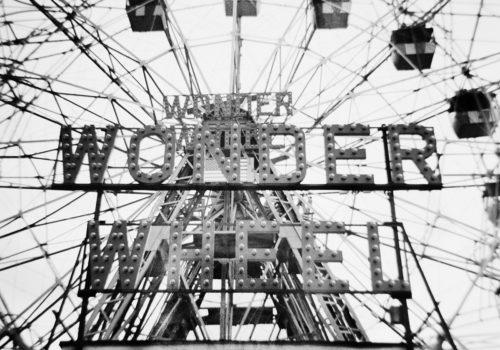
I wish to note that although Coney Island lost several attractions, including Astroland, to new development, it has retained many iconic rides and venues, its beaches, and the love of its patrons, both local and from afar. Like its iconic Wonder Wheel, Coney Island’s evolution is cyclical. It erupts every two to three decades as city politicians, developers, community leaders, nature itself, and other forces battle to shape its future. In fact, as Coney Island opens for its 2025 season, a proposed $3 billion casino and entertainment complex is in the works. Covering three blocks, the plan features a casino, hotel, convention center, and retail space.
What are you looking to do with this series?
Stefanie Dworkin : Images from the series have been in many curated international group shows over the years, as well as a few solo ones, including at the Tribeca Beauty Spa in NYC, which photographer Susan Rosenberg Jones produced; Legendary Brooklyn in collaboration with filmmaker/photographer Bethany Eden Jacobson at Gallery128 in NYC and a self-produced show at a friend’s apartment in Paris of my Coney Island images along with a screening of a documentary film I edited and helped produce for PBS on another New York icon, the Flatiron Building.
Currently, I am working on a book design for the project, supported by an online bookmaking workshop led by Elizabeth Avedon and Elisabeth Aanes through NORD Photography in Norway. I wish to publish a book either through a publisher or on my own. I realize it’s not so easy these days, but I feel it’s the next step in the evolution of this project. As a filmmaker accustomed to working on long-form and lasting projects, I am motivated to create what will hopefully be a beautiful, moving and lasting presentation of this body of work.
I also wish to explore printing silver gelatin prints. Up to this point, I have scanned my negatives, processed them in Lightroom and/or Photoshop, and then printed them digitally. At a recent portfolio review at the Los Angeles Center of Photography, reviewer Jonathan Blaustein encouraged me to return to the darkroom or, at the very least, print digitally in the style of silver gelatin prints. I feel he has a point there, and I am very curious to see such a printed portfolio. I think the images will be amazing!