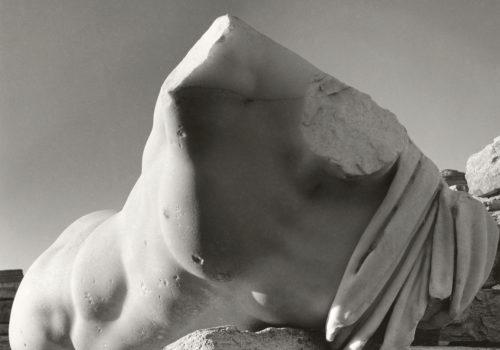
Presented as part of the associated program of the Auckland Festival of Photography, the exhibition Mark Adams: A Survey | He Kohinga Whakaahua, organized by the Auckland Art Gallery, is the first major retrospective devoted to this key figure of Aotearoa New Zealand documentary photography.
Photographer Mark Adams is well known in New Zealand. For over fifty years, he has traveled the country with his large-format camera to document the complex identity of the New Zealand landscape, exploring its colonial history, the significance of Māori culture, and intercultural relationships in the Pacific. His sensitive and rigorous practice draws as much from a carefully considered aesthetic approach as it does from a keen attention to anthropology and history. Bringing together nearly seventy photographs, the Auckland Art Gallery offers a look back at the major themes of his work.
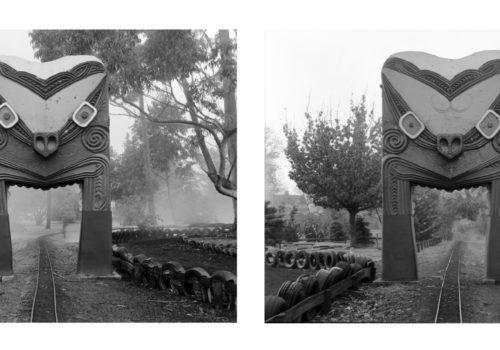
The exhibition opens with an iconic series produced between 1978 and 1986 in Rotorua, a major center of Māori culture. It was in Rotorua that Mark Adams met sculptor George Ihaka Brown and began to take an interest in Māori arts. From this friendship grew a shared desire to preserve and promote Māori traditions through photography. The images from Rotorua also reflect the photographer’s interest in the hybridization between Māori culture and European colonial culture:
“The photographs represent a subjective response to the region, its geomorphology, and the convergence of the cultures that inhabit it — Polynesian and colonial European. The evolving power dynamic between these two cultures is embodied in artifacts that convey, in an ironic and metaphorical way, the historicity of the place and, by extension, of the country as a whole.”
This early work already reveals the delicacy of Mark Adams’s photographic language, which, rather than imposing a perspective, prefers to raise questions, encouraging the country to reflect on its colonial past.
Another section highlights his work on the tatau (traditional Samoan tattooing) in Tāmaki Makaurau, Auckland, which he began in 1978. The result of a genuine collaboration with the tattoo masters he photographed, this series respectfully and precisely captures the rituals and symbols of an ancestral practice as well as the transmission of culture within the Samoan diaspora. While it marked a turning point in Mark Adams’s documentary practice and his awareness of his position as an “outside observer” in relation to these communities, the project also showcases the trust and intimacy he was able to establish with the people he documents.
The exhibition also presents photographs of historically significant sites, such as the locations where the Treaty of Waitangi (1840) was signed, and those visited by Captain James Cook upon his arrival in 1769 — an event that signaled the beginning of colonialism in New Zealand. For this project, Mark Adams notably reinterpreted paintings by William Hodges, the official artist of Cook’s expedition. One such painting shows a member of the Kāti Māmoe tribe standing on a rock before a landscape. The photographer found this exact rock and positioned his camera there to create a panoramic view from the perspective of the person being portrayed, thus reversing the gaze and the power dynamics attached to it. In addition to these panoramic images where the eye-level is a critical concern Adams also conducted several experiments with photograms, exploring the material dimension of his work. This ongoing technical research reflects his interest in the various photographic processes and their ability to convey the complexity of the narratives he explores.
Mark Adams: A Survey | He Kohinga Whakaahua offers a fascinating immersion into the work of the New Zealand photographer, revealing his unwavering commitment to memory, identity, and intercultural dialogue. It also highlights the unique status he has acquired within the communities he documents and how he navigates the balance between immersion and observation. Although he is Pākehā (a New Zealander of European descent), Mark Adams has, over his fifty-year career, cultivated deep and lasting relationships with Māori and Samoan communities. The duality of his position — as both “outsider” and “insider” — enables him to grasp the full complexity of cultural identities in New Zealand, without claiming to speak on behalf of the communities he represents.
More information