Mulhouse resists uniformity. The neo-Gothic style clashes with the architecture of the post-war boom years, whilst the route of the potash line cuts through a multitude of discontinuities and cross-border influences that call for a different perspective. The seventh edition of the Photography Biennale, ‘Sedimentations’, finds a natural home here: photography carries a spatio-temporal reflection that plays with linguistic, geographical, geological and mental boundaries, whilst questioning the limits of the medium itself. During these opening days, I oscillate between past, present and future, through what connects them.
Settled and Sédiments de mémoire blend explorations of personal and collective memory. The exhibitions are organised around questions of origins and borders. The photographers question the medium’s fixed nature, both in what they choose to capture and in how they present it: projections, unframed prints, installations still in the making. Here, photography leaves the wall: projected, unframed, it spreads across the surfaces of the space, conforming to its architecture or playing with its constraints. The viewer must move to interpret it. It is no longer an object facing one but a space into which one enters. Photography re-enacts sedimentation on its own scale, questioning the boundary and what crosses it.
‘Sediments of Memory’ is on display at the Städtische Galerie in Freiburg im Breisgau. There, I discover the work of Sandra Eades, Gisoo Kim, Lilly Lulay, Dalmonia Rognean and Wenke Seeman, curated by Eva Kallenberger and Camille Rey.
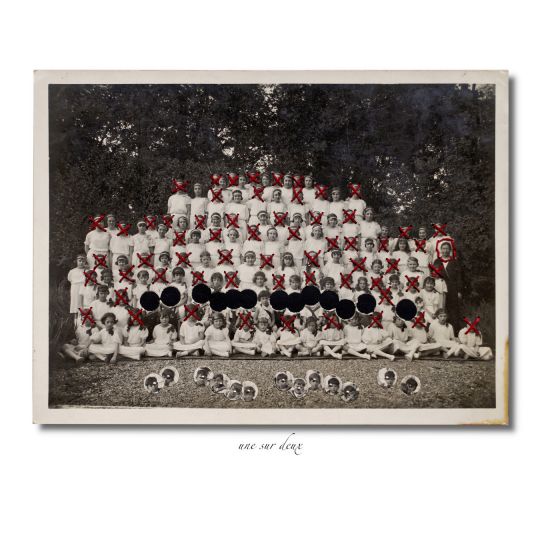
These photographers manipulate photography as one might manipulate a material: they fold it, cut it, layer it and create new materialities. This is one of the elements that contributes to the work of memory, highlighting the selection made by the artist and by memory itself. The images bear witness in fragments, imperfectly rendered. What we do not see, we can project.
Gisoo Kim sews. In Connected Spaces, the works are no longer merely photographs or finished sculptures: the prints are assembled using thread, sewn together. One can recognise cultural references linked to the artist, particularly through dresses inspired by Korean traditions. Other, more abstract objects open up a space for reflection: their contours defy precise description, leaving room for the viewer’s imagination. Everyone can attach their own disjointed memories to them. The thread creates new gaps, like omissions in memory. It is the impartiality of memory that plays tricks on us and twirls like the petticoats it presents. The following day, at the Filature de Mulhouse, Ange-Frédéric Koffi introduces the exhibition Settled, which he commissioned. The project explores the connection to the land and, more broadly, to territory — particularly when it has been altered, impacted or colonised. It features what remains of altered regions, and the way in which bodies, in turn, bear their imprint.
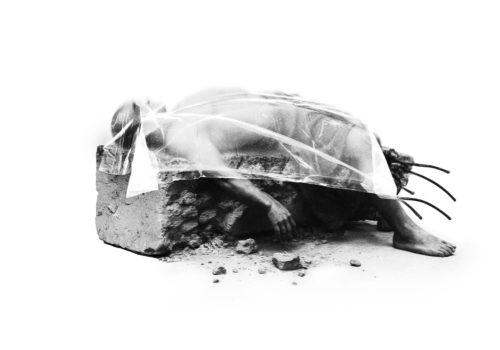
Mahmoud Alhaj superimposes several photographs: a concrete block captured in Gaza, and a reclining body his own photographed in France. He covers the whole with a transparent tarpaulin. The images remain off-frame; only two sentences on the composition of the concrete and its characteristics are framed: concrete has its characteristics; the body, we no longer know. A mobile phone, limited resources constraint is part of the project and fuels it. The eye is that of an architect: volumes, structures and the relationship to space.
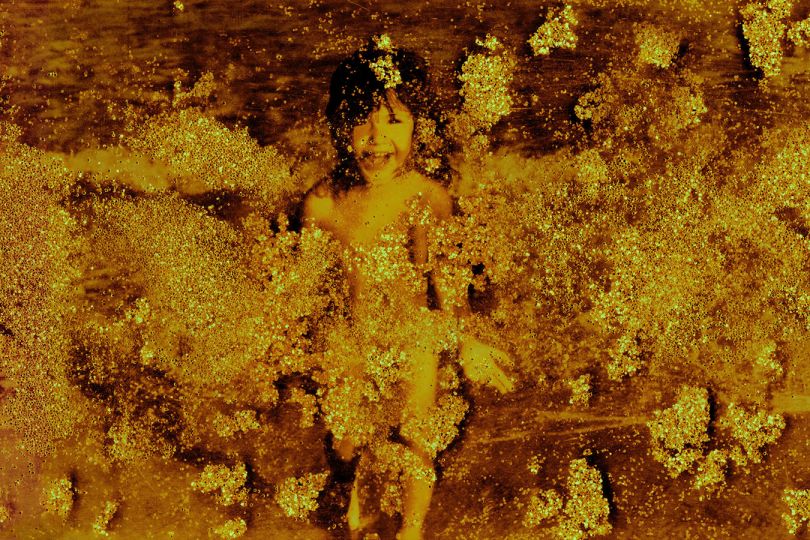
Taking a completely different approach, Eric Gyamfi’s Mapping Rumours: A Cartographer’s Guide seeks to reveal what the landscape leaves behind in the image. Prints on Rhodoid made from photograms, created using pigments from macabo, neem, teak or cassava. The forms are evocative: they might bring to mind a pointillist painting, but Gyamfi resists this interpretation: ‘I want to play with the liminality it induces; it looks like it, but it isn’t. ’ (I want to play with the liminality it creates it looks like it, but it isn’t.). One might invoke debates on the veracity of the photographic image, its supposed transparency, the whole critical apparatus. Yet the artist takes the opposite path: neither deconstruction nor rationalisation, but a letting-be of what the environment, the climate and the weather shape without prior intention.
I move between artists, visitors and curators, from one venue to the next. Anne Immelé, the artistic director, brings everyone together with equal respect: former students of the Beaux-Arts, established photographers and publishers, emerging voices, volunteers and partners. You can sense the humanity in the space left for dialogue and time to exchange ideas, as well as in the silence and the unfinished. This is particularly evident in the group exhibition she has conceived with the artists Gaëlle Delort, Marilia Destot, Rifat Göbelez, Bernard Guillot, Pauline Hisbaq, Sangyon Joo, Eugene Shinkle and Roselyne Titaud, where the artists’ works echo the processes and changes that sometimes occur suddenly, sometimes over the long term. The series Développements, taken in 2024, presents the speleological aspect of development, that is to say, the cumulative length of the interconnected galleries that make up an underground network. This seventh edition of the Mulhouse Photography Biennale thus mirrors what it exhibits: a form that takes shape through accumulations and connections, without one being able to precisely define its contours.
Ségolène Bulot
Sédimentation – une constellation Musée des Beaux-Arts, 4 Place Guillaume Tell, 68100 Mulhouse
Sédiments de Mémoire Städtische Galerie (Morat-Hallen), Lörracher Str. 31, 79115 Freiburg im Breisgau
Settled La Filature, 20 Allée Nathan Katz, 68090 Mulhouse