Bringing together more than sixty works, Jeff Wall – Time Stands Still. Photographs, 1980–2023 is a major retrospective of the Canadian photographer’s oeuvre — one of the most comprehensive to date. Favoring thematic and visual associations over a chronological display, the exhibition — the artist’s first in Portugal — offers a full immersion into over forty years of a practice dedicated to exploring the photographic image. A compelling journey, in subtle dialogue with MAAT’s undulating architecture. We met with Jeff Wall to discuss the curatorial choices behind Time Stands Still as well as some of the key issues that run through his work.
Dear Jeff Wall, let’s begin with your early years. When did you know you would become an artist?
I think I was an artist as a little boy because I was always drawing. I also loved reading the comic pages in the newspaper. Not because they were funny or entertaining but because they were so well drawn. I remember clearly gazing at those pages and really liking the way they looked. Later on, my parents subscribed to publications on artists that were sent to our house every month. I was very drawn to them. I must have been an artist then without really knowing it. I didn’t ever really become one… I always was, in a way.
Why did you choose photography?
I was interested in the medium early because we had the catalogue of the Family of Man exhibition (MoMA, 1955), which I was looking at so much. This is when I discovered photography and began to like it, although I didn’t think about practicing it. Later, in the sixties, when I became increasingly engaged with experimental art forms, at the time of conceptual art — which I became immersed in through a lot of ways — photography came alive in a different way. I didn’t enter it through the classic, John Szarkowski or Cartier-Bresson door, but the Robert Smithson conceptual art one. It was not necessarily better, it was just more « now ». But then that « now » got complicated. I explored that path but failed. I then slowly recovered a sense of what I had been doing earlier, as a painter kid, which was picture making. I recovered that in a new way in the seventies.
Today, a few decades later, you are showing your first solo exhibition in Portugal, one of your most extensive retrospectives. It is taking place in the stunning architecture of the building Amanda Levete imagined for MAAT. How did you approach its very organic and open space ?
This exhibition follows two others that took place last year in Basel (Fondation Beyeler) and London (White Cube), which involved a number of the pictures that are here. In these exhibitions we were always dealing with rooms, individual rooms, conventional rooms. One of the things that we tried to do was to find pictures that felt like they all belonged together. We created ensembles of pictures, almost like flower arrangements : each room had a different flower arrangement, different flowers, with different colors, different shapes and so on. But here, at MAAT, I can’t do that because there are no rooms. This exhibition space is really different from anything I’ve ever done before. It has this kind of spread of space without boundaries, in which I can’t invent closed ensembles. They had to open out and became figure sequences, which created idiosyncratic differences and similarities that might have not been revealed except for showing them in a space like this.
You also embraced the curved architecture of MAAT to create a striking visual contrast with your prints.
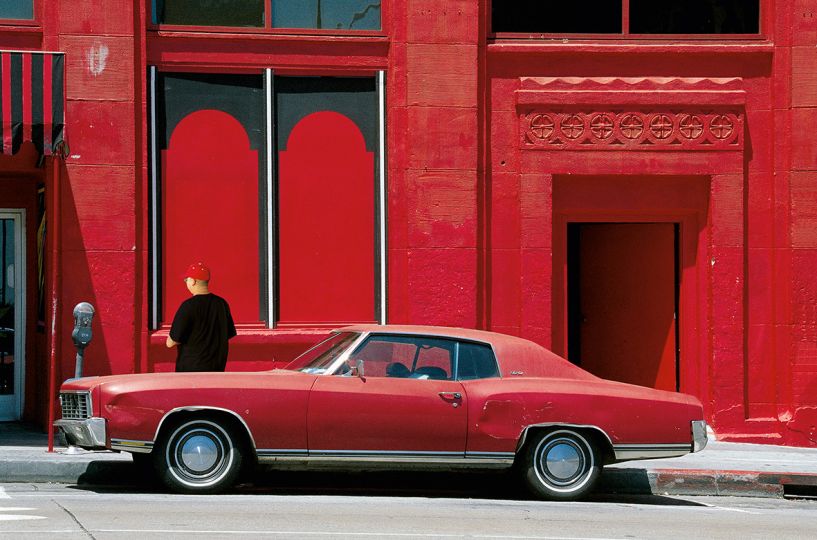
This is also something I had never encountered before. The sheer contrast between the flat and rectangular shape of my prints and the curved interior is another dynamic that I was very interested to work with. Another aspect I noticed is that the exhibition space has a strong decoration aspect, one could say it is « decorated » with pictures. I thought that people could come here, look at the room and then leave because they’ve already seen something essential about it. That wouldn’t really bother me as the decorative sense of the colors and so on is essential. There is a sense of enjoyment about the show, that wouldn’t have been available in any other kind of space.
This type of hanging underlines the idiosyncrasy of each picture. However some groups do shine through when visiting the exhibition. How did you put them together.
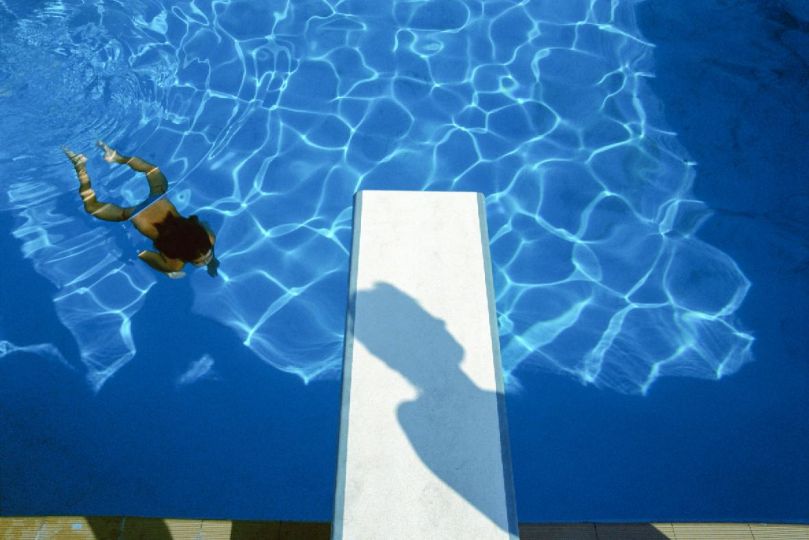
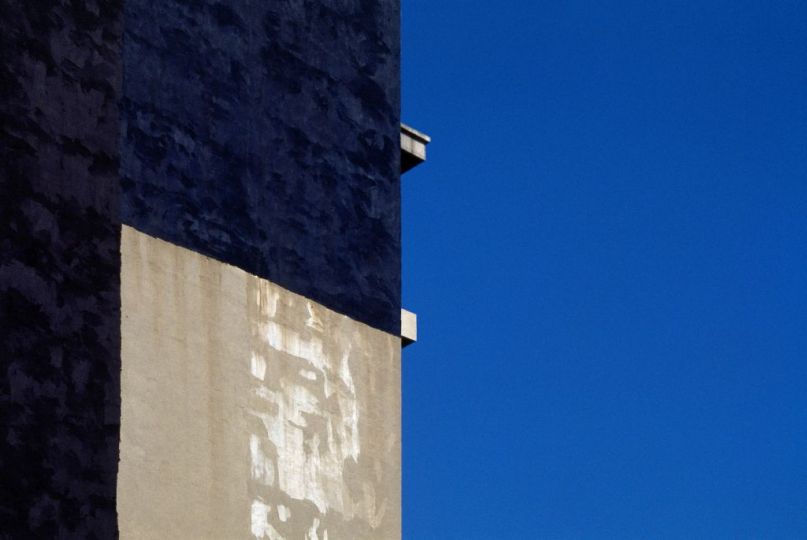
The exhibition does bring together pictures under certain central themes of my work. But some pictures will be shown next to each other because of the hands that appear in them or because of the different skies they display. A lot of the groupings of my pictures are as simple as that. Take the skies. It is interesting to see that in winter, the sky is grey while on a summer morning, it is bright blue. In another picture, it is spring and the light is coming from behind, the sky is almost white. These details interest me because I’m a photographer. Every picture has its own moment in time, its own season, its own illumination, its own shadows, its own intensity, and they’re all unique to an actual moment. Capturing those moments is what photography does. I think we can say that for any of the pictures here in the exhibition. It’s marked in certain ways.
You explore another aspect of photography, the eternal hovering between reality and fiction which the medium often blends together, creating a fictional reality or a realistic fiction. How do you relate to images ? You’ve spoken of “near documentary” photographs — what do you mean by that?
One picture in the exhibition shows a trap set that I photographed in 2021 in Vancouver. The trapping of animals for their fur has decreased, but it has not disappeared completely and you can find those vintage traps sometimes. I immediately thought it would be a very interesting subject for a very simple photograph. I only asked a trapper to put the trap where he would put it to catch what he was looking for. Therefore it is a sort of a collaboration. It’s not strictly a documentary photograph because I did something, but in this case, all I used was what the trapper would have done anyway. That’s why I talk about « near documentary » photography. It’s not documentary, but it could be. Besides, it questions what documentary photographs are, their appearance, how they are made?…
Photography has always had a strong relationship to text, whether it be documentary photography or more conceptual approaches. What is your relationship to literature, in the broader sense of the term.
Literature plays a large role in all pictorial art. I think all visual artists have a literary activity. But we’re not writing. Most of my pictures with events happening in them start from an observation or a thought, which I think of as a starting point. With it, I can work. This starting point has a literary aspect, a narration. But to make the picture, what I tend to do is try erasing this narrative origin. I accept it, and then try to suppress it in my own thinking and work on picture making only.
Looking back at those forty years of work. Where would you say your photography is leading you today ?
The challenge or the limitation of going somewhere new is that the camera leads the way, and the camera hasn’t changed much. No matter how advanced our manufacturing becomes, even with robots, we’re still producing the same thing. Until there’s an alternative to light passing through a lens, we’re limited to what the lens can do. In other art forms, you might have more freedom. But in photography, that limitation—the “unfreedom”—actually defines the medium. We’re bound to the lens. My work can’t change that much. No photographer’s work can, unless they take some big stylistic turn. I’ve made such shifts, but I don’t feel the need to move away from what I’m doing. I feel very much in photography—not outside of it. Besides, as limited as it might be, the camera lens is very close to how our eyes see. That makes photography feel very alive. We’re alive, our eyes are alive, we see things. The camera isn’t the same, but it’s similar enough that it creates this intense liveliness that keeps the image vibrant. That’s an open horizon.
More information