A Tribute to Jean Warêgne
Photographs taken in the Sahara and across Africa between 1949 and 1953.
My father, Jean Warêgne, undertook a series of cartographic missions in Africa (formerly the Belgian Congo, now the DRC) in his capacity as a specialist at the Belgian Military Geographical Institute (IGM – later renamed IGN, the National Geographical Institute). The aim of these missions was to produce a map of the Congo using stereoscopic techniques applied to aerial photographs taken during flights in DC3s equipped with special cameras. He took part in four missions: in 1949, 1950, 1952 and 1953.
Flights from Belgium to Africa were made in military DC3s (DC4s in 1953) with minimal equipment. As the range was quite limited, the flights were interrupted by numerous stopovers: in 1949, for example, the DC-3 left Brussels (the Melsbroek military base) to fly to Algiers, Aoulef (Algeria), Gao (Mali), Kano (Nigeria), Fort-Lamy (N’Djamena, Cameroon), Libenge (DRC), Coquilhatville (Mbandaka, DRC), Leopoldville (Kinshasa, DRC) and Elisabethville (Lubumbashi, DRC). The return journey was usually via Stanleyville (Kisangani, DRC), Bangui (capital of the Central African Republic), then Fort-Lamy, followed by the same stopovers on the way back to Brussels. The missions lasted around three months.
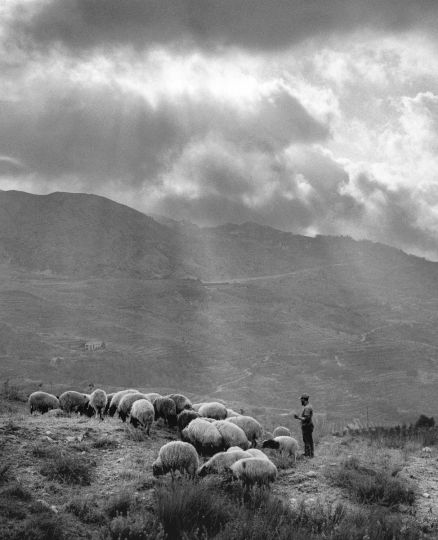
During these stopovers, and whenever his schedule allowed, my father, armed with his 6×6 Rolleicord camera, would wander through the markets or villages to capture life in these places so far removed from Europe. His Rollei had been modified to allow 4×4 cm shots, which meant he could fit a few more photos onto a roll of black-and-white film. I recently came across an old album that my mother had kept, containing contact prints: the original photos are therefore very small. I scanned them myself (at 600 dpi), then cropped and retouched them slightly to remove dust or minor damage caused by the passage of time.
These photos are an indisputable record of the societies of those distant years in the mid-20th century. To me, they exude a great sense of humanity, with the subjects generally looking into the lens with interest and curiosity, their gazes meeting those of the photographer.
This is probably a reflection of an era when tourism had not yet left an indelible mark on the world.
The photographs thus serve to preserve the memory of these people who are no longer with us, and whom my father knew. I think of him and of them, all swallowed up by the inexorable passage of time, yet each a witness to their own existence.
J-M Warêgne-Brussels-2026