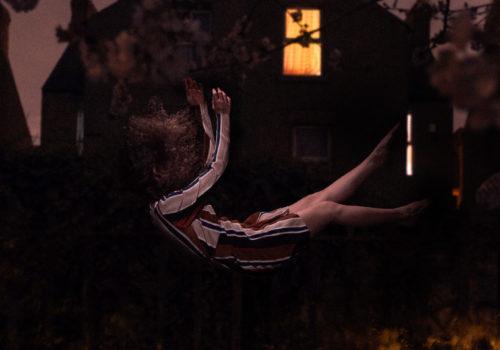
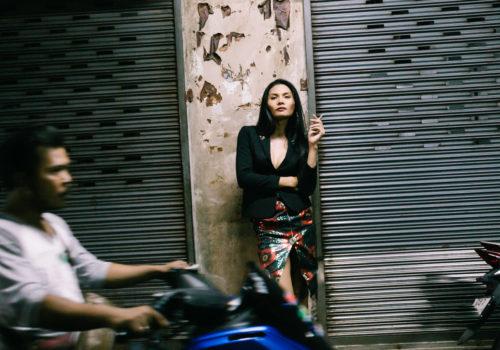
A Sudanese photographer, Hashim Nasr was in Egypt when the civil war broke out in his country in the spring of 2023. Unable to return home, he created the series On War and Displacement. Blending symbolism, dreams, and reality, his work pays tribute to those who remained behind while questioning notions of belonging and exile. A conversation with an artist offering a different perspective on war.
Can you tell us about the personal and political context in which this series was created?
This series was born out of reflection on many aspects of the Sudanese civil war, on myself, my family, and others in my country. I wasn’t present when the war erupted in April 2023, as I was on vacation in Egypt with my brother and our parents. So this series is about leaving behind my home, my memories, and my sense of security. It responds to the collapse not just of a country, but of the very idea of belonging.
How did you experience this period of exile in Egypt? What part did art play for you during that time?
At first, I lived in a mental void, a state of denial, hoping everything happening was just a dream that would eventually pass. But I had to come to terms with the fact that it was real. It took me months to adapt to this new reality. Creating these photographs truly helped me through it, even though it wasn’t always easy to go out and shoot.
From the start, did you intend to reflect not only your personal experience but also that of exiled Sudanese people more broadly?
Yes, absolutely. While the series is based on my personal story, it was never meant to be only about me. I remember calling my aunt during the second week of the war, and she told me they had to hide under the dining table to protect themselves from bombings and fighting outside. The feeling of loss, of losing everything and the forced displacement that haunt these images are experiences shared by so many Sudanese people. I wanted to create symbolic portraits of this collective experience, one that doesn’t always make headlines.
You describe your photography as a blend of dreamlike imagery and activist symbolism. What artistic references have shaped this vision?
Most of my inspirations are deeply rooted in my Sudanese culture, which is itself influenced by African heritage as well as international pop culture that heavily impacted me in my teenage years—especially visuals by Lady Gaga. Artists like Aïda Muluneh are recent inspirations: she uses visual language to explore emotions, space, and identity. I’m also drawn to visual minimalism and staged photography, where props carry metaphorical weight. All of these references combine with my activist roots, shaped by Sudanese legacy, to tell stories.
What role does dreaming play in your photographic practice?
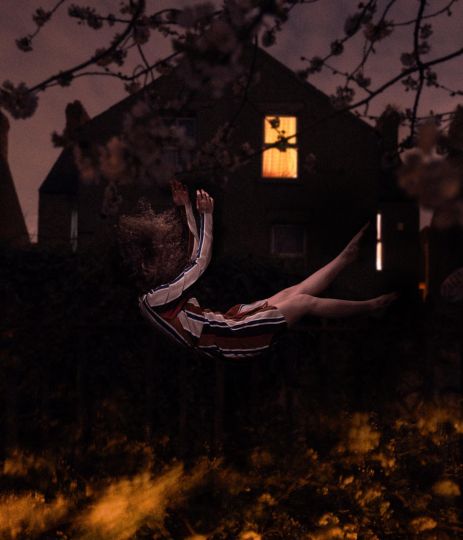
My photographs always live in that space between memory and imagination. The foundation of my series A Leap into a Dream was actually a dream I had in 2021. Since then, I’ve continued translating my inner visions into images right up to today.
Using a smartphone in this new series is both an aesthetic and political choice. Why did you decide to do that?
At first, I simply didn’t have access to a camera with interchangeable lenses, so my phone was the only tool I had to turn my ideas into photographic form. The convenience of a phone camera also made shooting easier, without drawing attention from people or authorities.
Why did you choose to hide your models’ faces?
As with the smartphone, covering faces initially came for safety for both myself and my models, who are friends. Later, the head coverings became visual element in their own right, adding depth to the images while helping my models feel more confident in front of the lens. It also allows viewers to connect more deeply with the essence of the images, without being distracted by individual facial features.
How do you build your images? What are the steps in your creative process?
I often start by writing or sketching an idea, a sentence, or even a memory I can’t let go of. Then I gather props or build small sets, often using materials from my immediate surroundings. I think of each photo as a scene. I work with natural light, color, and space—usually shooting alone or with close friends. I do some light retouching afterward, but I’m not a fan of heavily editing my photos.
Some of your images, like Remembering My Uncle or The Safest Place Was Under the Dining Table, express very tangible feelings through their titles. How do you combine intimate memory with symbolic staging in your work?
Starting from real elements and the stories behind each photo, I try to transform what could be obvious into something metaphorical. For example, in Remembering My Uncle, I express his absence through an overturned cone from which flowers emerge.
You’ve spoken about your desire to “make people feel the intangible aspects” of crises. How do you visually convey such complex, often unspoken emotions?
Opening the door to figurative and conceptual imagery really creates a space for viewers to grasp the depth of my ideas and visuals, and to reflect on the stories they hold. I believe topics like war can also be interpreted without having to show graphic or disturbing images.