Until September 27, the Centre Photographique Rouen Normandie pays tribute to the work of Françoise Huguier through a theme dear to the French photographer: Home.
Françoise Huguier is a true landmark in photography. On October 1st, she will officially take her seat under the Coupole, elected to the photography section of the Académie des Beaux-Arts. This appointment crowns a fifty-year career and a lifetime of globe-trotting. She once told her father she wanted to become a photographer for one reason: to travel. Camera in hand, the woman nicknamed la curieuse(the curious) roamed the planet, immersing herself in communities and capturing their everyday lives.
In Rouen, a portrait of her face framed by a paper-mâché crescent moon reveals the piercing gaze with which she has always seized upon the smallest details of the interiors that welcomed her. A brilliantly conceived scenography, playing with graphic effects and color, then invites us to step into Françoise Huguier’s singular world. To convey the breadth of her work, Raphaëlle Stopin, who has directed the Centre Photographique Rouen Normandie for the past ten years, chose to explore it through the lens of the home: “the home as caught in the banality of daily life, but also in what constitutes its flesh: spaces of intimacy such as the kitchen or the bathroom, and what unfolds there in terms of closeness and the body.”
Huguier studied this closeness at length in Russia, in Saint Petersburg. The exhibition opens with her now-iconic series Kommounalki (published in 2008 by Actes Sud). For a decade, the photographer spent three months each year in one of these communal apartments inherited from the Soviet era, immersing herself in the daily lives of their inhabitants in order to capture, directly but not without poetry, the life behind closed doors. Stacks of dishes, drying laundry… in these images, everyday objects stand as protagonists in dialogue with the faces around them. Whenever she enters a home, it is these elements that her eye seeks first. She loves to observe how people inhabit a space. For her, intimacy is a way into the world: “When you’re interested in a society, there is, of course, the intellectual side. But it’s also how people live how they eat, how they wash…”
Bathing is a recurring motif in her work. It reappears in a strikingly cinematic sequence made in 1992 as part of her series En route pour Behring, for which she traveled across Russia to the Siberian Arctic, sharing the daily lives of different communities. There, she was taken to the bania, the Russian public bath. The experience was a revelation. These naked, imperfect, steam-drenched bodies became an obsession. To watch a body wash itself is to enter the deepest realm of intimacy. Raphaëlle Stopin speaks of “the viscera of the home,” mirroring the entrails of a walrus slaughtered by Huguier’s Siberian hosts. Violent as the image may be, it is strikingly delicate. A profound softness emanates from the texture and colors a result, the photographer explains as a consummate technician, of choosing Kodak 320 film.
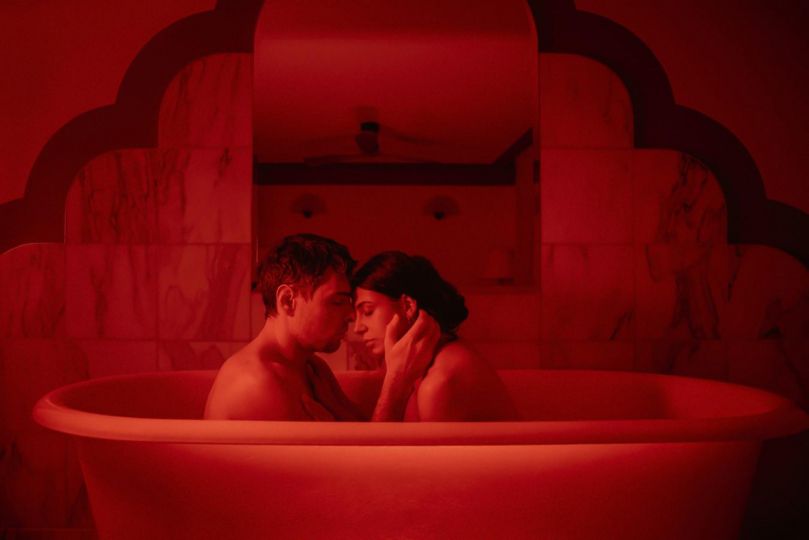
The exhibition closes with more recent works in Asia, particularly in Cambodia, where Huguier returned in 2008—fifty years after being kidnapped by the Viet Minh in her family plantation at the age of eight. That reconciliation opened doors long closed and led her to revisit Thailand, Singapore, and Indonesia territories she approached, of course, from within. Here too, we find her enduring love of color, which has become her signature. The exhibition especially celebrates the power of her hypnotic reds, which invite us to sink into the warmth of these homes. Across the globe, it is this intimate atmosphere we encounter, one that only she knows how to reveal. Once immersed in Françoise Huguier’s world, you never want to leave.
Zoé Isle de Beauchaine