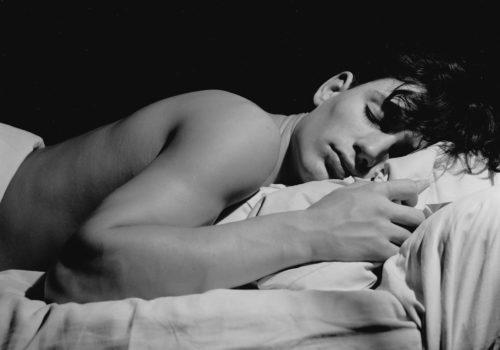
Galerie David Guiraud presents, until June 20, 2026, the exhibition “Raymond Voinquel – The Body in Secret,” which reveals a lesser-known aspect of the work of French photographer Raymond Voinquel (1912–1994).
Usually admired for his set photography and his portraits of major figures in theatre and cinema, Voinquel also explored the male body with a sensitivity that was rare for his time.
Created in the mid-20th century, these photographs of male nudes reflect a vision that is both classical and profoundly modern. Inspired by antique sculpture, dance, and theatrical aesthetics, Voinquel stages the body with sculptural precision and controlled lighting that reveals the tension of muscles, the purity of lines, and the elegance of movement.
Long kept confidential, these images now form an exceptional body of work in the history of French photography. At a time when representations of the male nude were rare and often marginal, Voinquel was one of the few photographers in the world to develop an aesthetic, sensitive, and deeply artistic body of work centered on the human form.
This exhibition presents around twenty rare works, difficult to assemble, as the artist did not make this work publicly available and produced prints very sparingly. The gallery is exhibiting vintage prints from the 1930s and 1940s, featuring Louis Jourdan, Jean Marais, and Jacques Sernas as models, as well as later prints in 30 × 40 cm and others signed in 50 × 60 cm, specially produced for his only exhibition in the United States.
Raymond Voinquel (1912–1994)
Raymond Georges Voinquel was a French photographer, born on January 11, 1912, in Fraize (Vosges), and died on July 15, 1994, in Paris.
He is best known as a set photographer—that is, he photographed film shoots as well as actors and actresses, particularly for promotional and cinematic documentation purposes. Over the course of his career, he worked on around 160 films, collaborating with major directors such as Marcel Carné, Jean Cocteau, Max Ophüls, Jean-Pierre Melville, and Luis Buñuel.
He also worked with Studio Harcourt between 1940 and 1944, where he created striking portraits of cinema figures. Among his photographs are famous portraits of artists such as Audrey Hepburn, Gérard Philipe, Édith Piaf, Jean Gabin, Jean-Paul Belmondo, and many other iconic actors and actresses of French cinema.
In addition to his set photography and celebrity portraits, Voinquel also explored male nude photography. He further produced documentary series, travel and landscape photography, and contributed to the illustration of literary works.
Raymond Voinquel and the Male Nude in the History of Photography
In the 20th century, the representation of the male nude in photography gradually moved beyond academic or athletic contexts to become a true field of aesthetic and cultural experimentation. In a social climate where homosexuality remained largely marginalized, several photographers explored the male body as a space of artistic freedom and sensitive expression. Through the staging of the male form, these artists developed an aesthetic in which classical heritage, formal modernity, and erotic subtext intertwine. The male nude thus became both a reference to the antique ideal and a ground for exploring an intimate gaze.
In France, Laure Albin Guillot developed, as early as the 1930s, a refined and modernist photography in which the human body appears as a pure form. Her work on the male nude remains relatively rare but reveals a particular attention to texture, light, and the stylization of the body.
At the same time, in the United States, George Platt Lynes produced some of the most daring images of the male nude of the 20th century. His photographs, often created in private settings, explore an aesthetic that is both theatrical and sensual. The play of shadow, the dramatization of poses, and the stylization of the body are central elements of his work.
In Europe, Herbert List developed, in the 1930s and 1940s, a vision deeply marked by the classical ideal. Inspired by antique sculpture and Mediterranean landscapes, he photographed young men in pared-down compositions in which the body becomes an architectural element of the landscape.
The work of Raymond Voinquel fits within this international context while maintaining a distinctive singularity. Unlike George Platt Lynes, whose work often embraces a dramatic and erotic dimension, Voinquel favored a more restrained and sculptural approach. His use of light is handled with great precision, highlighting the plastic construction of the body.
In some respects, his vision is close to that of Herbert List: the same attention to the purity of lines and the same fascination with the legacy of classical statuary. Yet Voinquel retains a more intimate and less mythological approach.
These photographs, rare within his body of work, reveal a lesser-known facet of his practice. They testify to a demanding aesthetic pursuit in which the male body becomes at once a subject of study, an artistic form, and a sculptural presence.
Raymond Voinquel : The Body in Secret
Until June 20, 2026
Galerie David Guiraud
5, rue du Perche
75003 Paris
+33 (0)1 42 71 78 62
www.galerie-david-guiraud.com