‘Triumphant Flood’: Saintes under water, the poetry of the river and the climate crisis
A current event
In February 2026, the Charente burst its banks. In Saintes, the quays disappeared beneath the water, the roads gave way, and the gardens faded into an ethereal atmosphere that seemed to rise from the river itself. The town awoke to a shifting mirror on the horizon, reflecting facades, trees and bridges, as if the landscape were wavering between wakefulness and dream.
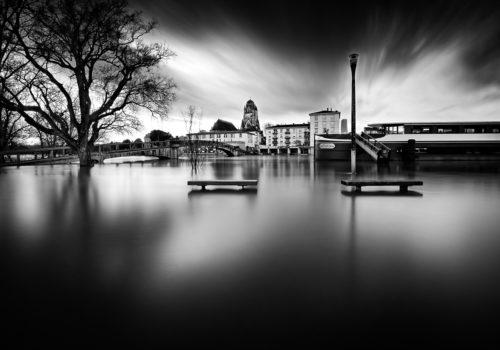
A few months later, one of these images, entitled ‘Triumphant Flood’, crosses borders. In it, Saintes appears as a stone island floating on a lake. This photograph, born from a flood experienced from within, has just won three First Prizes at the 2026 London Photography Awards, in the categories of historic architecture, fine art architecture and black and white. International recognition for a deeply local scene: a small town in the Charente captured just as the water is overflowing its banks.
But behind the awards, this photograph is merely the gateway to a wider series dedicated to the floods in Saintes; a project spanning several years and several floods, where visual poetry does not seek to make us forget our climate concerns, but to make them tangible.
Experiencing the flood from the inside
I live in a flood-prone area. When the Charente overflows, it is not a distant event observed on a screen; it is daily life that shifts, journeys that become more complicated, water levels we monitor, sandbags we line up, sandbags that pile up. The flood is not merely a spectacle: it is a rhythm imposed upon time, a state of prolonged vigilance.
On flood days, the river lays down the law. At night, we watch for warning messages; in the morning, we open the shutters with a silent apprehension. And yet, amidst this tension, there are moments of almost unreal suspension: the city plunged into a strange stillness, voices muffled, reflections taking over the space. The water transforms the space, the mist softens the contours, and familiar landmarks begin to float.
It is in this liminal space that the desire to photograph arises. At a certain point, the gaze shifts: we no longer see only what needs to be protected or circumvented, but also what is revealed. We begin to seek out the lines, the masses, the silence. Photography does not come from a detached vantage point; it comes from a prolonged coexistence with the river, from a forced intimacy with its overflowing waters.
Creating the series ‘Floods in Saintes’
‘Inondation Triomphante’ is one of the images capturing this coexistence, but the series goes far beyond a single panorama. Through the Charente’s repeated flooding, I have created a body of photographs that seek to give form to this metamorphosis of the landscape. Some images are aerial views: the town, as if set upon a stone plinth, surrounded by a mantle of water; the river’s bend tracing an arabesque around the neighbourhoods; trees from which only the tops emerge, like dark punctuation marks in a blank sentence.
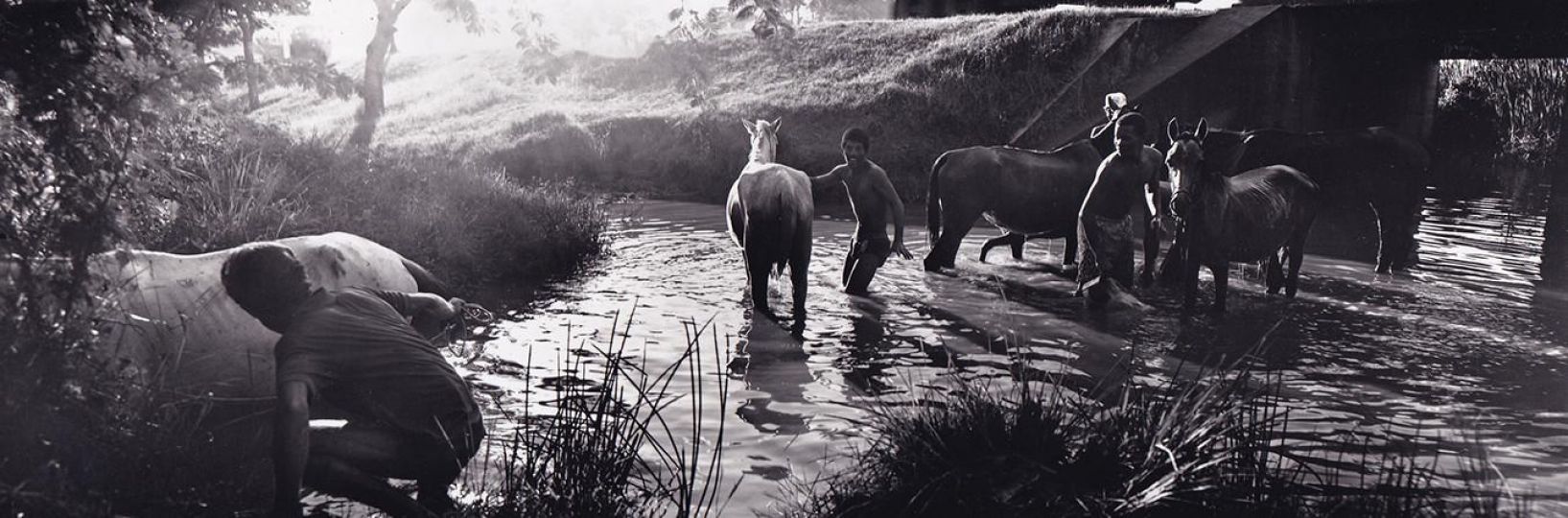
Other images are closer, almost intimate: a flooded road lost in the mist, a grove submerged up to its trunks, a low stone wall whose outline can barely be made out beneath the surface. Bridges become fragile footbridges, the riverbanks fade away, and the old façades are reflected as shimmering doubles in the brown water. The historic city engages in a dialogue with its own mirage.
Black and white was the obvious choice for part of this work: it allows the key lines to emerge, simplifying reality to extract a sort of luminous skeleton. I sought a visual style in which the flood is neither overly dramatised nor reduced to a mere picturesque backdrop. The aim is to turn it into a temporary architecture: that of a city redrawn by the river.
The poetics of water: between beauty and unease
Photographing floods raises a simple yet unsettling question: do we have the right to find this beautiful? The water covering everything, the ethereal atmosphere unifying the scenes, the reflections that mirror the world—all contribute to an almost dreamlike aesthetic. And yet, behind every image, there are cut-off roads, flooded homes, very real concerns.
I embrace this ambivalence. For me, photography’s role is not to choose between beauty and anxiety; it allows them to coexist within the same image. The city invites admiration as a floating vision, and at the same time, the viewer is fully aware of what this means for those who live there. It is by accepting this paradox that we can, I believe, capture something true.
In these images, water is not merely a threat; it is also a revealer. It emphasises the contours of the land, it reveals the low-lying areas, it maps out the invisible vulnerabilities. The ethereal atmosphere, partly created by the long exposure, softens the landscape, rendering it mysterious yet more legible in its broad strokes. I try to allow the river the possibility of being both gentle and powerful, as if each photograph were a sentence in which the water whispers its own grammar.
From Saintes to the Atlantic: climate and landscapes
The floods in Saintes are not an isolated incident. They are part of a period in which extreme weather events are becoming more frequent and climatic norms are gradually shifting. My work on the Charente echoes another series I am developing on the Atlantic coast, focusing on marine inundation and coastal erosion. Here, the river overflows; there, it is the ocean eating away at the dunes.
Seen in this broader perspective, the ‘floods in Saintes’ become a chapter in an ongoing narrative: that of the Charente region transforming under the influence of the climate. The flooded riverbanks, the submerged roads, and the villages lying below the river interact with dykes, marshes, and threatened coastlines. Everywhere, the same question arises: how do we inhabit a landscape that is changing faster than our memory?
This extensive body of work, which I group under titles such as ‘Aqua Arena’ or ‘Brèche de Téthys’, seeks to explore the many faces of water: a protective fluid, a gentle horizon, but also a force of submersion. The floods of Saintes are the most intimate version of this, the closest to my daily life. It is through them that the climate ceases to be a statistical curve and becomes a lived experience, a photographic motif, a poetic narrative.
Career and international recognition
The award won by ‘Inondation Triomphante’ at the London Photography Awards did not come out of the blue. Since 2022, my work on the landscapes of the Charente, the mists, the architecture and the waters has been recognised with numerous international awards, including several first prizes and a title of Photographer of the Year. My local roots—in the river, the town, the ocean—do not prevent the images from travelling; on the contrary, it is often their deep connection to the land that gives them universal appeal.
The three First Prizes won in London for a photograph taken during the floods in Saintes have a special significance. They confirm that one can start from a specific place, a very real event, and place it within a broader conversation about how we see the world. They also remind us that a medium-sized town, a river that appears calm, can become the setting for powerful images, capable of moving juries thousands of kilometres away.
I take this recognition as an encouragement to continue a long-term project: to patiently observe the same river, the same town, the same banks, and to accept that what changes—the light, the water, the weather—is at the heart of the story.
Looking further
Looking back today at these photographs of the floods is like returning to those days when Saintes seemed to float in a state of suspended time. The water was carving out new boundaries, and the town presented a face we had not chosen, but which we had to face head-on. In that particular silence of flood days, each image appeared like a note on the river’s stave.
The photographs gathered here do not claim to explain the climate, nor to resolve the issue of flood-prone areas. They offer another path: that of a poetry of rising waters, where we attempt to capture within the same frame both the beauty of the landscape and the fragility of our lives within it. Perhaps, in a few years’ time, these images will also serve as records of a bygone era. For now, they are a logbook: that of a town in the Charente region learning to look at itself in the shifting mirror of its river.