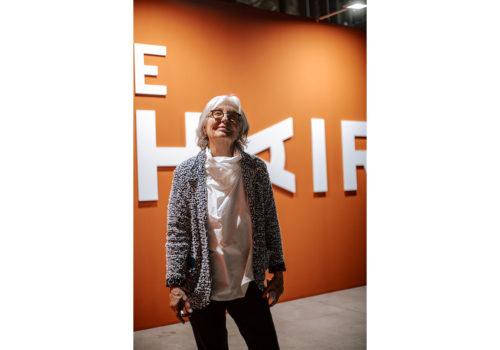
I was introduced to Paola Rampini by gallerist Benjamin Jaeger, who has been part of The Phair since the beginning. That first conversation made me want to dig deeper into the fair, what sets it apart, and the remarkable career behind it. Enjoy the read.
Nadine Dinter: In 2019 you co-founded The Phair, blending photography with a contemporary art fair format. What inspired its creation, and what’s the concept at its core?
Paola Rampini: The Phair was launched in 2019 in Turin, within a very particular context: a city that, as a whole, has made a clear and concrete commitment to investing in photography. This vocation dates back to the early 19th century and has steadily evolved over time, gaining further strength in recent years with the establishment of major institutions such as CAMERA – Centro Italiano per la Fotografia and the Turin branch of Gallerie d’Italia. As a result, the city has built a system capable of using photography as a lens through which to interpret contemporary reality, positioning it not only as a documentary tool but as a central language within contemporary art. It is within this framework that The Phair was conceived, with the aim of creating a meeting point between “Photography” and “Fair,” and of pushing beyond the traditional boundaries of the medium. The project reflects a shared vision, across political, cultural and institutional spheres, which has further expanded since 2024 with the launch of EXPOSED – Torino Photo Festival. Today, throughout the month of May, Turin’s leading museums and cultural institutions present exhibitions and initiatives dedicated to the image, forming a rich and layered program for audiences. The Phair | Photo Art Fair is an integral part of this ecosystem: we select leading contemporary art galleries, not necessarily photography specialists, but those able to present projects grounded in image-making, video and lens-based media, contributing to a broader and more contemporary understanding of the medium.
Before The Phair, you and Roberto Casiraghi founded Artissima in Turin. What makes the city such a vital hub for art and photography?
PR: Roberto Casiraghi and I founded Artissima in 1994, which today stands as one of the leading international fairs for contemporary art. Turin’s importance is deeply rooted in its history and a distinctive cultural ecosystem. It is the birthplace of Arte Povera, one of the most influential movements of the late 20th century, which redefined artistic language through the use of everyday materials and natural processes. Among its key figures are Giovanni Anselmo, Gilberto Zorio, Alighiero Boetti, Michelangelo Pistoletto and Giulio Paolini – who will also be featured at the fair this year. Turin is also home to Italy’s first museum dedicated to contemporary art, Castello di Rivoli, alongside major institutions that have developed over time, such as Fondazione Sandretto Re Rebaudengo and Fondazione Merz. Thanks to sustained investment, the city has become a true international capital of contemporary art. Within this context, photography – understood as one of its key languages – has, in recent years, found particularly fertile ground on which to grow: Turin is the only city in Italy with two institutions dedicated to photography (Gallerie d’Italia Torino and CAMERA – Centro per la Fotografia).
Throughout May, Turin transforms into a photography capital with numerous must-see exhibitions. Could you highlight some key shows or institutional programs happing across the city this season?
PR: May is increasingly becoming the month of photography in Turin, not least because of EXPOSED – Torino Photo Festival. All the city’s leading cultural institutions offer programs dedicated to the image: from CAMERA – Centro Italiano per la Fotografia to Gallerie d’Italia – Torino, from Pinacoteca Agnelli to Fondazione Sandretto Re Rebaudengo, as well as Fondazione Merz and GAM – Galleria Civica d’Arte Moderna e Contemporanea. Within this vibrant context, The Phair, hosted at OGR Torino, plays a key role in shaping a rich and complementary cultural program. Together, these initiatives are reinforcing Turin’s identity as an international hub for contemporary image-making, grounded in research and strong curatorial vision.
How does The Phair integrate with Turin’s broader cultural landscape? What is your mission regarding public engagement, and how do you put that into practice?
PR: The Phair is part of a wider cultural program and is in constant dialogue with local institutions. Photography is an immediate and accessible language: one that everyone instinctively understands. We work closely with cultural partners to ensure that the fair is deeply woven into the city’s DNA. Our mission is to create an experience that extends beyond the exhibition format, becoming a truly expansive cultural platform. In this respect, our Talk Program, curated by Brandei Estes and Benjamin & Steffi Jaeger, plays a central role: we host leading international figures, from institution directors and curators to artists and collectors, creating opportunities for meaningful exchange and in-depth discussion. Over the years, we have collaborated with organizations such as the Victoria & Albert Museum, Prix Pictet and the Helmut Newton Foundation, alongside prominent figures from across the global art scene. This is complemented by guided tours, public talks, and a curated program of events, as well as an exclusive VIP program, all contributing to attracting an increasingly international audience.
This year’s key visual is Nanda Lanfranco’s portrait of Giuseppe Penone at the famous Castello di Rivoli. What makes this image particularly meaningful, and why was it chosen to represent The Phair’s 2026 edition?
PR: Each year, we select our key image in collaboration with one of Turin’s leading cultural institutions, underlining the strong connection between The Phair and the local ecosystem. In the previous edition, for instance, the visual identity was based on a work by Mario Gabinio from the GAM collection. This year, we have chosen a photograph by Nanda Lanfranco depicting Giuseppe Penone in 1991 at Castello di Rivoli Museo d’Arte Contemporanea. The work, now part of the Nanda Lanfranco Archive established in 2025 by the CRRI – Centro di Ricerca Castello di Rivoli, is kindly loaned by the museum. It is an image poised between the physical and the conceptual, a threshold between reality and vision. It perfectly encapsulates our understanding of photography as a medium capable of moving through reality and reinterpreting it as art. It is, ultimately, a tribute to the artist, the place and the power of photographic vision.
Looking at this year’s line-up, are there any presentations, artists, or galleries you’re particularly excited about?
PR: Among the most significant presences are the works of Giulio Paolini, presented by Tucci Russo gallery, which perfectly embody what The Phair seeks to promote: a form of contemporary art in which photography is integral to the language itself. We are also particularly pleased to feature internationally renowned artists such as Nick Brandt, whose work – presented by Willas Contemporary and centered on environmental fragility – resonates powerfully with the major exhibition Nick Brandt. The Day May Break dedicated to him at Gallerie d’Italia – Torino, curated by Arianna Rinaldo. Another meaningful example of this growing synergy is Toni Thorimbert, who is featured in the city as part of EXPOSED with a show at CAMERA, and at the fair through Galleria Valeria Bella. Alongside established names, we place great emphasis on emerging artists, firmly believing that scouting and discovery are essential to maintaining a dynamic and forward-looking curatorial vision.
You share the directorship with Roberto Casiraghi. How do you two structure your collaboration and divide responsibilities?
PR: Roberto Casiraghi and I have worked together for over 30 years: first with Artissima (1994) and now with The Others (2011), and The Phair (2019). Our collaboration is built on deep and natural alignment, without rigid role divisions. We work in a highly flexible way, united by a shared vision. Broadly speaking, Roberto focuses more closely on relationships with galleries, while I oversee strategy and coordination, although we are constantly in dialogue and support each other across all areas. Gallery selection is entrusted to an international curatorial board, and the project is made possible by a highly skilled team, whose contribution is essential to its success (Viola Giannerini – Event Manager; Ilaria Garofano – Exhibitors Relations; Myra Geraldine Meterangelo – VIP & Press Relations; Cecilia Sacerdoni – Hospitality & Public Program; Giorgia Maninchedda – Organizing Secretariat).
Reflecting on The Phair’s launch, what are the biggest challenges in establishing a new fair with this specific focus?
PR: The first challenge was to build a strong and distinctive identity. We opted for a curated and uniform format, each booth measuring 24 square meters, prioritizing quality over quantity. Another key challenge, which remains ongoing, has been convincing contemporary art galleries to take part in a thematic fair dedicated to photography. Today, this has become one of The Phair’s defining strengths. Finally, within an increasingly crowded international landscape, it has been crucial to carve out our own space and establish solid international visibility.
How would you describe The Phair in 1 word?
PR: Elegant. I don’t think anything else needs to be added.
When it comes to photography, who’s your all-time favorite artist?
PR: Gerhard Richter best represents the idea of photography that we promote at The Phair.
He is an extraordinarily versatile artist, capable of moving across different languages and styles, from abstract to figurative painting, from straight photography to overpainted photographs. At his best, he embodies the philosophy of The Phair – which is not limited to photographers, but focused on photography as a means of artistic expression. Alongside him, I have great admiration for photographers such as Thomas Ruff and Candida Höfer, masters of photography whose work is defined by rigorous, innovative visual inquiry.
At the same time, I’m drawn to a lineage of visionaries ranging from Shirin Neshat and Francesca Woodman to younger artists such as Bastian Woudt and Paulo Nazareth.
Save the Date:
THE PHAIR, 22 – 24 May 2026, 12 noon – 8 pm daily
@ OGR Torino (Sala Fucine), Corso Catelfidardo, 22 – Torino, Italy
More information at: https://www.thephair.com/en/homepage_en/