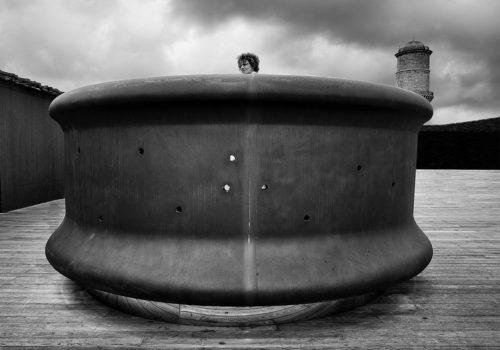
The gallery in the Berlin district of Mitte presents a retrospective of this major figure of German photography one of the founding members of the Ostkreuz agency with images made from 1994 to the present. An architecturally conceived artistic practice to be discovered until the end of the month.
“So, what have we got here?” : the atmosphere is unsettling, the tones worn and weathered… Like a detective, the photographer, born in 1955 and originally from Dresden, produces archival images through an invariable process. Working with a large-format camera, he creates monumental prints of such pronounced detail and such tangible volume that one has the sensation of being able to walk through these spaces, searching for clues. Before embarking on this practice of bearing witness to the transformations of history-laden places, Harf Zimmermann worked as a reporter for major press titles including Stern, Geo, the New York Times Magazine and The New Yorker, and already working on the margins of his assignments was photographing empty places that nonetheless carry the souls of those who had passed through them. For a few minutes or for decades. And so we traverse sites located predominantly in Germany, while also passing through Italy, New York, India and Mozambique.
Harf Zimmermann takes us, for example, into the former Singer factories in Wittenberge, which produced sewing machines for much of the Eastern Bloc, or into the former temple of techno, the E-Werk. Housed in a former electrical substation built in the late 1920s, this venue was one of the emblematic clubs of the 1990s, before closing its doors and becoming an events space today. In these abandoned places, traces of life are perceptible: torn pin-up images from magazines still clinging more or less to the walls… Surfaces that reveal genuine compositions made of layers that time simultaneously erases and exposes. And therein lies the power of the result: this capacity that these spaces have to tell stories. To tell the life of the worker who lived there, in the basement of the factory, or that of a Berlin night that no longer exists.
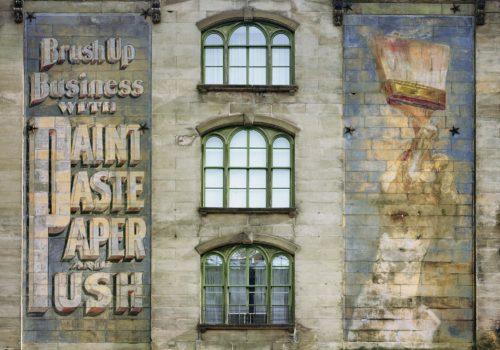
In Berlin, the photographer developed a fascination for firewall party walls (Brandwände). During the Second World War, as Berlin was subjected to massive Allied destruction, some of these shared walls originally designed to limit the spread of fire between buildings held firm while the structures around them collapsed. While some can still be seen today, their fate is generally one of demolition. Here again, these surfaces appear layered, like cliffs eroded by time. And here and there, nature reasserts itself, lending the photographs a romantic quality. Some images even stem from a never-published assignment from the 2000s that sought to juxtapose Nazi-era Berlin with the present: walls sculpted by bullet impacts gaze upon the illuminated buildings of the famous Alexanderplatz.
Zimmermann always has a precise idea of how he wishes to capture these volumes; he studies the movement of the sun, the mood of the sky. Graffiti, advertising hoardings, textures and details allow the multiple lives of these buildings destined to be replaced to be guessed at. These images archive what they were and what they may never be again. This is how we discover Germany’s industrial past, its ever-changing capital and its neighbourhoods on the cusp of gentrification, such as Prenzlauer Berg.
And then the weight of nostalgia settles before these large prints reproduced here rather smaller than usual for lack of space. Among them, one particularly notices the cathedral in Mozambique that has none of the usual dimensions and yet exudes an equally solemn atmosphere, with magnificent paintings still clinging to the texture of the walls, looming over the ruins.
The exhibition concludes with murals created by German illustrator Lisa Marie Blum, photographed by Zimmermann in a bunker on Spandauer Damm in Berlin. Dating from the Second World War, these frescoes were intended to distract the children of families taking refuge there. Figures of children and castles appear alongside small wooden soldiers: scenes that invite reflection on what war does to childhood, then as now. Scattered through the city, these blockhouses survive, most now in private ownership and closed to the public.
On the impressive table running through the gallery, leporellos created by Harf Zimmermann especially for this exhibition are on display. Each accordion book is a unique piece, hand-bound, and will be auctioned on Saturday 27 June, under the hammer of Thilo Billmeier, the exhibition curator.
Noémie de Bellaigue
The exhibition So, What Have We Got Here? can be seen at Chaussee 36 until 27 June 2026.
Chaussee 36 Photography
Chausseestraße 36
10115 Berlin
https://www.chaussee36.photography