The Hypogea
Hartmannswillerkopf, Buchenkopf, Sudelkopf for some, Vieil Armand, Tête des Faux, or Sudel for others—all place names unknown to the general public, except for a handful of specialists, enthusiasts, or local residents.
We are located in the tragic setting of the First World War, in the Vosges mountains, which I explored for several years, equipped with my photographic equipment, flashlights, and a caving companion.
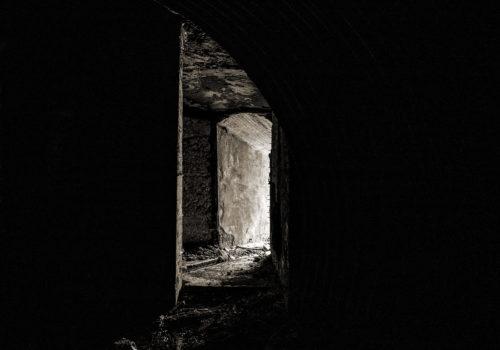
We ventured into the accessible gaps we encountered along our paths during our numerous outings, searching for passages between the rubble of partially collapsed tunnels. From the underground exploration of these bowels of the Great War, I wanted to construct a narrative and appropriate these ruins through an aesthetic and memorial prism, creating a series of photographs in absolute silence and darkness, seeking to reveal spaces that are at first glance unfathomable while ensuring ample room for interpretation and imagination.
Hypogeum (n. m.): this is an underground construction in the broadest sense; in archaeology, it refers to underground burials.
Life has long since deserted these little-known sanctuaries, giving them an atmosphere shrouded in a disturbing serenity. Most of the remains, fortresses built at the dawn of the conflict, evoke a gradual erasure of memory and the conflicting tensions between Man and Nature. The destinies of these structures, of nature, and of architecture as a human intervention, thus converge in a representation characterized by a certain plastic unity: ruin. Thus, erosion, corrosion, oxidation, burial—the passage of time, in short—lead this architecture to its disappearance, its slow and gradual sedimentation, and ultimately oblivion.
Notes
The Hypogea draws on the ghosts of Edward Grieg (Peer Gynt and the Mountain King), Julien Gracq (A Forest Balcony, The Peninsula), Richard Wagner (The Nibelungen), and J. R. R. Tolkien (Moria and the Kingdom of the Dwarves), among other sources of inspiration.
The series was created using the technique known as “lightpainting,” using two independent light sources, without the use of any kind of AI. Finally, the reflections on ruins and memory were partly inspired by Mr. Bouchier’s article in the journal Frontières, vol. 28, 2016, Urban ruins: memory, explorations, representations.