Pierre-Elie de Pibrac never approaches a country as a backdrop. Over the past several years, his work has been built at the intersection of anthropological inquiry and a photography inhabited by human stories. Brought together here, the series Hakanai Sonzai, Mono no Aware and Desmemoria trace a sensitive geography of modern fragilities, from Japan to Cuba.
The title Hakanai Sonzai could alone summarise the entire approach. In Japanese, the expression means “I feel myself to be an ephemeral creature”. A phrase that speaks to the awareness of impermanence at the heart of Japanese culture. Between December 2019 and August 2020, the photographer travelled the archipelago for eight months, accompanied by his wife Olivia, with whom he conceives his projects, and their children. From Kyoto to Yakushima Island, and to the foot of Mount Fuji, he conducted a lengthy investigation into those who live on the margins of social norms.
Marked by the Fukushima nuclear disaster, the country leaves little room for the expression of personal struggles. The photographer set out to meet figures that society tends to render invisible. Hikikomori recluses who have shut themselves in their rooms for sometimes years on end, “evaporated” people who have chosen to vanish voluntarily, former yakuza, students who have fallen victim to ijime (school bullying), and survivors of Fukushima.
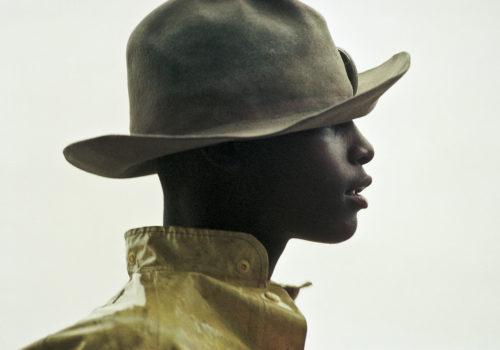
Even before the encounter, Pierre-Elie de Pibrac has already initiated a dialogue with his future “subjects” by sending them blank notebooks to fill in and disposable cameras. When the moment of the portrait arrives — taken with a large-format camera, and thus counter to reportage — the image is born from an exchange and a trust that is not easily gained in Japan. In these portraits with their soft colours, bathed in natural light, a shared question surfaces: how to find one’s place in a world where individuals seem constantly compelled to blend in obediently.
The photographer describes his approach: “What is important to see in my images is not necessarily my message — and that is why I do not use exhibition labels — it is so that you can project a relationship with the people photographed. For me, colour is life; and through that life, you can enter into a relationship. Also, what will allow you to look more carefully is the support, the presentation. The reality of the paper gives meaning, and it is through that meaning that you will be able to see better.”
As a counterpoint to the large colour portraits, Mono no Aware brings together landscapes and still lifes in black and white. Waterfalls, dark ponds, unsettling undergrowth, abandoned architecture and impenetrable forests compose a body of work in which beauty is constantly tinged with a diffuse threat. Inspired by the aesthetics of ukiyo-e, the celebrated Japanese woodblock prints, these images are printed on handmade mulberry paper specially produced for the occasion. Each print reveals silvery nuances and gradients that reinforce the impression of an apparition from another age. The landscape becomes a metaphor for a human condition subject to the erosion of time.
At the Chapelle des Cordeliers, the exhibition Desmemoria extends this exploration of fragile worlds. After Japan, Pierre-Elie de Pibrac turns to Cuba, where he spent eight months between 2016 and 2017. His subject: the sugar industry, long the economic backbone of the island. “Sugar is the blood of Cuba,” as the saying goes; it is also its memory. The collapse of the Soviet bloc and the closure of more than 70% of Cuba’s sugar mills in the early 2000s profoundly transformed the country. Pierre-Elie de Pibrac meets the azucareros, sugar workers whose trades are slowly disappearing. As in Japan, he favours duration, listening and relationship. The portraits, always in large format, reveal far more than a dying profession — they tell of the gradual erasure of an entire world. Through the faces, gestures and living spaces of these men and women, the photographer captures the traces left by the great upheavals of History on these ordinary yet precious lives.
Jean-Jacques Ader
Exhibitions in Toulouse: “Hakanai sonzai” at the Château d’Eau (gallery 2) from June 5 to August 30, and “Desmemoria” at the Chapelle des Cordeliers from June 5 to July 5, 2026.
Info https://chateaudeau.toulouse.fr/