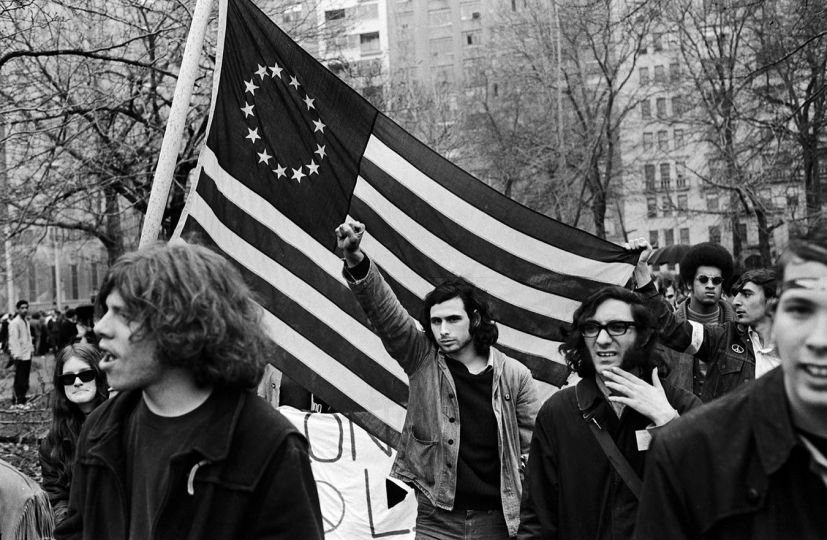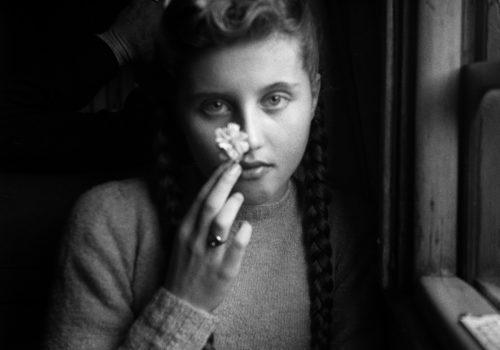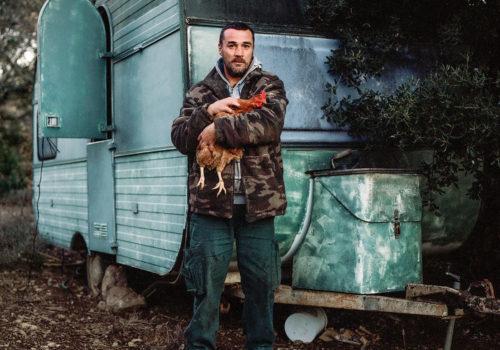
The name Holger Herschel (1959) may not ring a bell, but it should. Apart from sharing his name with one of the founders of photography, he also has a lot in common with Lewis Hine. Like Hine, he has a background in sociology, and he uses his camera as a means of documenting and arguing for social change. After a brief academic career, he worked as a photographer at the Maxim Gorki Theatre in Berlin, and in 1992 Holger Herschel became a freelance photographer.
The fall of the Berlin Wall, known as the Wende/Umbruch (Turning point/upheaval) in 1989, did not bring the promised land to former East Germany. On the contrary, uncertainty, closures, part-time work and unemployment became the new social reality. This led to a long transition, which is also reflected in the language used. In the West, the term Wende is commonly used, emphasising a turning point. In the East, Umbruch emphasises the radical and abrupt nature of the process. It is not only a difference in perception, but also in how people experience the (unfinished?) transition.
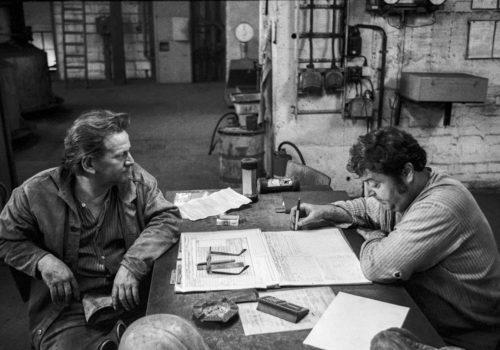
Eastern Germany was highly industrialised – at the company near Schwarze Pumpe, one of the subjects of Holger’s documentaries, 14,000 people worked at the world’s largest lignite processing site. It was part of an industrial complex where the planned economy employed more than 70,000 people and where a new city was created (Hoyerswerda-Neustadt). The second series, Altes Eisen, focuses on GISAG, a company with more than 30,000 employees specialising in plant engineering and castings. In the wake of the Wende, Holger Herschel photographs the change: street scenes, portraits marked by reality and alienating landscapes.
Last year, a voluminous publication devoted to 12 photo series by Herschel was published, entitled “Vergessene Zukunft” (Forgotten Future). Each series is accompanied by an essay. Broadly speaking, the subjects can be divided into two main groups. The emphasis is on the direct consequences of unification in the period 1990-1993. Schwarze Pumpe & Altes Eisen deal with working conditions in companies after 1989, while Hoyerswerda-Neustadt & Wohnkultur focus on housing and living conditions. In Grosses Kino, he shows the façades of cinemas in former East Berlin, and in Denkmale, he explores the culture of remembrance of the GDR regime.
Mainzer Straße (Berlin-Friedrichshain) deals with the eviction of squatters who had occupied homes there in 1990 and resisted the police with force. An eviction with wider consequences: it also marked the end of the city council in Berlin at the time.
A second series of documentaries highlights the transition in the period after the Wende/Umbruch: Sophiensäle (2006) about the establishment of the now famous theatre and arts centre in Berlin Mitte, Dong Xuan about an empty factory that becomes the economical, trade and cultural centre for the Vietnamese community in Berlin (2006) and finally Kietzer Wende from 2022-23, which focuses on a community in a village just across the border in Poland.
A fine “classic” edition, offered at a very accessible price. However, one important note: the texts are exclusively in German, without translation into French or English, which makes the content considerably less accessible.
On the other hand, many of the images are now being shown to the public for the very first time in over 30 years. There are also clear parallels with contemporary developments: today, too, people have to adapt to rapid changes in the social, economic, political and geopolitical spheres. Today, too, uncertainty is taking hold of the population. And as the photographer expresses himself:
‘I hope to contribute a little to understanding this era, to understanding it at the time, but also to understanding it today. And that there is also hope and a chance that we will finally manage to master all this.’
Vergessene Zukunft / A Forgotten Future’
Bilder vom ostdeutschen Umbruch / Images of Upheaval in East Germany
J. Danyel & H. Herschel
Ch. Links Verlag
978-3-96289-233-3
Hardcover, 288 pages, Published 13/08/2025
German
€28
Holger HERSCHEL
Forgotten Future
Berlin Brussels Art Projects (BBAP) – Marie-Thérèse Huppertz
Rivoli #43 – chaussée de Waterloo 690 – 1180 Brussels
www.bbap.art – [email protected]
11 January – 28 February 2026
Thursday – Saturday, 2pm – 6pm
https://holgerherschel.de
This exhibition is also part of PhotoBrussels – so do have a look at the others:
Michèle Schoonjans Gallery Beyond the Horizon – Scarlett Hooft Graafland 11 Jan. > 28 Feb. 2026
Entry Gallery Den Silencio – Jaïr Marc Castillo 11 Jan. > 28 Feb. 2026
Vue Gallery Maman est là – Julie Scheurweghs 11 Jan. > 28 Feb. 2026
Zwart Huis How the Light Gets In – Peter H.Waterschoot et Stefan Peters 11 Jan. > 28 Feb. 2026
In-DEPENDANCE / Ibasho Land – Bodyscapes – Group Show 15 Jan. > 07 Mar. 2026
Studio Baxton Dolorès Marat 21 Jan. > 8 Mar. 2026
Galerie Eric Mouchet Leather and S&M Underground – Robert Mapplethorpe 22 Jan. > 14 Mar. 2026
L’Enfant Sauvage CAT ISLAND BLUES – Katherine Longly 16 Jan. > 15 Mar. 2026
Spazio Nobile Panoramic, 15 years of Art Photography – Frederik Vercruysse 22 Jan. > 15 Mar. 2026
Contretype Earth Not a Globe – Philippe Braquenier 15 Jan. > 29 Mar. 2026
Fondation A Stichting RePose ExPose CounterPose – Tarrah Krajnak 22 Jan. > 17 May 2026
Hangar The House – The Anonymous project by Lee Shulman & Family Stories – Group Show 23 Jan. > 17 May 2026
John DevosJohndevos.photo (ad) gmail.com