Features of a featureless landscape
The primary characteristic of the rural Wyoming landscape initially appears to be absence.
Here you can crest a hill and look around to see what looks like an unfamiliar planet — identical and treeless rounded hills, stretching in all directions to the horizon, under an enormous empty sky. For 34 million years, all of this was thousands of feet below the surface of an inland sea.
I questioned at first how to make sense — let alone make a good picture — of an environment in which emptiness seems to dominate.
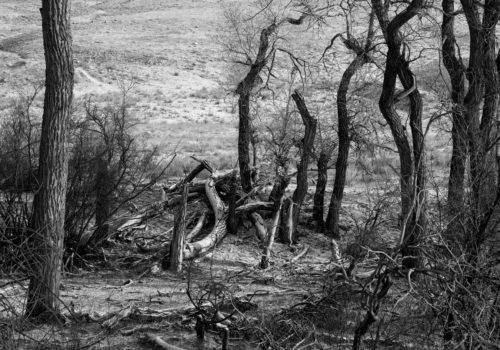
But life is reassuringly abundant in the creeks and gullies that wind around and below these hills, where two species of tree predominate: the plains cottonwood (populus sargentii) and the peach-leaf willow (Salix amygdaloides). The two trees, closely related and commonly found together, are wonderfully different from the more predictably vertical trees native to the northeastern US where I’ve lived most of my life. I’m drawn to them for their weird deformations and lack of artifice and their ability to thrive in an unforgiving ecosystem.
This landscape reminds me of the insignificance of our human experience compared with the billions of geological years that brought us to this point, and the resilience of plants and animals eking out their existence here.
In a word, the Wyoming landscape evokes awe. With awe is, for me, the proper way to observe the world and to try to photograph it. I typically fall short in both respects, but not always. And it is always something to aspire to.