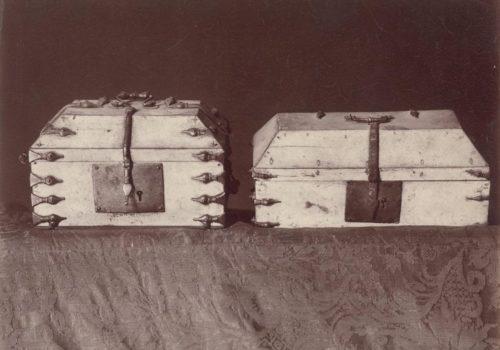
The 47th dialogue dialogue of the Collezione Ettore Molinario is a game of boxes – one inside the other, one beside the other – designed to reveal the connection between a masterpiece of 13th-century Arab-Norman art and one of Kiki Smith’s most iconic works.
It’s a story that unfolds between Palermo and New York, between the secrets of power and the power of those who know how to surrender to mystery.
Ettore Molinario
To mystery its contemplation, its fear, and therefore its desire we are drawn early in life. A box, deceitfully called a gift, wrapped in that innocence and lightness to which unaware adults expose the eyes of their heirs: this is where the obsession begins to take root, in both mind and body.
Every tightly sealed wrapping challenges the senses, and at the same time, every container, seemingly inaccessible, invites a deep breath.
Calm! – both divine and diabolical practice – for secrets are revealed gradually, with the pain of waiting and distance serving as their reward.
This is what gifts teach us, where the gift is above all the art of imagination: to rush in, tear the paper, force a lock: it’s madness. I was born restless, with a fire I had to learn to temper over the years. The proof? It took nearly thirty years for the image Kiki Smith created of her renowned sculpture Upside Down Body with Beads to find its companion – its elective and equally secret sister – in my collection.
The « encounter » took place just a few months ago in Palermo, in the Treasury of the Palatine Chapel, where an extraordinary collection of ivory boxes is kept, jewels of 13th-century Arab-Norman art, perhaps once containing other jewels. Giacomo Brogi, a Florentine, photographed them toward the end of the 19th century, a refined yet innocent souvenir of the Grand Tour. At first glance, the image is composed, quiet. And yet those pointed studs, like sharp claws clutching the box’s corners as if it were flesh, that iron lock – simple and brutal – and the ivory that recalls the whiteness of skin, reveal such more. These boxes are places of power, hidden and precious, just like our cranial vault: the inviolable chest of our secrets, urges, memories, which the body, both a physical and political reality, then sets in motion, processes, digests, expels.
Our body, precisely, is Kiki Smith’s kingdom. No other artist, in the New York struck by the AIDS epidemic, celebrated human fragility as she did: its fragmentary nature, its being life and illness at once. A structure of bones that supports and gives form, but also fluid: semen that fertilizes, infection that drains, excrement that completes the nutritional cycle. And our cranial box, faceless in Kiki Smith’s work, just like the caskets that once guarded the treasures of the Norman kings, from Roger I to Emperor Frederick II, to the last descendant, Queen Maria of Sicily, what history do they celebrate? They are a gift: hard to accept, but necessary in order to reach awareness and maturity. Someone offering you the certainty that not everything can be known or controlled – every event, every desire. Someone inviting you to respect the indecipherable, the uncontrollable, the formless, even within yourself. A king’s gift. An artist’s gift.
Ettore Molinario
DISCOVER THE COLLECTION DIALOGUES
https://collezionemolinario.com/en/dialogues