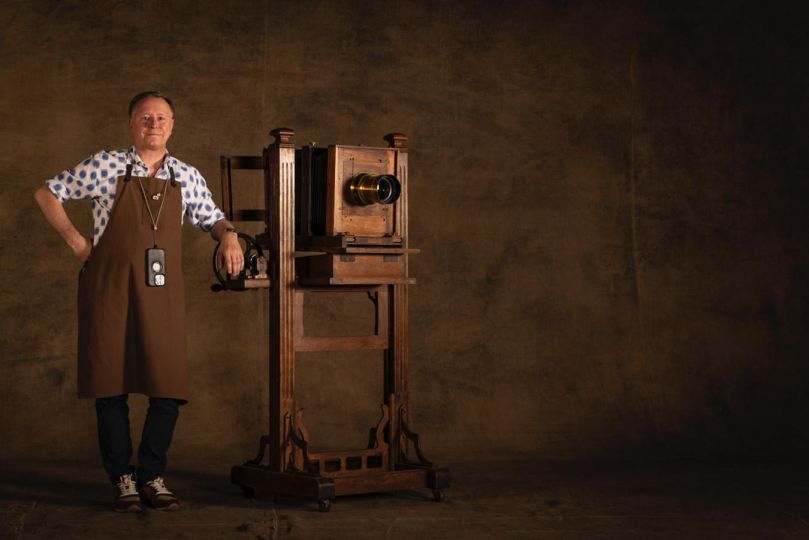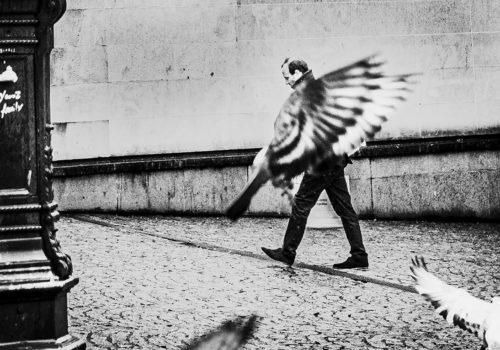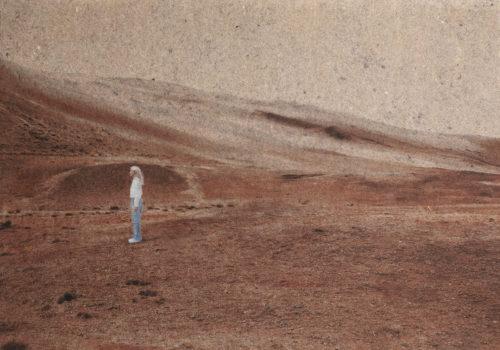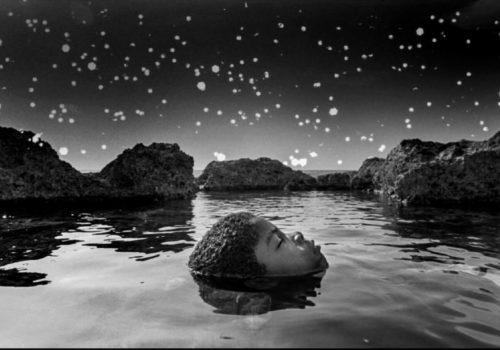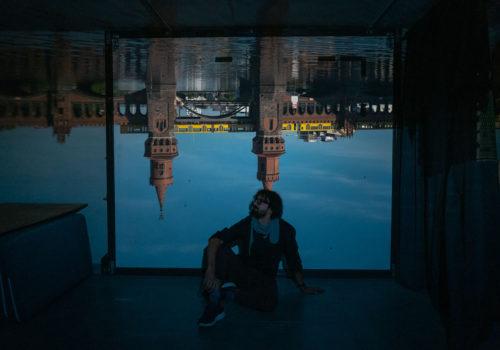
I met Maciej Markowicz in the summer of 2024 at Anne Clergue Galerie in Arles. The gallery was showing his unconventional, poetic Camera Obscura-based work, and I was instantly drawn to the question of how these images were created and who was behind them.
So, it’s my pleasure today to share more about Maciej’s inspirations, his way of working, and the ideas that drive him. Enjoy the read!
Nadine Dinter: Camera Obscura… how did the idea of working with this particular photographic method come about?
Maciej Markowicz : It came from confronting mortality and choosing to stop running through life. The camera obscura enforces that choice – you can’t hurry with it. That constraint became the point.
When I was a young boy, my Polish grandmother called me pędziwiatr – a roadrunner, always chasing, always moving, gone with the wind. But one day, I almost ran out of time. A sudden illness nearly took my life. Many doctors gave up, but one didn’t.
That early experience completely changed my perception of time. It made me obsessed with time’s passing – with the temporal qualities of life. I’m here now, but I might not be here tomorrow. This awareness doesn’t limit me; it awakens me. Every moment becomes precious. Every second of light becomes sacred.
Why the Camera Obscura specifically? Because for me, the Camera Obscura is not only a camera – it’s a sanctuary. A place where I can stop being the roadrunner and become present with light itself. Inside the darkened space, the world projects itself, inverted and pure. Did you know that for the first 10 weeks of life, a newborn baby sees the world upside down and mirrored, just like a camera obscura? Their brain hasn’t yet learned to flip the image. That raw, unfiltered gaze into the present moment is what I’m after.
The camera obscura returns me to that primordial perception. It’s a temple of light where I can be truly present in the moment and practice slowing time.
For years I was looking for ways to express what I felt about time, about light, about presence. I had been building camera obscuras and exposing directly on photo paper since 2007. Then one night in New York in 2012, riding the subway through a tunnel, the train lights went out for a few seconds and the light from the tunnel started flickering through the windows. I had a revelation: motion is time made visible. And all I needed was to set the camera obscura in motion.
At that time, after 15 years of searching for my place in art and photography’s vast landscape, I found it inside the moving camera obscura – not because of what it does, but because of what it reveals about being alive in time.
Your work harnesses a historical photographic method to capture almost otherworldly auras, infused with a contemporary, future-forward sensibility. Have you developed a specific term for your type of image-making?
MM : I call them “Motiongraphs.” These works capture time’s actual flowing nature – the continuous transformation that gets lost in our snapshot way of seeing. We think we see the world, but we’re usually distracted, rushing, planning the next thing. I sometimes feel my life became digitally possessed and digitally processed. Modern life makes it very hard to experience the present moment as it actually unfolds.
A Motiongraph is not a photograph of something. It’s a record of time itself dancing with light. It’s what happens when you slow down enough to join the universe’s own creative process.
Think about it: every photon in these images traveled 8 minutes from the Sun to reach Earth, traveled 93 million miles carrying the fundamental energy that powers all life. Then, for exactly 8 seconds, I allow that cosmic light to write its story on photographic paper. I’m not just making art – I’m collaborating with light and time to record their continuous unfolding.
Each work is unique because time never flows the same way twice. Heraclitus said “No one steps in the same river twice” – my floating Camera Obscura embodies that truth. I capture the river’s flowing, not just the river.
Why unique negatives rather than reproductions? Because uniqueness reflects life’s actual nature. This moment – right now – will never happen again. Each breath you take is unrepeatable. Each Motiongraph honors that truth. It’s not about scarcity for market value; it’s about honoring the singular nature of lived experience.
I’m interested in revealing time’s flow, light’s power, the power of slowing down enough to actually be present. The Camera Obscura is just my way of doing that.
You are currently using your floating Camera Obscura in Berlin on the Spree River to create images. How did the idea of working from a boat first arise?
MM : Water is a perfect metaphor for time.
The river flows relentlessly. It connects everything. It’s never the same from moment to moment, yet it maintains its essential nature. The river doesn’t resist its flowing – it embodies it.
When I live and work inside the floating Camera Obscura, I’m practicing a kind of meditation. The boat rocks gently. Light dances across water. The city slides past at 8 km/h. Inside the darkened space, I’m simultaneously moving and still: the paradox of the roadrunner who stopped running.
Why water specifically? Because I feel we’ve lost our connection to natural rhythms. We live in an acceleration-obsessed culture where everything must be faster, more efficient, more productive. The river doesn’t care about success or achievement. It just flows. Being on water pulls me into that rhythm – into what is real rather than what we construct.
The philosopher Henri Bergson distinguished between “clock time” (temps) and “lived duration” (durée). Clock time is what we measure. Lived duration is what we experience when we are fully present. The floating Camera Obscura gives me access to durée – to time as we actually live it, not time as we anxiously track it.
Inside the Camera Obscura boat, I’m practicing the therapy of slowing down time. This isn’t just metaphorical. Studies show that when we’re fully present, time literally expands. Eight seconds of complete attention contains more lived experience than hours of distracted rushing.
People sometimes ask about the technical details – how I built the boat, what materials I used. But that’s asking HOW. The real question is WHY. Why does an artist choose to live inside a floating darkroom?
Because being in the dark is like being inside my own mind. The black is the color of the subconscious. When I hang the photographic paper in darkness, when I count those 8 seconds of exposure, when I become part of the Camera Obscura itself – I’m practicing a kind of presence meditation. The boat carries me, and I become one with the machine, one with the water, one with light’s eternal performance, one with the unique moment of here and now.
The water is the relentless force that connects everything. Past flows into present flows into future. The river doesn’t segment time into discrete moments – it reveals time’s continuous nature.
In 2015, you launched the project Camera Obscura Van New York. Could you share some highlights from that period and how long the project ran?
MM : The van project was about searching for the American Dream while discovering what’s actually real.
I grew up in 1980s Poland dreaming about America – this mythical place of freedom and possibility. In 2010 I received a scholarship to the School of Visual Arts (SVA), and in 2012, I set out in a converted van-turned-Camera-Obscura, chasing that dream through American roads.
But here’s what I discovered: when you slow down enough to really see, the dream reveals itself as both true and false. The dream exists, but not in the way we imagine. The real magic wasn’t in destinations – it was in the light: in the way shadows dance, in the specific quality of American light that’s different from anywhere else.
I spent years inside that Camera Obscura Van, photographing New York practically incognito, traveling through the rushing metropolis at speeds slow enough to actually witness life rather than just pass through it. The van became my first floating temple – my first remedy from the acceleration culture.
The highlight wasn’t a place or an image. The highlight was discovering that motion could be my missing element. I had struggled for 15 years trying to capture time, light, and memory of place in a single photograph. Then I understood: I needed to stop fighting motion and start collaborating with it, by recording the motion of our life directly on a sheet of photographic paper.
The van taught me that being carried by the machine, becoming part of the camera itself – this wasn’t just technique. It was my philosophy. It was a way of being in the world.
Your series often carry poetic, minimal titles such as View from the Bridges… . What direction are you exploring next?
MM : I will be continuing to practice the art of presence in an age of distraction.
I keep my titles minimal because I want people to experience the work, not read about it. Text can be a distraction. I like the work to speak through light and time, and I wish for viewers to immerse themselves in each work for at least 8 seconds.
My subject is time itself. The temporal qualities of existence. The relentless flow of the present moment. Artistically, I’m exploring how the Camera Obscura can become even more of a temple – a sacred space for experiencing light. Maybe working with meteorological balloons, maybe going underwater. But these are just new forms for the same essential question: How do we remain present to life’s fleeting, precious, unrepeatable nature?
My Camera Obscura keeps moving because life keeps flowing. I simply continue practicing the art of being present to that flow.
Your upcoming show, Above the River and Under the Sky opens at INNSITU gallery in Innsbruck in mid-April 2026. Could you give our readers a glimpse of what to expect?
MM : The title itself hopes to trigger the curiosity and give a hint of what I’m exploring.
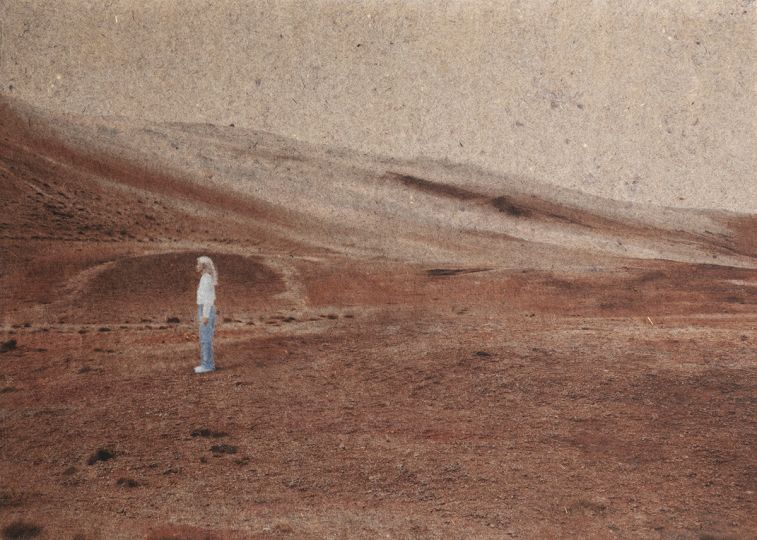
My project exists at the intersection of a historical photographic technique – the camera obscura – with contemporary landscape practice and temporal philosophy.
This new body of work, produced in Vorarlberg and Tyrol, Austria, recalls a strong feeling I first experienced when working with my prototype Camera Obscura Van in New York back in 2012. Those early works were mainly views from bridges – being suspended, temporarily “hanging” between verticals and horizons. Inside the darkened vehicle, waiting for the inverted image to form on light-sensitive paper, I exist(ed) in a state of suspension: between the flowing river below and the shifting skies above, between the moment outside and the exposure forming within, between seeing and making.
Above the river, under the sky – that’s where we all live. That’s where every breath happens. That’s where light performs its eternal dance, moving through space and time.
We exist in this impossibly thin layer between water and sky, between earth and cosmos. We’re sandwiched between these two realms, and most people never stop to feel that truth. My work invites viewers to experience this threshold – this space of suspension and becoming.
What viewers will experience isn’t photographs hung on walls. It’s an invitation to witness time’s flowing nature. Each large-format work is what I call a “Temporal Lemniscate” – a visual embodiment of the infinity symbol, where limitation and limitlessness collaborate together.
When the number 8 lies down, it becomes infinity. My 8-second exposures capture one complete journey around this eternal symbol. Eight seconds is long enough to witness time’s flow, short enough to maintain the energy of the present moment.
Against the fabricated myth of 8-second attention spans, my practice demonstrates that 8 seconds of true attention – cosmic attention – opens doorways to infinite awareness. It’s a therapy of slowing time with light.
But ultimately, specific exhibition details are less important than the core question: Are you willing to slow down long enough to witness what light wants to show you?
How do you prepare for an exposure inside your Camera Obscura? Do you follow a particular routine?
MM : When I prepare to make photographs, I mainly prepare to receive what light offers.
I don’t take photographs, I receive them: “Taking” implies control, possession, extraction. “Receiving” implies collaboration, humility, presence.
My routine is a ritual of presence:
I enter the darkened Camera Obscura – entering my own mind, entering the subconscious space where the black color reveals rather than conceals.
I hang the photographic paper in complete darkness – this is a kind of dance, moving by memory and feel rather than sight. The performance inside the Camera Obscura isn’t for an audience. It’s a kinship with light.
I count 8 seconds – not 7, not 9. Why 8? Because 8 seconds is my personal portal to the present moment. Because knowing I might not be here tomorrow makes each 8-second moment sacred.
During those 8 seconds, I become still. I breathe. I feel the movement. I hear the wind. I become part of the flowing Camera Obscura, part of the place, part of light’s journey from the Sun.
Then the paper is developed, and light’s autobiography reveals itself. I don’t manipulate, don’t “fix” it in Photoshop, don’t try to improve what light wrote. What happened happened. Time flowed, light danced, and I was present to witness it.
If you were to pair your work with music, what composer, band, or genre would best resonate with what you are doing?
MM : Music that teaches you how to listen the way my work teaches you how to see.
If I had to choose two musicians that embody what I do with light and motion, it would be Chopin’s Nocturnes and Keith Jarrett’s improvisations.
Chopin’s Nocturnes capture the inner stillness, the contemplative darkness of being inside the Camera Obscura. Listen to his Nocturne in E-flat major, Op. 9, No. 2 – there’s an intimacy, a sense of being alone with light and shadow, where every note is like a photon finding its way through darkness. Chopin understood that the most profound feelings arise in quiet, solitary spaces. That’s what the Camera Obscura is – a nocturne made of light instead of sound.
Keith Jarrett’s endless improvisations – especially The Köln Concert – are pure motion, life in constant movement, impressions flowing without plan or control. He sits at the piano and lets the music emerge from the moment itself, responding to what came before, anticipating what might come next, fully present in the act of becoming. This is exactly what happens inside my floating Camera Obscura: I’m improvising with motion, with water currents, with changing light, with the rhythm of the river carrying me forward.
Together, they’re perfect: Chopin is the stillness inside the darkened Camera Obscura. Jarrett is the motion of the boat on water. Inner feeling meets outer flow. Contemplation meets improvisation. Light meets motion.
Both require the same thing my work requires: you cannot rush them. You must surrender to their time, enter their rhythm, let them unfold at their own pace. In our acceleration-obsessed culture, this becomes radical – music and art that insist on presence, on the therapy of slowing time.
What’s your recommendation to the latest generation of experimental photographers?
MM : Stop being interested in photography. Start being interested in what you want to reveal. Once you fully explore your commitment to subject matter, the tools become secondary.
My four essential pieces of advice:
- Find what you cannot not do
I almost died young. That experience made me obsessed with time’s precious, fleeting nature. I couldn’t NOT explore temporality. What’s your obsession? What wound are you healing? What question are you living with? Don’t just be “interested in photography” – be consumed by something that photography helps you reveal.
- Build your temple, not your career
For me, the Camera Obscura is a temple of light, a sanctuary from acceleration culture, a space where the therapy of slowing time happens. What’s your temple? Find the space – physical, mental, eternal – where you can do your deepest work. Build that. Protect it. Let it reveal who you are from the inside out, not what you think the world wants to see.
- Let your limitations become your liberation
I work only with direct exposure on photographic paper. I expose for exactly 8 seconds. I can only work where sun shines. These aren’t constraints – they’re my creative engine. Find your sacred limitation. Stop trying to do everything. Do one thing with such devotion that it reveals infinity.
- Remember: you might not be here tomorrow
My grandmother called me roadrunner. Then I almost ran out of time. That awareness changed everything. It made every moment precious. Every photo is sacred. Every 8 seconds a gift. The therapy is in the practice, not the recognition. Live like you mean it. Make work that truly matters to you.
Final truth:
The roadrunner discovered that to catch time, you must first stop running. The Camera Obscura taught me that 8 seconds of complete attention doesn’t give me less – it gives me everything. It gives me the infinite window inside every ordinary moment.
Find your 8 seconds. Find your temple. Find what you cannot not do.
Then dedicate yourself to revealing it, not just photographing it.
For more information, check out the artist’s IG account @maciejmarkowicz
SAVE THE DATE:
Above the River and under the Sky
INNSITU Gallery, Innsbruck | Camera Obscura Project for the 200th Anniversary of Photography
Opening Week: April 13-16, 2026