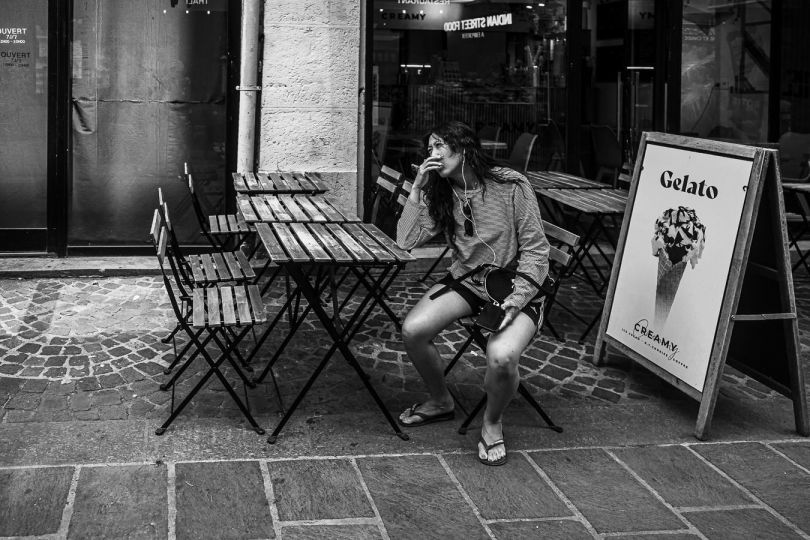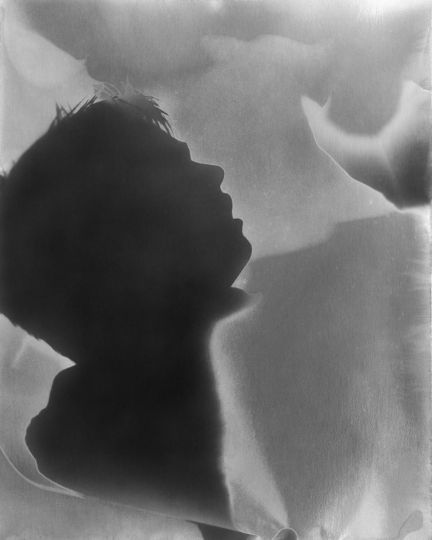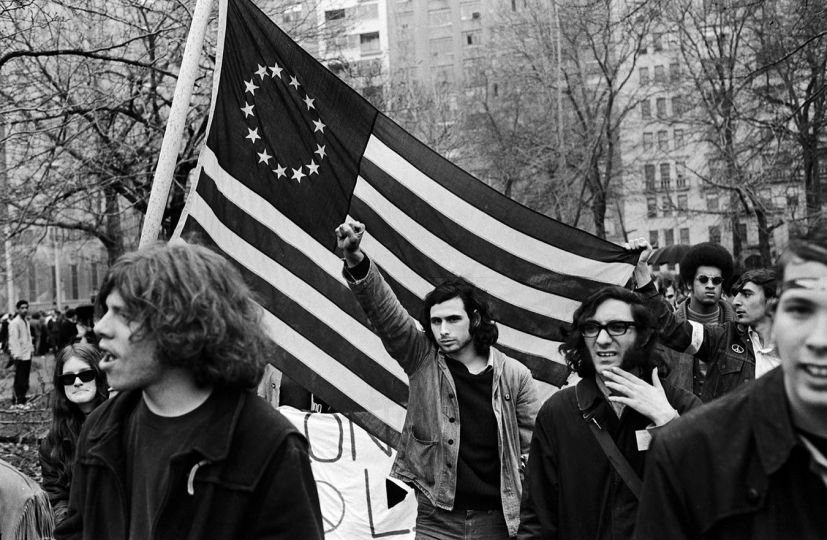
This is the star exhibition of Visa pour l’Image.
The Jean-Pierre Laffont retrospective, titled “Photographier en toute liberté” in French and “Photographer Unchained” in English.
It is accompanied by three texts.
JJN
Jean-Pierre Laffont : Photographer Unchained
His career began during the Algerian War, but it was in the United States that Jean-Pierre Laffont established himself as a key French photojournalist. The sixties, the seventies, the eighties… He became a witness to the pivotal years of a country conquering the world, where the elite of music, cinema, and literature paraded. But this exhibition also aims to highlight other reports by the most American of French photographers, such as his work on child slaves, carried out in a dozen countries around the world. Multiple publications in the most prestigious newspapers of the time bear witness to his perspective on a world at the turn of the millennium in the grip of wildest changes. This retrospective, entitled “Photographer Unchained,” looks back at this journey, which is a landmark in the history of photojournalism.
Jean-Pierre Laffont writes :
I started photography at a very young age. When I was a teenager, I went scuba diving and wanted to be an underwater photographer. I was lucky that my mother gave me a camera that I didn’t use underwater but with which I took my first photos during the Algerian War. I had a visual sensibility, and at the time there was no photography school in France, so I went to the one that had the best reputation in Europe: the École des Arts et Métiers in Vevey, Switzerland. That’s where I became a photographer, a profession that smacks of adventure, driven by the desire to be a witness to my time, to explore the world in complete freedom, to cover current events, to tell stories, that’s what I wanted to do.
When I began my career as a photojournalist in the 1960s, photographers were treated poorly and worked in total anonymity. Their photos were never signed and very often belonged to the clients who commissioned them, but I had the chance to join Gamma, which was then a small agency that had opened in Paris . Gamma was a photographer’s dream, a dream of freedom and autonomy, an agency of photographers for photographers. I am a loner, I like to work alone and only for what I think is important, the financial aspect did not interest me, only my desire to inform motivated me. I make my own itineraries, I choose my stories, I build my reports, I make appointments, I advance my expenses, I buy my plane tickets, I develop the films, and I write my texts. Sometimes I even edit my photos. I only like to work speculatively, that is, without commissions, which was the only way for me to work. I had no deadlines or specific requests, just my desire to cover this or that event. Later, I would refuse all commissions so as not to sacrifice my working freedom. I would travel the world without any guarantees. I loved doing everything, I loved covering the news, I loved being a street photographer, I loved photographing French personalities passing through New York, I loved going to Los Angeles and photographing American film sets, I also loved covering major social and economic events, in different countries around the world, and above all, I loved choosing my stories, taking the time needed to organize them, photograph them, and doing all of this with great freedom. When you’re on assignment, it’s not the same, you’re working for someone. So there’s the anxiety and the responsibility of closing. No salary, no constraints, I took photos and lived off Gamma’s financial records and the principle was simple: 50/50, the agency and the photographer shared everything, 50% of the revenue, and 50% of the expenses, and we owned our pictures. I really liked this formula.
There’s always a good time for everything, and we had ours. Being a photojournalist, an adventurer, a backpacker, a concerned photographer the time allowed me to be all of these things. I wanted to be free, free to photograph what I wanted, free to cover stories my way, free to pursue my passion as a photojournalist in the countries of my choice and with the stories of my choice. These were the golden years of film photojournalism. I was lucky to experience this period where one could work in complete freedom.
Jean-Pierre Laffont. NY, April 21, 2025
Jean-Pierre Laffont. In his eyes, the strength of his heart.
By Stephanie Mathis.
He captured the most significant historical moments of the second half of the 21st century, those etched in our collective memory; his precise and uncompromising gaze, his sincere and profound commitment, are praised worldwide. Having just celebrated his 90th birthday, photojournalist Jean-Pierre Laffont welcomed me with his wife and editor, Eliane, at his home in New York. Two hours of raw truth, like each of his photographs. Two hours that passed like two minutes. With open hearts.
“If I had waited a little longer,” “if I had positioned myself a little more to the left,” “if I had chosen a 50 rather than a 35″… Jean-Pierre may be one of the most renowned contemporary French photographers, but he criticizes himself enormously; he doesn’t like his photos. And he especially thinks about the ones he missed.
An eternal dissatisfied man.
Decades later, he remembers them. And one in particular, when he explored India for over a year, following Indira Gandhi and documenting the country’s development
“from the cow and the beggar to the atomic bomb.” He recounts it with great precision. “One day, I left Benares very early, around 6:00 a.m., to photograph a locomotive factory. I was in my taxi, a little sleepy, when we arrived at a level crossing.” Laughing, he slipped in an aside: “There’s nothing longer in the world than a level crossing in India. There’s always a flow of all kinds of people on both sides of the barriers when they close, because no one obeys: camels, buses, pedestrians, kids on bicycles, rickshaws…” There, he suddenly looks to his left: two men pass in the distance, dressed all in white, loincloths and turbans, their bodies gaunt and tanned like Indians can be; one pushing, the other pulling, a small cart with ball bearings, on which there is an absolutely modern engine, painted green and red in the colors of the flag, with the name of the Indian nationalist party written on it in Hindu. “This is my photo: the India of yesterday pushing the India of tomorrow!” he enthuses. A symbol. Everything then followed: he wanted to take his camera out of the bag, the train coming in, the taxi about to start again, people pushing, the driver urges him not to get out. He did go out of course. In vain. The two men disappeared into the crowd. His voice breaks. “I’m looking for them, even today.”
One example among many others. Films running out, flashes that won’t start, cameras that break down… The ups and downs of a photographer’s life before the digital age. Yet, Jean-Pierre asserts: today, even if technology has evolved, he would take the same photos.
A photographer who loves freedom.
Because he’s always known what he’s looking for. “I read everything, I know what’s going on, I do a lot of research on what I’m going to photograph!” A true news junkie who turns on the television before taking off his jacket when he gets home. He’s aware of history, of the moment unfolding before his eyes. “I’ve always wanted to work on my ideas.” This independence is hardly compatible with assignments and commissions. He recalls the time the New York Times magazine asked him to do a portrait of George Bush (Sr.), then about to become president: an image in the mood of the campaign, of a victor.
“I went with him to Massachusetts, he always gave the same speech, whether it’s to fishermen or house painters… Everything is always the same, it did not interest me at all.” Annoyed, without filters. “But around him, there are a thousand photos to take, people protesting, signs saying ‘Go home!'” He did make this “proper” portrait, but with pain. “An assignment is like a horse in the branches of its cart; you have blinkers on,” he sums up.
His goal is to help people see what’s happening in the world: for him, that’s the mission of photojournalism. As a child, he saw the injustices in Morocco. “I wasn’t proud.” of the relationship of the colonists and the Arabs. Then during the Algerian War, which he fought, of the Harkis.
“The French did everything, the ports, the roads, the railways, the airports, the schools… but they didn’t take care of the people.” Is this what gave him the desire to show minorities, sometimes the oppressed, often the most vulnerable? Probably, and no doubt for what will remain the great report of his life, the one in any case that gave him international recognition, and for which he won multiple awards: child labor.
A tireless witness to the world.
The story began in Pakistan in 1978. Ali Bhutto was at risk of being overthrown. “I was in the middle of the riots, there was not much to photograph, the people were very noisy, Bhutto’s police force beat the crowd very hard for twenty minutes, then nothing, then it started again at another intersection.” In short, an uninteresting day for a photographer. “And there was this kid, 3 or 4 years old. He followed me everywhere, with his two bottles of Coke. Around 11:00 a.m. or 12:00 p.m., I ask my friend from the PPK, the Pakistani press: ‘What’s he doing here? He has to go home.’ He answers: ‘He’s working, he’s waiting for you to be thirsty.'” A shock, a detonation for Jean-Pierre. “I cried and cried and cried…” A resurgence of his childhood, which violently resurfaces in his consciousness. “Who sold the newspapers? Who polished the shoes?” Who carried the bag of groceries from the market? Who looked after the car? Who ran errands? The list is (almost) endless. “Children.” He left that same year. For more than six months, to fourteen countries. With his own money, without telling his agency what he was going to do or where he was going. Colombia, Pakistan, Mauritania… Child labor is a deep wound that affects every country. So, he took photographs, in large numbers, to bear witness. Children who were “visually” at most ten years old, because he had done some research: “childhood is up to 12 years old according to UNICEF; at 12 years and one day, he is a young adult.” Child labor has already been photographed, but not like he did. Not with such diversity, nor such intensity. A documentary collection that is valueless, so much so that it has lots of value.
An obsession: the given moment.
He doesn’t know most of the subjects he photographs. He never asks them to pose.
“Even for portrait sessions, I wait for you to do something I like, in terms of composition, lighting…” He often spends his time like a hunter. Watching. And he sometimes waits a long time to photograph only the precise moment, the one that follows a well-considered line of reasoning. “If I’m wrong, too bad.” He dares, trusts himself.
“When the new President Ford was sworn in, I was part of the pool of accredited journalists, I knew I would get his picture for free, no point in being one of the pack.” So he sets off to capture the outgoing President, Nixon. Flying off for the last time aboard the Army One helicopter, soldiers on the ground rolled up the red carpet while keeping their caps from flying away. The photo goes down in history. “Annie Leibovitz was there with me, but she, because she couldn’t do otherwise, wasn’t accredited to the White House,” he smiles.
Neither political nor an artist.
Do his photos have a political dimension? He denies it. If his pictures help to forge a conscience, it’s because he is immersed in the heart of society, that’s all. “I see who will win elections, who will lose them. I listen to the speeches of each side, I know what they should say, what people expect.” But he denies expressing any opinion in his work. A photo of him can be used in very different ways, he assures us. “One day, at the Guam base during the Vietnam War, I lay on my back at the end of the runway of the B-52s, the largest bombers in the world. There’s only one cliff before the sea, the planes fly very low over the edge of this cliff. I took five or six photos that were good.” One of them simultaneously appeared on the cover of two magazines: one from Xerox with the title “Why not bomb the dykes?”, the other from the Algerian Liberation Army, the FLN, captioned “These are the world assassins” The same photo was used by both the far right and the far left.
“That’s the job of my agency, my editors. I don’t make any judgments.”
He barely acknowledges that he has a sense of composition and a sense of the moment. “Does that make me an artist, compared to what others, the real ones, do?” Almost vehemently, he retorts: “But no, I’m useless compared to that!!” He continues. “An artist is someone so lofty, singular, and particular; I’ve never felt that fiber deep within me.” Because writers, musicians, painters, and sculptors project everything they have in their heads into their art; they move him. And inspire deep respect. “I work with a machine that photocopies reality. I always have an abstract frame in which I move, I stand up or bend down so that the composition behind my subject is the one I want.” He tempers. “I have no respect for what I do! On the other hand, yes, I have a series of happy accidents.” » Which are historic.
“Like the longest kiss, at the first New York Gay Pride Parade with my 21-millimeter Leica.” A kiss for history.
The message, nothing but the message.
Jean-Pierre doesn’t want to intellectualize what he does. In a second, he knows if a photo is good or not. What criteria should he use to judge it? “The composition, the presence in the image, the message it conveys.” The latter must be obvious. And he shows me his famous view of the Statue of Liberty during restoration: “There, it’s clear: it’s Liberty in prison.”
A point on which he’s perfectly aligned with, Eliane, his wife and editor. His perfect partner. Together, they founded the agencies Gamma USA and Sygma Photo News. She has worked for many other photographers, but has remained loyal to him. Today, she decides on publications alone: ”A book is a whole; what does the photographer want to tell?” A different perspective is needed. “The photographer lives the moment, in his own bubble; what I try to tell is what he experienced, but from a broader perspective. Outside of his bubble.” Like a drone. Hence the importance for the editor to know his photographer well. “There has to be a symbiosis.”
More than just photos, they are metaphors of their time.
Her favorite photos are those that come straight out of the news. As an excellent literary figure, she elaborates.
“I like things to become metaphors.” She seizes upon the most recently published book, Photographer’s Paradise: the United States as a photographer’s paradise, a country where things happen, and where they can be photographed. “I realized that Jean-Pierre had told the whole story about America.” A gigantic fresco, a personal portrait. And especially of its pivotal decades, from the 1960s to the 1990s, which shaped it. “It took me two years to select 400 photos.” Those she now considers the most emblematic of this period, and which wouldn’t necessarily have been the ones she would have chosen fifty years ago. The eye evolves.
She reviews the prints: the farmer who runs out of gas for his truck and takes out his horse; the three children in Harlem who follow a jazz truck on which Jean-Pierre is riding; the little boy in the Bronx who climbs onto the roof of a car; the hands reaching out behind a prison gate… They all tell a much bigger story than they seems to at first glance. They all say something about the period; about the economic recession, the harshness of life, the insecurity and filth of New York at the time, but also about the joy, movement, energy, confidence in the future. They also say something about these different attitudes towards existence: resignation, hope, rebellion.
And then, sometimes, it’s not the main photo of the event that is the most telling. A good example is the photo of Muhammad Ali, waving his finger, during the (boxing) fight of the century, in 1971, between him and Frazier. “It’s wonderful. But what I had put aside was the extraordinary crowd that came to see it.” She repeats, and detaches: “Extraordinary.” In fact, highly fanciful, marginal characters, in the most absolute excess, dressed in chinchilla coats and colorful hats. The show is them. The era is them.
Storytelling: the magic of photos and words at the service of a story.
These photos tell history as words can, in an obvious parallel. Moreover, Jean-Pierre writes. Every day. At the time, travel journals, very narrative. Which are today a solid thread of the story that Eliane, for her part, is responsible for reconstructing.
Jean-Pierre often rediscovers photos thanks to his wife. He has a fantastic memory for events; she has a fantastic memory for images. He never influences her as to what she will select; she knows better than he does. Even the choice of the book’s title and the cover photo, which end up imposing themselves naturally. “You can’t publish without having a preconceived idea,” she confesses. In the end, Jean-Pierre likes the books. “A sine qua non!” Eliane assures.
Because they are sincere, authentic, and powerful, these stories, created by Jean-Pierre in images and by Eliane in words, resonate widely. The success of their latest opus on this Turbulent America, which Jean-Pierre loves as much as he criticizes, proves it. In France as in the United States. But for different reasons, Eliane believes. “The French like it because it shows the America we want to remember: the hippies, the energy, the youth, the country in turmoil and liberating itself; the Americans, because it shows them an America they don’t often get to see.”
Her next project is a book about hippie youth, because “today’s America comes from there,” according to Eliane. And for the future, the theme of travel inspires her. She already points to what would be the cover photo: a man and a woman dancing, embracing, on the deck of the legendary France. A wildly poetic visual, evocative of travel in its broadest sense: boats, the sea, the couple… The adventure of a lifetime. “You shouldn’t just look at a photo, you have to feel it,” she rightly adds.
Jean-Pierre’s two or three million photos now represent an almost infinite source of work for her. Enough to open up a wide range of possibilities. Eliane laughs mischievously: “When I’m done looking after his career, I’ll look after mine.”
Hold on to your happiness, impose your luck, embrace your risk…
Jean-Pierre doesn’t regret any of the photos he’s taken. He’s constantly looking toward the future. “The photo that interests me is the one I didn’t take, the next one.” Of course, he may not have found the photo he needed. Sometimes he didn’t “feel” the story, sometimes he came home empty-handed. But by his own admission, he experienced very few of these moments. He traveled everywhere, everywhere he saw countries develop: China, Japan, Korea… He had a front-row seat to the emergence of the world as we know it.
Luck is also the fact that he has always survived. When, in 1972, he went to the Andes to find these young men who had spent more than fifty days in the Eternal Snows after the crash of their plane, and survived by eating the corpses of their comrades, he assured me: “I was certain that we were going to crash.” He was in his little cuckoo clock, the turbulence was unspeakable. “I was literally jumping on the armrest, my plane was bouncing around my neck, up to my nose!” A tragedy that almost added to another. “We landed on the highway from Santiago de Chile to Valparaiso. As we exited, the pilot was kissing the ground.” He still can’t believe it, he knows he’s a miraculous.
The couple is in unison: “We were happy, we had great moments that turned out well.” So much the better because being a photographer, “it’s a job that requires luck,” Eliane is convinced. Obviously, luck is never just luck, it is often accompanied by risk-taking, openness, courage; but it seems that it’s always the same people who are lucky. And they were.
To meet, first and foremost. Jean-Pierre hits Eliane with his car as she was leaving the Parc Monceau. Distracted, she went through the light, which is green for cars. They laugh together. Jean-Pierre: “My car just grazed her.” Eliane: “It was raining, I slipped, I fell.” Fate brings them back together, even though they’ve already met from afar in Morocco. She falls in love with him at the same time as she does with photography. She calls him “My love,” always. They found each other it is wonderful, and are aware of it: many lives change after an encounter.
Exceptional encounters.
Don’t underestimate the encounters: Jean-Pierre nods. Two women, in particular, deeply touched him, made a lasting impression on him. Through their contact with him, and through what they told him.
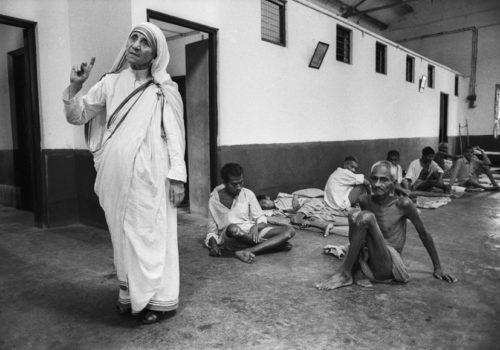
The first of these is Mother Teresa. He recalls: “I was in a taxi, in the streets of Calcutta. There were a lot of people, the taxi was going very slowly. Mother Teresa was next to me, we were going to her moratorium, a place where people go to die. Without air conditioning, we had rolled down the windows on both sides. Suddenly, the taxi slowed down, a guy came on Mother Teresa’s side. He arrived with a small bundle in his arm, a filthy towel. He puts it on her knees, I take a picture of him, he leaves. And she opens the door: there’s a newborn baby, still warm from its mother’s miasma, with the umbilical cord. She tells the driver to change direction and go to the orphanage.” » Mother Teresa doesn’t like being photographed at all, she finds herself “old, wrinkled, and ugly,” but she knows the importance of these photos of Jean-Pierre for TIME Magazine because readers will undoubtedly send money for his work. She then turns to him. “This morning, I went to Mass, and I said a prayer. I asked God that every time you take a picture, he will send a soul from purgatory to heaven.” Jean-Pierre is still upset by this.
He wipes away a few tears and confides his second encounter: Marguerite Yourcenar, who had been appointed to the Academy for three months, and without an “official” photo. Le Figaro Magazine asked him to take one at her home. A meeting is arranged in her small house in an isolated village a month later. “On the agreed date, I was up very early, take the ferry, rent a car, arrive at her house at 10 a.m., ring the bell: no one there.” Intrigued and patient, Jean-Pierre waits. “At 10:30 a.m., a taxi comes and drops Madame Yourcenar off in front of her house. She comes to the car and says to me: ‘I apologize, I couldn’t come earlier and be on time. You’ll give me courage by going into the house.'” He follows her and her dog; she explains that her partner of thirty years, Grace, died four days earlier; she is returning from the crematorium. Relieved to have him by her side, she didn’t cancel: “We need these photos, and since you’re not a journalist, you’re not going to be concerned with my being, you’re only going to be concerned with my appearance.”
“It’s beautiful, isn’t it?” Jean-Pierre asks me with a look. Yes, it’s beautiful, and much more than that. These are the moments that make a life.
His passion as his one, only virtue.
He misses photographing professionally, he confides. “I’d like to photograph women in the army.” He’s constantly bubbling with ideas for reporting, even though he knows the profession has changed, photography has become more democratic, and has lost its value. He’s saddened by this, consoled himself, and now loves to share his knowledge and educate younger people.
He doesn’t care for honors. Despite being decorated with the Arts and Letters and the Legion of Honor, he doesn’t seek them out. “Vanity frightens me, it offends me.” Embarrassed. “When you reach the end of your life, tributes rain down on you, it’s horrific.” Touching. “In life, I’ve never known boredom, I’ll know it when I die.” Some of his photos have become iconic, why these and not others? How does a photo become one? A mystery! And so much the better. Jean-Pierre doesn’t pay much attention to it. “I’ve never had any ambition, I’ve always wanted to do well, that’s what motivated me to get up every morning.” The greatest are the most humble, it’s well known.
Perhaps his greatest satisfaction has been changing destinies. He describes a photo taken of boat people in Vietnam. A photo that made the cover of Newsweek, and in which a man recognized his brother. They were later reunited thanks to him. “For a long time, they wrote me a postcard on January 1st.” Is that ultimately what matters most to him? “It does,” he admits modestly.
The exchange draws to a close, Jean-Pierre holds me back for a few moments and shows me one last photo: that of a Native family in the heart of the Adirondacks. Two parents, three children, seated at a table under a tapestry depicting a religious Last Supper. An incongruous scene. Caught in the moment, they all look towards the camera. Jean-Pierre thinks he’s lost. He looking for his way to his destination, sees an old house, and decides to ask for directions. “I knock on the door, no answer, I go inside. At the end, there’s a dining room, a family gathered around, looking at me. I ask them for directions, no answer.” He asks the question again, still no answer. “And then, the oldest girl struggles to articulate ‘They’re dumb’.” He understands that they are deaf and mute. Fascinated. “The children only communicate with each other with birdsong because they haven’t learned to speak.” » He imitates the squeaks. “Everyone burst out laughing, it was a very happy family.” We feel his infinite tenderness for these people, these farmers from another time. His all-consuming desire to show them as they are. In their profound humanity, which is also his. And ours. A universal truth.
In the showroom stacked with books and prints, in Eliane’s office, its walls carefully pinned with hundreds of archival photographs, I contemplate a lifetime of photographs into which Jean-Pierre has poured all of himself, as has Eliane. As I leave, I can’t help but think of Camus’s words: “Our world has no need of lukewarm souls, it needs burning hearts.” I didn’t ask him if he loved her, but I’m sure he did.
Stephanie Mathis. February 27, 2025
Jean-Pierre Laffont : Photographer Unchained
August 30 to September 14, 2025
Couvent des Minimes
24, rue Rabelais
66000 Perpignan
https://www.visapourlimage.com/en/festival/expositions/photographier-en-toute-liberte