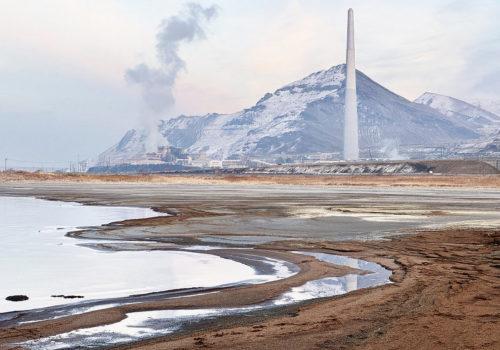
Chilean artist Alfredo Jaar was announced yesterday evening, 25 September, at the Victoria and Albert Museum, South Kensington, as the winner of the eleventh cycle of the Prix Pictet, the global award for photography and sustainability. Receiving the prize of 100,000 Swiss Francs (126,000 USD / 107,000 EUR), Jaar was selected by an independent jury from a shortlist of twelve photographers for his 2025 series The End.
The End focuses on the Great Salt Lake in Utah, described by scientists as an ‘environmental nuclear bomb’. The lake is a keystone ecosystem in the western hemisphere but is being destroyed by excessive water extraction. It has lost 73% of its water and 60% of its surface area since the mid-nineteenth century, exposing toxic dust and driving salinity to dangerous levels. Saline lake loss triggers a long-term cycle of environmental, health and economic suffering and without a dramatic increase in water flow, the Great Salt Lake risks disappearing altogether, causing immense damage to Utah’s public health, environment and economy.
The lake and its wetlands provide minerals for Utah’s industries and sustain thousands of local jobs, supporting $2.5 billion in direct economic activity yearly. It also increases rainfall and sustains 80% of Utah’s wetlands, providing a habitat for ten million migratory birds. This unfolding disaster may be past the point of no return, a potential tragedy of incalculable magnitude and a sign of things to come.
The series was selected in response to this year’s theme Storm, encompassing both the natural phenomenon and as a metaphor for the growing volatility of our age, from environmental collapse to political upheaval and conflict.
About his series, Jaar said:
‘My objective in this series is to show the tragic fate of the lake and simultaneously reveal its extraordinary beauty and potential. In spite of the dire situation we are in, I wanted to create images of great beauty and sadness. In the face of the magnitude of this tragedy, I decided to print these images in a small, unspectacular format, as a kind of visual whisper, a lament for our dying planet.’
Sir David King, Chair of the Prix Pictet jury, said:
‘The economic, social and political impacts of the current climate catastrophe are immense. Storm seems to be the default setting for our times and there really could not have been a more timely moment for the Prix Pictet to invite nominations on this theme.
The diversity of approaches with which the twelve shortlisted artists have interpreted the theme was extraordinary and the exhibition they have presented at the Victoria and Albert Museum is truly remarkable. Given the scale of this achievement the selection of a winner was a considerable challenge for the jury. Any one of the twelve shortlisted artists could easily have won the award but, in the end, my colleagues on the jury unanimously decided that Alfredo Jaar should be named the eleventh laureate of the Prix Pictet.’
About Alfredo Jaar:
Jaar participated in the Venice Biennale (1986, 2007, 2009 and 2013) and the Bienal de Sao Paulo, Brazil (1987, 1989, 2010 and 2021), as well as Documenta in Kassel, Germany (1987 and 2002). Solo exhibitions of his work have been held at the Musee cantonal des Beaux-Arts, Lausanne (2007); Alte Nationalgalerie, Berlinische Galerie and Neue Gesellschaft fur bildende Kunst, all in Berlin (2012); Les Rencontres d’Arles, France (2013); Yorkshire Sculpture Park, United Kingdom (2017); Zeitz MOCAA, Cape Town (2020); SESC Pompeia, Sao Paulo (2021); and Hiroshima City Museum of Contemporary Art (2023). Jaar has received numerous awards including the Hiroshima Art Prize in 2018 and the Hasselblad Award in Sweden in 2020. In 2024, he was awarded the IV Mediterranean Albert Camus Prize in Spain and this year has won the Edward MacDowell Medal in Peterborough, New Hampshire.
His work can be found in dozens of public and private collections, including The Museum of Modern Art and the Guggenheim Museum, New York; Museu de Arte de Sao Paulo; Tate, London; Centre Georges Pompidou, Paris; M+, Hong Kong; and Tokushima Modern Art Museum, Japan. He became a Guggenheim Fellow in 1985 and a MacArthur Fellow in 2000, both in the United States.
The twelve shortlisted photographers were:
Takashi Arai, Exposed in a Hundred Suns, 2011–ongoing
Marina Caneve, Are They Rocks or Clouds?, 2015–19
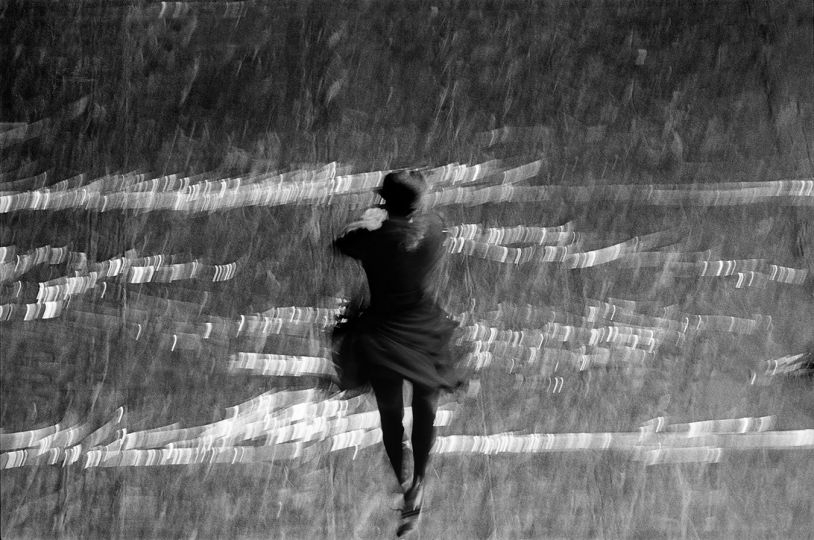
Tom Fecht, Luciferines — entre chien et loup (Luciferines — Between Dog and Wolf), 2015–25
Balazs Gardi, The Storm, 2020–21
Roberto Huarcaya, Amazogramas, 2014
Alfredo Jaar, The End, 2025
Belal Khaled, Hands Tell Stories, 2023–2024
Hannah Modigh, Hurricane Season, 2012–16
Baudouin Mouanda, Ciel de saison (Seasonal Sky), 2020
Camille Seaman, The Big Cloud, 2008–2014
Laetitia Vançon, Tribute to Odesa, 2022
Patrizia Zelano, Acqua Alta a Venezia (High Water in Venice), 2019
The independent jury for the eleventh cycle of Prix Pictet was:
Sir David King (Chair), Founder and Chair, Climate Crisis Advisory Group
Philippe Bertherat, President, MAMCO Foundation, Geneva
Jan Dalley, Contributing Editor, Financial Times
Duncan Forbes, Head of Photography, Victoria and Albert Museum, London
Zewditu Gebreyohanes, Editor, The Custodian, Substack
Gauri Gill, Winner, Prix Pictet Human
Funmi Iyanda, Creative Director, OYA Media, Lagos and London
Jeff Rosenheim, Joyce Frank Menschel Curator in Charge of Photographs, The Metropolitan Museum of Art, New York
An exhibition featuring the work of the twelve photographers shortlisted for the award is on view at The Pictet Gallery at the V&A South Kensington, London, until 19 October 2025. The exhibition will then tour to over a dozen venues, bringing the work of the shortlisted photographers to an international audience, starting with exhibitions at Ishara Art Foundation, Dubai (17 October to 13 December 2025); TOP Museum, Tokyo (12 December 2025 to 25 January 2026); and Luma Westbau, Zurich (6 March to 5 April 2026).
To accompany the exhibition, Hatje Cantz has published a book featuring the work of all twelve shortlisted photographers, as well as outstanding images by other nominated photographers. The publication also features newly commissioned essays by Jean-Baptiste Fressoz and Mariana Mazzucato, as well as a special interview between Michael Benson and Don McCullin.
Prix Pictet Storm – Shortlist Exhibition
26 September – 19 October 2025
V&A South Kensington
Cromwell Road, London SW7 2RL
Admission free
www.vam.ac.uk/info/prix-pictet
About the Prix Pictet
Prix Pictet was founded by the Geneva-based Pictet Group in 2008 and is recognised today as the world’s leading prize for photography and sustainability. It is independently governed, managed and administered by an independent secretariat and an independent jury, with an advisory board.
For each cycle, the award focuses on a different theme that promotes discussion and debate on issues of sustainability. A network of over 350 nominators, including critics, curators, and other specialists in photography, invites artists from around the world to submit their work. The independent jury creates a shortlist of twelve photographers based on artistic and photographic merit, originality in conception and/or execution, relevance to the current cycle’s theme, ability to address a pressing sustainability challenge, and ensuring their series is a unified and coherent body of work. The jury then selects the winner from the shortlist, and a prize of 100,000 Swiss Francs (124,000 USD / 107,000 EUR) is awarded for a body of work that speaks most powerfully to the theme. (Read more about the prize and process here.)