Ikuru Kuwajima : Photography between memory and experimentation.
Ikuru Kuwajima is a Japanese visual artist and photographer with a singular path, marked by a deep sensitivity for territories, history, and representation. Born in Japan, trained in the United States, and having lived for many years in post-Soviet countries (notably Kazakhstan, Russia, and Ukraine), he developed a body of work at the crossroads of documentary, visual research, and personal storytelling.
Kuwajima doesn’t just take photographs: he questions memory, explores collective imagination, and blends images, text, maps, and drawings. His approach often introspective, sometimes ironic is part of a search for meaning in the face of political, geographical, or cultural upheaval. Rejecting the spectacular or sensational, he favors slowness, intuition, fieldwork, and an almost ethnographic take on his subjects.
With projects like Trail or Tundra Kids, he redefines the boundaries of traditional photojournalism, moving toward a form of visual art in which ambiguity, subjectivity, and formal experimentation become tools for a critical reading of reality. A member of the Reflexions Masterclass, Kuwajima advocates a free and demanding approach to photography, often nourished by archives, formal research, and a desire never to repeat himself.
Website : www.ikurukuwajima.com
Instagram : @ikurukuwajima
represented by Galerie LENEUF Sinibaldi Paris
https://www.alain-sinibaldi.com/
Your first photographic trigger ?
Ikuru Kuwajima : I don’t remember exactly, but I think it was when I was around 5-6 year old. I took a fuji disposable camera my parents had and made a few clicks.
The man or woman of image who inspired you?
I.K. : The gender doesn’t matter to me.
The image you would have liked to take?
I.K. : If I’m mentioning something very particular, it was in the south of Kyrgyzstan in 2011 when I saw a girl with a huge leaf parasol like in the scene of Totoro by Miyazaki. I asked the driver to stop, but he was talking to someone or listening to loud music and didn’t stop. That was the end of the story, but I don’t even know why I remember this particular story.
The one that moved you the most?
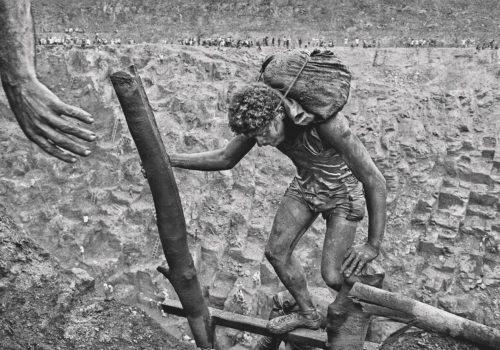
I.K. : Actually, when I first saw Salgado in Tokyo around 2003 when I was still a high school student and before even starting photography, it moved me a lot. I don’t remember exactly which one, but ones of children’s. It was the first time I saw this type of photography. At that time, you didn’t have so much access to different kinds of photography, you know.
And the one that made you angry?
I.K. : Maliciously manipulated photos of the Russian propaganda, as well as award-winning photos that are presented as journalistic but actually are set-ups. But, I should add that the former is done by the state, so the scale is much bigger and therefore it’s much more malicious, harmful and destructive than the latter.
Which photo changed the world?
I.K. : I don’t want to overvalue photography, as people who like photography tend to do. Nonetheless, I think journalistic photographs have been having significant impacts on the world one way or another, but I can’t really name specific ones because there are many.
And which photo changed your world?
I.K. : Award-winning journalistic photos that were actually set-ups = disappointment to some of the photojournalism establishments who I naively thought were a group of concerned people, which weren’t always the case. It was many years ago, though.
What interests you most in an image?
I.K. : I’m interested in exploring something new through photography and art in general, and images are the memory and proof of my exploration, as well as my interpretation, and I try to work hard on this visualization. In other words, it’s a way to express.
What is the last photo you took ?
I.K. : I’m in Marrakesh at this moment, so just a street photo from Marrakesh shot by my iphone yesterday.
A key image in your personal pantheon?
I.K. : It’s rather a series of images, but the work “Trail” was important in a way that it was an important step for me to shift from traditional documentary photography to more conceptual and artistique photography. And, I made it thanks to the Reflexions Masterclass that pushed me to expand the boundary.
A photographic memory from your childhood?
I.K. : I started photography when I was 21 or so in the U.S, and actually, I never like seeing family photos and photos of myself, and my childhood in Japan is no exception. When I was a child, we didn’t really have a camera either except disposal ones that my parents bought from time to time. The only photo I vividly remember from that period is the photo of my grand mother who died earlier. We prayed in front of her photo often and on.
According to you, what is the necessary quality to be a good photographer?
I.K. : I think you kinda have to be obsessed with photography (I’m not).
What makes a good photo?
I.K. : Something that touches emotion of viewers. This type of image often contains some element of newness or originality to viewers or evoke some old memories important to them.
The person you would like to photograph?
I.K. : I don’t really have any particular person who I want to photograph.
An indispensable photo book?
I.K. : I’m not that big fan of photo book, but I liked Greater Atlanta – Mark Steinmetz.
The camera of your childhood?
I.K. : Like I said earlier, I didn’t really have access to camera in my childhood.
The one you use today?
I.K. : I mostly use Sony Alpha 6500 for my recent collage-like projects. Actually, I want to shoot on film, like on mamiya 7, but the films became too expensive, and I changed my approach.
How do you choose your projects ?
I.K. : Things that interest me and are close to me, things that are new to me and viewers. For me the story and concept are the most important, but at the same time, I choose projects that could be represented and visualized in a unique and unconventional way. I mean I chose a project based on potential in its form and concept and whether you could achieve some harmony and consistency between them.
How would you describe your creative process?
I.K. : In the past 10 years or so, I generally try not to hurry. I try to think a lot and embrace failures. I work step by step and try to experiment a lot, and that gives me good results usually. Before that, I was a bit in hurry too much and made a lot of mistakes.
An upcoming project that’s close to your heart?
I.K. : I’m hoping to work on a project in France and possibly also in Japan or maybe even in China. Sort of international historic project. I will need to do a lot of archive research for now.
Your favorite drug?
I.K. : I don’t really take drug. I even quit smoking last year. I just drink wine, beer and coffee if you consider them as drug.
The best way to disconnect for you ?
I.K. : Practice new languages. J’apprends le français maintenant.
What is your relationship to the image ?
I.K. : Originally, I’m a rather person of letters or conceptualist more than visual. But, I’m not that super good at it and even dispersed my brain to several different languages in the past years so that I can’t really express what I want to say quickly and precisely, so photography or visual art in general came in handy for me.
Who would you like to be photographed by ?
I.K. : I don’t really care who takes my pictures, so I don’t have a preference.
What is the difference between photography and art photography?
I.K.: It’s a matter of context and concept. Non-artistic photography has neither.
The secret to the perfect image, if it exists?
I.K.: Such an image doesn’t exist.
With no budget limit, what artwork would you dream of acquiring?
I.K.: I have no particular desire to own artworks.
The image that obsesses you?
I.K.: None in particular.
Your latest folly?
I.K. : I drank until 4 o’clock in the morning like when I was in the 20’s, fell asleep in the airport and missed the flight from Tbilisi to Chisinau. It was in May or so.
An image to illustrate a new banknote?
I.K. : I would put a portrait of Nestor Makhno (an ukrainian anarchist) on that.
If you would not have been a photographer ?
I.K. : A translator, and I’m actually a translator. I mean, when I’m not a photographer or artist, I’m a translator. But, maybe I’m sometimes a translator, because I’m not a commercially-successful artist and need some side job. Therefore, if I’m not an artist/photographer, then I would be doing something completely different – I would probably study biology like ornithology and try to become a researcher at a university, and that’s probably what I should have done.
The job you would not have liked to do ?
I.K. : When I was a poor student at the university of Missouri in the U.S., I worked at the university cafeteria and Indian restaurant and washed dishes for hours several times a week, I wouldn’t want to repeat this anymore.
Your greatest professional extravagance?
I.K. : That’s when we built a baseball field in Nizhniy Tagil, Russia for my art project. It was before the war.
What question gets you off track?
I.K. : I don’t know.
What was the last thing you did for the first time?
I.K. : I travelled to Marrakesh from Agadir by bus for the first time, that was two days ago.
The city, the country or the culture you dream of discovering?
I.K. : It’s territorially very broad, but I think I began to get more interested in the central and western parts of Sub-Saharan Africa.
The place you never get tired of ?
I.K. : Ukraine in some way.
Your biggest regret ?
I.K. : The biggest regret is that I tried too hard to win photo contests and stuff to make a carrier when I started out like 15 – 20 years ago,
In terms of social networks, are you more into Instagram, Facebook, Tik Tok or Snapchat and why?
I.K. : I’m more into Facebook because I’ve never been very active on social media, but I’m becoming more active on Instagram since I finally realized that Facebook is only for old people in some countries. So if you don’t have Instagram or TikTok, you basically don’t exist for the younger generation — and that actually caused me some problems when I started working in Ukraine in 2022.
Color or B&W?
I.K. : I don’t have any preference. It depends on the projects I’m working on. They are just two different type of forms, and I chose the one (or both) that convey the concept of each project in a more effective way.
Daylight or artificial light?
I.K. : It depends also on the projects I’m working on.They are just two major different types of light sources, and I chose the one (or both) that convey the concept of each project in a more effective way.
Which city do you think is the most photogenic?
I.K. : I felt Bucharest, Romania very photogenic when I lived there in 2007, but not any more.
If God existed would you ask him to pose for you, or would you opt for a selfie with him?
I.K. : I would ask him to pose for me. I’m not a selfie person.
If I could organize your ideal dinner party, who would be at the table?
I.K. : Good friends of mine I haven’t seen for a while, like several of them.
The image that represents for you the current state of the world?
I.K. : Saturn devouring one of his sons.
According to you, what is missing in today’s world?
I.K. : Modesty, empathy and will to fight against the authority
If you had to start all over again?
I.K. : I would try to become an ornithologist
What do you like people to say about you?
I.K. : I don’t really care
The one thing we absolutely must know about you?
I.K. : I don’t know, probably nothing.
A last word ?
I.K. : I would like to thank the curatrice Ilaria Crosta and the gallery LENEUF | Sinibaldi for giving mr the opportunity to present my works in the gallery, and I would like to thank Reflexions Masterclass that gave me opportunities to know good people like Ilaria and helped change my approach to photography significantly, which eventually carried me to the domain of art.