Amanda Sauer : Silent Observations
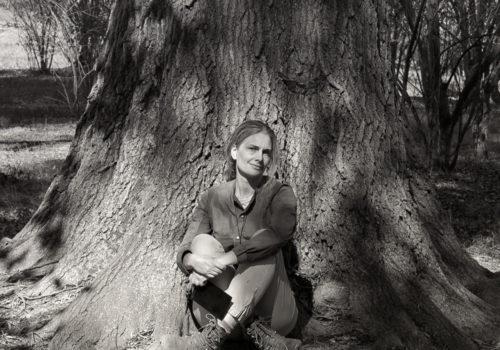
After an initial career in climate change research, Amanda Sauer reinvents herself through photography and cinema, training at the Virginia Commonwealth University. This fusion of scientific rigor and artistic sensitivity infuses her work with rare depth, where each image seems to emanate from a meticulous observation and an unwavering attentiveness to the world. In Giant Willow Oak, published in 2023 by L’Artiere Edizioni, she crafts a visual narrative of rare intensity, where the tree becomes the center of the universe, and slowness, the keystone of introspection. For several years, she photographed a majestic willow oak in Washington, D.C., spiraling around it counterclockwise, like the rotation of the Earth, capturing in black and white the subtle transformations of the plant, as if each movement were a breath of suspended time.
Her patient, almost mystical approach follows the path of To Measure Time, a work previously acquired by MoMA and Yale, where she already explored the tensions between observation, repetition, and transformation. These concerns extend today into her teaching of analog photography and large format at Northern Virginia Community College, where she imparts her art with the same precision she applies to her own creations.
A finalist for the 2024 Dummy Award and exhibited at renowned festivals such as Les Rencontres d’Arles, Fotofestiwal, and the PhotoBookMuseum, Giant Willow Oak asserts itself as both a sensitive and conceptual work. Printed in tritone on bamboo paper, this book is not just a series of images: it is a visual meditation, a reflection on time, memory, and the subtle ways life imprints itself in us, often without us even realizing it.
Through her answers to our questionnaire, Amanda Sauer opens the doors to her universe, revealing the profound impact of photography on our perception of reality, while sharing fragments of her personal history and her quest as both a mother and an artist. Her words, like her images, are shards of intimacy, where reflection on the image intertwines with contemplation of the world. Through a vision made palpable in her art, she invites us to redefine our relationship with pictures, memory, and others, while questioning the future of photography and its role in our ever-changing world.
Website : www.amandasauer.com / Instagram: @amandajsauer
« Giant Willow Oak by Amanda Sauer, published by L’Artiere
What sparked your passion for photography?
Amanda Sauer : Seeing the image appear in the developer tray in my high school darkroom. Each time I print in the darkroom I still find it magical.
Which photographer has inspired you the most?
A.S. : Probably Robert Adams, both his photographs and his words. There’s a directness and moral clarity in his work that you feel afterwards, it stays with you. But while you are immersed in his photographs you get lost in the beauty of the composition, the tonality, the rhythm. It’s so powerful. There was an exhibition of his work at the National Gallery of Art in Washington DC in 2022. I went many times. The first time I visited I became so emotional I had to leave; once outside the brightness, the movement, and the colors of the world seemed so cruel and jarring. His photographs create their own world, reflecting a truer version of this world we all share.
What photo do you wish you had taken?
A.S. : There’s an Atget photograph of a majestic old tree in Parc de Saint Cloud. I had this photograph in my mind as I was making photographs for my book “Giant Willow Oak.” I think part of my attraction to this tree was me trying to remake Atget’s image as my own.
What was the last photo you took?
A.S. : I made photographs while walking through snow in the woods of Maine. I am trying to do something with the idea of winter for the same reason I make much of my work – I want to capture something fleeting that I sense will disappear.
What’s the strangest photo you’ve ever taken-intentionally or not?
A.S. : Many years ago, my shutter went off while my camera was slung over my shoulder on a walk. At that time (I was 22?) it was the strangest, most beautiful photograph I had ever made. I tried for years to recreate it, without success. I wasted so much time and film! Now I am more accepting of these accidents as gifts.
How do you choose your projects?
A.S. : I start by returning again and again to a specific place, usually an arboretum or garden where the human influence is visible. I photograph what interests me, and over time, it becomes a project based on what I see happening with my photographs. For my book “Giant Willow Oak” I was fascinated by this one unusually old and large tree. As I photographed, I noticed that I was slowly circling the tree. I became enchanted with how the form of the tree changed with my point of view, offering different visual characterizations. On top of this, the tree transformed depending on the season. How can one expect a single image to contain all of these shifting perspectives?
My project became to make an expanded “portrait” as a way to pay reverence to the tree. I imagined a series of images where the tree would turn with the seasons, and I went as often as I could to make photographs. I became deeply bonded to the tree. I saw my circling as a kind of orbiting, as if I was tethered by my attraction to the tree began thinking about love as a kind of symbolic gravity, about how we create our own personal universes from these bonds that connect us to others. I also began to see the project in terms of my experience as a mother, the constraints and sustained attention that it demands.
What balance do you strike between intuition and thought in creating an image?
A.S. : For me there has to be both. Intuition guides me as I am making photographs; the thought usually comes later upon reflection and informs where I go next.
What makes a photo “successful” to you?
A.S. : It has to speak to something beyond the frame. And the elements have to work together in a coherent way. It’s really hard to do, but when it happens, it’s worth all the failures.
What makes a photo memorable? And what makes an image timeless?
A.S. : As a photography professor I see a lot of photographs. The memorable photos are the ones that surprise me, showing me something in a new way or revealing a relationship between things I had never before considered. Timeless photographs are ones that connect to a universal human experience, they feel familiar even when they come from the past.
What details do you look for in a face, a landscape, or an object?
A.S. : In a landscape I’m usually looking for the imprint of humans as a way to learn about our relationship with nature. But I usually end up photographing my response to the landscape, what inspires me in that specific place, not the initial concern that led me there.
Can technique ever outweigh emotion in photography?
A.S. : You really need both, and they need to work together seamlessly.
Is beauty in photography purely aesthetic for you?
A.S. : Beauty has a complexity that points to something beyond the aesthetic. It may be philosophical, conceptual, or emotional; what matters is that it provides a counterpoint that leads to a greater appreciation of the aesthetic. If not, I would use a different adjective, such as “pretty.”
What elements help make silence visible in a photo?
A.S. : One of the fundamental qualities of a photograph is its silence (Robert Adams says it better in his text for « Summer Nights Walking”). It is the viewer’s imagination that fills in the sound. Silence becomes visible when we imagine no sound. I felt silence very strongly in Angela Boehm’s recent book “Minus 30.” Her landscapes are blindingly white, vast, and distant.
Does the uniqueness of a photo come from the moment or the staging?
A.S. : It can be either, or if you are lucky, a little of both.
In one word, how would you describe your relationship with photography?
A.S. : Wonder. I photograph to know if what I see is really there.
What interests you most in an image?
A.S. : With some notable exceptions, I’m not that interested in a single image. I am much more intrigued by how photographs work together to create their own world.
Are you more into color or black & white?
A.S. : I go through phases. Because I use film I have to chose in advance. Lately I’ve been working in black and white, but I really miss color.
Natural light or studio?
A.S. : There’s nothing like natural light, and following the light is how I find my photographs. I sometimes use a reflector outdoors, which is a way of trying to get the best of both.
Can color be a form of storytelling?
A.S. : Why not? The book “Bluets” by Maggie Nelson is a perfect example of this through literature. Or in photography Cig Harvey comes immediately to mind.
Can we talk about photography without mentioning time?
A.S. : No, photography is recorded light and time. This simplicity is what makes it endlessly fascinating for me.
What role does the invisible play in your images?
A.S. : Anytime a photograph leads you outside the frame, it engages with the invisible. It could be an emotion such as grief or an issue such a climate change. I think a lot about photographing absence, which is not the same as the invisible.
Can a photo be truer than reality?
A.S. : I try to question the truth of both photography and reality; it’s how they intersect that makes it interesting. I don’t think you can separate them. Perhaps a photo becomes “truer “than reality when it inspires you to see differently?
Can a photo change the way we perceive an event?
A.S. : Yes. We see this in media images all the time. But it is also true on a more personal level, just look at social media! And I think about my children, whose memories can be displayed on the camera roll of my phone – do they remember the event or just the photograph that they see years later?
Is photography a testimony or a form of manipulation?
A.S. : It’s always both! And that’s why it’s interesting.
Which photo changed the world? And which one changed your world?
A.S. : The pale blue dot photograph (a distant photo of Earth taken by NASA’s Voyager 1 in 1990) is often cited as one of the most influential photographs of all time. It gives us the perspective that Earth is small, fragile, and beautiful. I felt an overwhelming sense of awe when I saw the first James Webb images in 2022. They again reminded me of what a miracle Earth is within the vastness of space.
What was the first image that deeply moved you? And the one that made you angry?
A.S. : I honestly can’t say which was the first image, but in 2004 I saw Sally Mann’s “What Remains” exhibition at the Corcoran in DC and was deeply moved. She made these hauntingly beautiful photographs of death and also of her children’s faces. That same year we saw the photos of American soldiers torturing prisoners in Abu Grabih, which made me very angry.
If you had to choose one photo to represent you, what would it be?
A.S. : It would have to be one of my Giant Willow Oak photographs. I spent five years photographing that tree and have projected so much of myself onto it!
If you could photograph the inside of your thoughts, what would it look like?
A.S. : I’d like to think of my thoughts as the twisted, tangled branches of a very old tree. When I was photographing my Giant Willow Oak project, I would lay in bed at night and see images of branches in my mind. The same thing would happen on days when I printed the negatives in the darkroom. It is such a pleasurable way to fall asleep.
What was the last thing you did for the first time?
A.S. : I recently tried out some parkour moves taught to me by my 9-year-old son. It wasn’t pretty!
A key image in your personal pantheon?
A.S. : Robert Adam’s photographs of cottonwood trees.
A photographic memory from your childhood?
A.S. : In my early childhood, we lived in tract house in Utah that could have been in a Robert Adams photograph. My house was the last one before the vast expanse of ranchlands leading to the mountains. From my back yard we would watch the sunset over the Wasatch range; the view was so beautiful that as an adult I didn’t think it could be real – that I must have imagined it or that my memory had been embellished by nostalgia. My father recently digitized films from that time and there was footage that proved it was indeed real, and it was exactly as I had remembered. I went back to this house when I was 18. It’s now in the middle of a sprawling suburb; the view is gone, there are only houses as far as the eye can see.
What is your greatest regret?
A.S. : I try not to have regrets, but life is complicated. I wish I had been able to make more work when my children were young, including about that experience. I also wish that my career had advanced a little farther before becoming a mother because it has taken so long to gain momentum again, which has been difficult. But then I may not have spent as much time with my children, so I would probably regret that too.
Does a photo still belong to you after you’ve shared it?
A.S. : I’m not sure a photograph ever belongs to anyone. It does however require a viewer to be activated, to bring a specific perspective to understanding the visual information. When you share a photograph, you allow others to engage with its content to derive their own meaning. It’s a privilege to have this opportunity and one can learn so much from it. But I also understand that there are times when one does not want to share.
An indispensable photo book?
A.S. : One of my first photobooks was Binke Kawauchi’s “Utatane.” I ordered it from Japan in the early 2000’s. It’s a medium-sized softcover book that feels intimate in my hands. One gets lost in the sequence of the images; it feels like a daydream (“utatane” translates to “nap”). I think it was the first book where I loved the physical book object as much as the photographs inside.
What was your childhood camera?
A.S. : As a child I made many photographs where I dressed up my dog and staged her in different scenes (her name was Karma, she was so gentle and patient!). But I don’t actually know what kind of camera it was.
What camera do you use today?
A.S. : I have several 4×5 cameras, but my favorites are a beat-up Toyo monorail with a long bellows for close ups and a fancy Toyo VX (a field/monorail hybrid) to get more extreme camera movements in the field. I love to walk with my Mamiya 7ii, which is a 6×7 rangefinder. And I use a Fuji GFX for times when digital just makes more sense.
Your favorite addiction?
A.S. : Chocolate. And photobooks! But not at the same time, that could be messy…
If your camera could talk, what would it say about you?
A.S. : My camera would probably ask why sometimes it gets to go out again and again and again, and then later it gets put away in a closet for a really long time.
In your opinion, what is the role of photography in how we perceive the world?
A.S. : We have too many images in our head to directly perceive the world without subconsciously referencing a photograph. It affects our expectations, as well as how we interact with everything around us; internalized images mediate most, or maybe all, of our life experiences.
What are the major challenges for the future of photography?
A.S. : I wonder whether or not Al will replace photography as we know it, and if there will be a value placed on camera-based work in the future. I have my hypothesis, but only time will tell.
How are social media influencing the creation and reception of images today?
A.S. : l’Il ask a further question – how is the creation of images for social media influencing our daily lives and relationships? I think many people are making little (and big!) life decisions around how to get the perfect image to post on social media. I worry about how to raise my children in the middle of all of this: How do we live our lives for ourselves and not for an audience?
If photography were a weapon, what kind of “shot” would you prefer?
A.S. : I dislike the weaponized language around photography and make a conscious effort to not use it. Unfortunately, photography has been a weapon used by the powerful against the “other” – and this is still happening. Thankfully these “other” groups are also using photography as a way to empower themselves.
If you could photograph a historical and/or contemporary figure, who would it be and why?
A.S. : Berenice Abbott. I had a dream about her many years ago and felt like she was trying to tell me something very important, but I couldn’t understand. I’d use my time photographing her to try to figure out this lingering mystery
If photography could capture emotions as well as images, what emotion would you want it to convey?
A.S. : Gratitude.
If you had an interdimensional portal, what would be the first photo you’ d take in another world?
A.S. : A portrait of Harriet Tubman. I’d start the myth that we are beings of fierce moral integrity in the hopes it would somehow, someday affect how we see ourselves back on Earth.
If your camera were a superhero, what would its secret power be?
A.S. : A camera is a superhero – it creates photographs which can suspend and travel through time. For example, when I make a portrait of my children, I am simultaneously working in the present, past, and future: I release the shutter in the present; the latent image is already in the past; and the resulting photograph will happen in the future (and future me is grateful for this record of my children in the past).
If a photo of you were to illustrate a futuristic invention, what would it look like?
A.S. : Probably every photographer has dreamed of inventing the “eye camera” – where you can just directly make a photograph by looking with intention, no equipment needed. The illustration for the “eye camera” would show me winking and holding a photograph of what I just saw.
An image to illustrate a new banknote?
A.S. : An ancient tree.
What photo would you love to take… but that could ruin your career?
A.S. : I make a lot of boring photographs, if I shared them all, it would probably not be good for my career.
If you had to photograph the story of an ordinary object, which would you choose to turn into a masterpiece?
A.S. : I would photograph a piece of my mother’s pottery, perhaps one of her hand-made bowls, in an attempt to honor all that she has created.
Which city do you find most photogenic?
A.S. : It’s hard to not be visually seduced by Paris, but I think Havana might be more photogenic.
If God existed, would you ask Him to pose for you, or would you prefer a selfie with Him?
A.S. : I would be too humbled to ask for either.
If I could organize your dream dinner, who would be at the table?
A.S. : I know very little about my ancestors. I would love to learn what their lives were like.
The image that best represents the current state of the world, in your eyes?
A.S. : It would be an image containing the complexity of what we are facing, but still offering a glimpse of hope. It’s the image I am constantly chasing in my desire to make photographs.
The one essential thing people should know about you?
A.S. : I am very tall. It surprises everyone.
One last word?
A.S. : Thank you, these are not the usual questions!