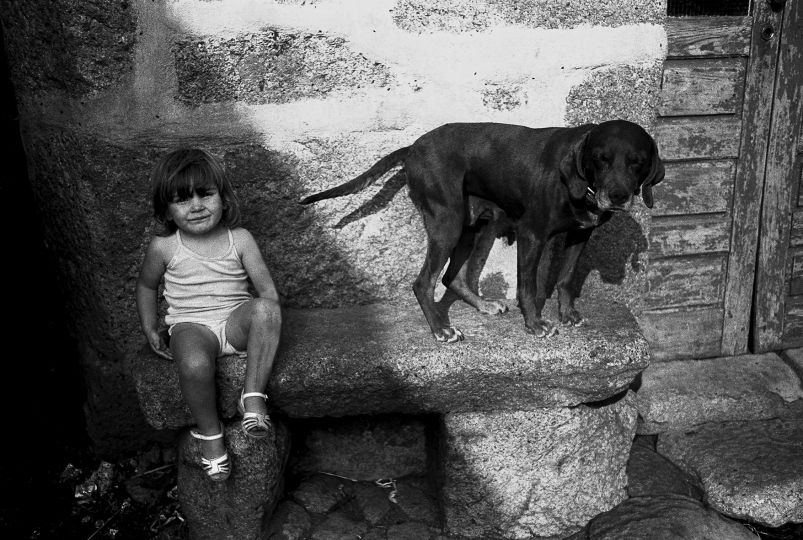
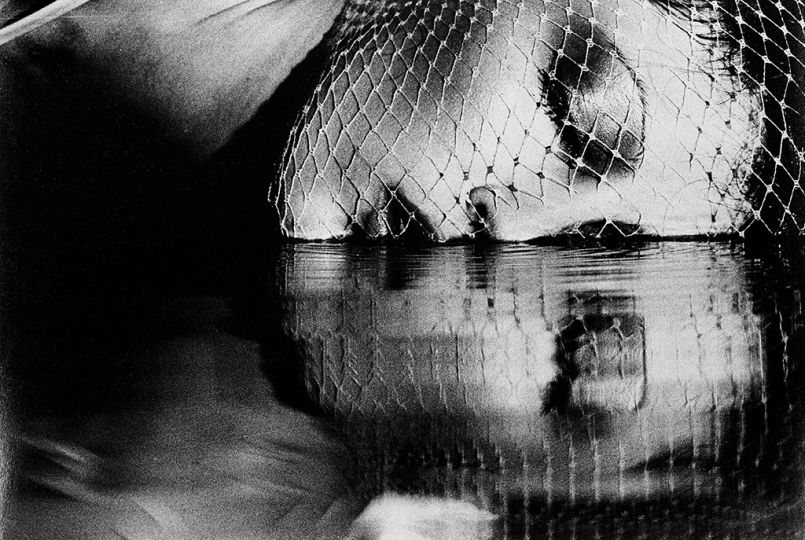
The International Center of Photography (ICP) presents Sergio Larrain: Wanderings until January 12, 2026, consisting of prints drawn entirely from the Magnum Photos archive, the cooperative that Larrain was a member of for over fifty years. Curated by Agnès Sire, former Director of the Fondation Henri Cartier-Bresson, Paris, the exhibition primarily highlights the work Larrain made during the first twenty years of his career, in cities such as Valparaíso, Santiago, Paris and London. With examples from many of his most renowned series, Wanderings provides a new perspective on Larrain’s inventive and humanist photography that for decades has remained little seen and seldom exhibited.
“The terms Sergio Larrain used to describe the ‘state of grace’ necessary for ‘receiving’ a good image are mystical, as if the images were already present in the cosmos and the photographer acted as a medium,” said Agnès Sire. “He was at one with stone, just as he was at one with the children of the streets, who meandered like angels appearing out of nowhere. His magnetic eye carved out fragments of reality, with no fear of what was outside the frame, of the time to come, of bold diagonals, of direct sunlight or of darkness. Neither are his pictures closed: the figures often move out of the frame, as elusive and resistant to confinement as their author.”
Structured chronologically and using Larrain’s own writings as a guide, Wanderings looks at both the material and spiritual drama of rural and urban life while also charting the subtle evolution of Larrain’s style. The photographs he made in 1957 of the fishing community on Chiloé Island off the coast of Chile would prefigure many of his coming series, with their attention to the plight and circumstances of children and the psychological tension to be found in even commonplace scenes. That same year, the children of Santiago, Chile were the subject of Larrain’s first major body of work, resulting in photographs that look unflinchingly at the material hardship of these children while also finding moments of levity and surprise. In these photographs the conditions of poverty are shown vividly though without sentimentality, as Larrain sought to shed light on their situation without valorizing their experiences.
Larrain later relocated to Paris for a while and traveled extensively throughout Europe while reporting for Magnum Photos, of which he became a full member in 1961. His photographs from Paris and London reveal a keen interest in bizarre and unexpected combinations of architecture and humanity, resulting in new and almost surreal compositions within these rapidly changing cities. Upon returning to his native Chile, Larrain completed his seminal body of work titled Valparaíso, which depicted the texture and atmosphere of urban space overcome with struggle, with specific attention paid to children who seem to wander the streets as much as they navigate them. In photographs of dramatically compressed space and staggered, tense compositions, Larrain’s kaleidoscopic portrait of the city itself, from its nightlife to its architecture, has proven to be an enduring statement on the clash between history and modernity.
As Larrain worked in and reported from countries throughout South America in the 1950s and 1960s, his photographs continued to show figures resistant to being fixed within the frame, constantly in motion and in flux, a reflection of his own style and the social character of the countries themselves. This unsettled and fleeting quality is regularly set against dynamic views of architecture and the built environment, reflecting the friction between inner truth and external pressures.
Writing about his work and the effect that photography can have, Larrain wrote: “I want the photographs I make to be an immediate experience and not one that is chewed over. I understood that photography, like every other form of artistic expression, is something that you have to seek deep inside yourself. The perfect photograph is a kind of miracle that appears in a blaze of light—subject, shapes and perfect mood; you press the button almost by chance and the miracle happens.”
David Campany, Creative Director at ICP, said, “Shining a light on great but overlooked photographers is an important part of what we do at ICP, so it is with tremendous excitement that we are bringing Sergio Larrain’s truly exceptional pictures to new audiences.”
About Sergio Larrain
Sergio Larrain, born in 1931 in Santiago into a Chilean family rich in art and culture, studied forestry at University of California, Berkeley and the University of Michigan. He became a freelance photographer, worked for O Cruzeiro magazine, and received a British Council scholarship in 1958. He joined Magnum Photos a year later after meeting Henri Cartier-Bresson in Paris. Larrain’s notable series include Vagabond Children (1957), London (1958–59), and Valparaíso (1952–62). In 1963, he published his first book, El rectangulo en lamano. Later in life, he collaborated with Pablo Neruda on his book Una casa en la Arena, with Neruda also contributing texts to Larrain’s books about Valparaíso. Larrain passed away in 2012 at his home in Tulahuén, Chile.
Zach Ritter
Sergio Larrain : Wanderings
Until January 12, 2026
International Center of Photography Museum (ICP)
84 Ludlow St.
New York, NY 10002
www.icp.org
Exhibition organized in collaboration with Magnum Photos.
www.magnumphotos.com