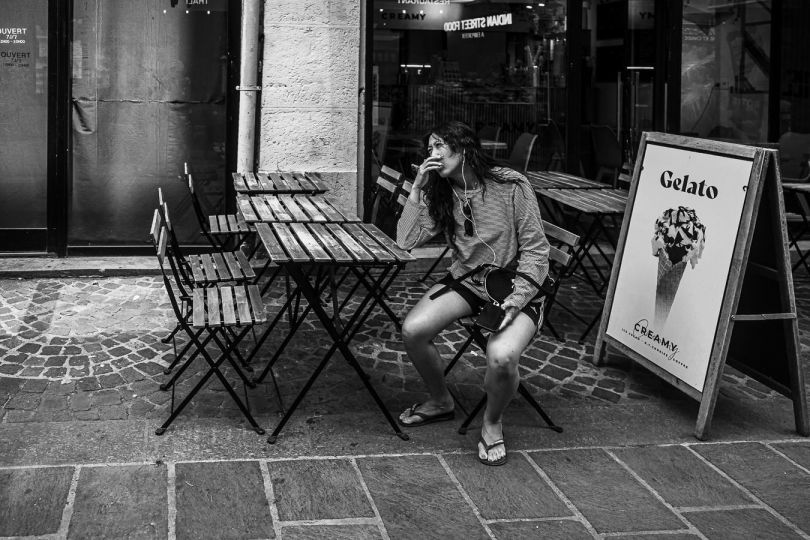
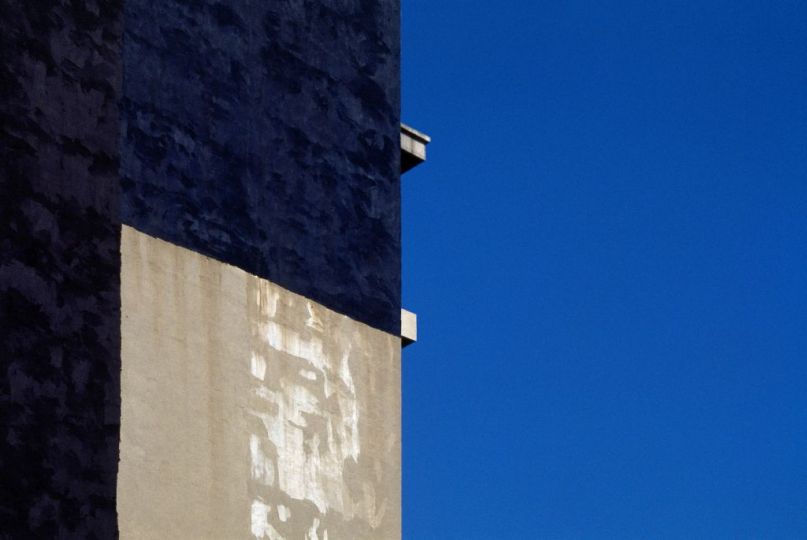
The publication of Quartet, bringing together in one volume four of Daido Moriyama’s early photobooks – Japan: A Photo Theater, A Hunter, Farewell Photography and Light and Shadow – provokes asking what makes his work so compelling. The answer is not to be found by reducing him to a symptom of a defeated, post-World War II Japan or by situating his style as indicative of the fast-forward urban dynamo called Tokyo. Moriyami is his own artist, not a historical-social construct or the manifestation of a cultural phenomenon.
He has called himself a ‘hunter with a camera’, omitting to tell us he is also the hunted. A sense of the fugitive is not an echo or an inflection, waiting to be discerned and traced in his work. It is a plight, a state of being, the substance and the form of his photography. For a number of years Moriyami himself was a fugitive from his chosen career, disillusioned, in retreat, hiding from his terrors. His friend Tadanori Yokoo, writing a short piece in Quartet, remembers when Moriyama’s face would light up with a dream of withdrawing from the limelight and setting up a small printing and developing shop ‘in somewhere like Hokkaido’.
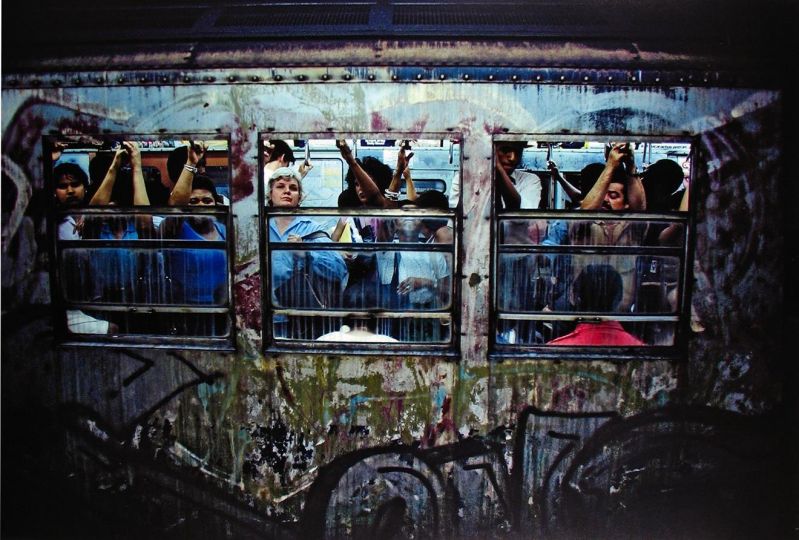
The kind of despair that the dramatist Chekov evokes in his stories of small-town life would not have been felt because Moriyama’s self-reflexive horror does not reside in the perceived banality and inertia of provincial life. It is, instead, expressive of the self’s sense of itself as a subject fleeing from its own existence, haunted by its own ghost. A chord can be struck with Lacan, the French psychoanalyst, and his accounts of the subject (S) as barred ($). Like being banned from a club one would very much like to join, the subject is left outside, isolated, not a substantial object fully assimilated into the symbolic order of the system that seeks to bestow on us the sense of an integrated self. There is, for Lacan, an impossibility at the heart of our selfhood and it divides the subject between its appearance and the void in the core of its being. This is not a division between appearance and its hidden substantial ground but the disturbing realisation that $ is nothing but its own inaccessibility, its own failure to be anything more than an essential lack: a nothingness, a non-All, where there should be something. This is a way of reading the frantic, angsty, self-exiled human figures that populate Moriyama’s street photography: on the move, never schlepping, when they are passive it is usually only images of parts of their bodies that are seen in repose; the rest of the time, they glare agitatedly as if trying to find the point of surviving; even the stray dog photographed in A Hunter has a questioning pose. In a shot of commuters on a subway train, from Farewell Photography, handholds above them dangle like nooses; fugitives from consciousness, they are arrested, condemned.
It is this disquietude that provokes empathy for viewers who see themselves in the disarrayed comportments and blurry, raw images of faces hungry with lack (and for Lacan desire is lack), not predatory but preyed upon. Moreover, there is no aetiology to be sought or applied. Contextualising Moriyama within the culture-conflicted Japan emerging from war and atom bombs is necessary but it cannot account for the way he approaches photography. After all, aspects of his visual style are also to be found in film noir, those American movies which predate World War II and continue into the 1950s. Despite the very different historical settings, there is a shared concern with the use of strong contrasts of light and shadow to create unease, the adoption of irregular camera angles, an intentional asymmetry. For Moriyama, this reaches a terminus of sorts with Farewell Photography where belief in the camera as a means of representing reality, or belief in a representable reality, teeters on the edge of self-destruction. Moments of present time are so perishable, so evanescent, that they can barely be captured before vanishing. Moriyama, like Stephen Dedalus in Joyce’s Ulysses, feels the urgency of the need to ‘Hold to the now, the here, through which all future plunges to the past.’
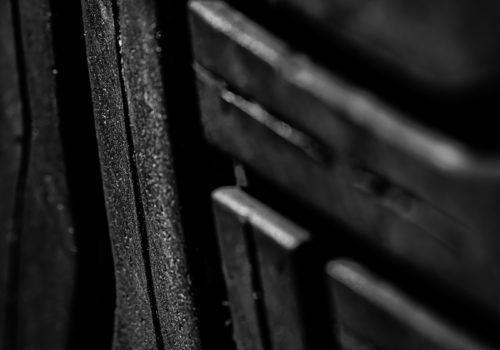
In the ten years after Farewell to Photography Moriyama seems to have inhabited the skin of the human figures he had earlier snapped with his camera on the streets and rooms of those Tokyo neighbourhoods that so attracted him. These were lean, low-key and low-fi years, a period of creative and personal crisis, and when he comes out on the other side his photographic concerns have shifted. Few people and no honky-tonk dives populate Light and Shadow and the images have lost the element of the murkily sinister that characterizes his earlier work. The subject matter has an empirical, muscular quality – a motorcycle’s lamp, a viaduct, bicycle wheels, machine parts – no longer out of-focus, spectral in a realm of moody shadows. What remains the same is the stark contention of light and non-light; when light does triumph it comes in the form of a glistening sink or a urinal mercifully freed from Duchamp gimmickry. The mundane possesses its own, non-estranged theatricality, a tonic for disenchantment.
Sean Sheehan
Moriyama: Quartet
Thames & Hudson
Edited by Mark Holborn
Extent: 440 pp
Illustrations: 250
Size: 29.5 x 21.7 cm
ISBN: 9780500027882
£65.00
https://www.thamesandhudson.com/products/moriyama-quartet?_pos=1&_sid=2729d28e6&_ss=r