The photographic work of Hiroshi Sugimoto explores, with a goldsmith’s patience, the limits of visual representation. His work unfolds between conceptual imagination and pictorial rigor, even defining the functions of photography itself. It enters into dialogue as much with Japanese literati painting as with the abstractions of the second half of the twentieth century, including Pierre Soulages, who himself acknowledged that his outrenoirs stemmed from the same obsession with time and space, shadow and light.
Born in 1948 in Tokyo, educated at Saint Paul’s University and then at the Center College of Design in Los Angeles, the photographer settled in New York in 1974. Since then, he has lived between the United States and Japan, where in 2009 he founded the Odawara Art Foundation, on the site where, as a child, he first saw the ocean and its horizon appear.
Sugimoto’s work has been, and continues to be, exhibited in the most prestigious museums around the world; most recently at the Château de Versailles in 2018; at London’s Hayward Gallery and the Benesse Art Site in Naoshima (JP) in 2023; at the Sainsbury Centre in Norwich (UK) and Gyre, Tokyo in 2025; at the Ebara Hatakeyama Museum of Art in Tokyo in 2025; at the Parrish Art Museum, Water Mill, NY, and soon at the Singapore Art Museum and the National Museum of Modern Art, Tokyo in 2026.
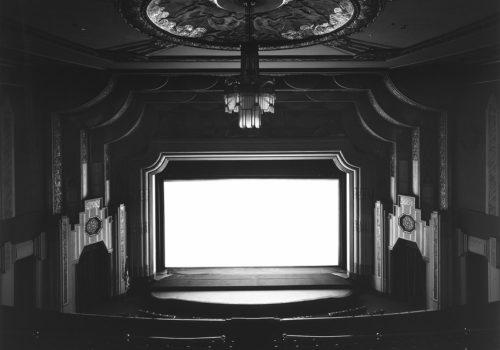
Among his foundational series, Theaters, initiated in 1978, serves as a manifesto. For forty years, the artist photographed movie theaters around the world according to an unchanging protocol: he opened the shutter at the beginning of the screening and closed it at the final credits. The screen, saturated by the total duration of the film, becomes a white rectangle of almost mystical intensity, which the artist describes as “the excess of light illuminating the darkness of ignorance.” Around this irradiated surface, the baroque or Art Deco architectures that frame it emerge. Critic James Attlee sees in it the visual equivalent of satori, that flash of awakening in Buddhist thought. Hiroshi Sugimoto explains: “I realized that before my eyes, externalized on the negative, was my exact inner vision. This image did not exist in reality; nor had I seen it with my own eyes. Who, then, had seen it? I believe it was the camera itself.”
This relationship to memory and time also surfaces in Pine Trees (2001), a photographic rereading of the Screens of Pine Forest by Hasegawa Tohaku. According to the tradition of honka-dori, “taking up the melody,” which allows a work to be reinterpreted, Sugimoto composes, from meticulously observed trees, a vast diptych of twelve images: “It was only at the ultimate vanishing point of perspective in Japan, the imperial palace, whose carefully tended nature is the summit of artificial beauty, that I found the image of the pine I had been waiting for. After studying each of the pines gracefully curving in every direction, I synthetically composed this imaginary pair of six-panel screens. Here, then, is a painting in photographs, although the photographed site escapes any real location. It is everywhere and nowhere, a fiction of pictorial idealization, just as the original was”.
The horizon line, in his work, joins ancestral memory. The Seascapes, shown notably in 2012 at the Pace Gallery in dialogue with the late canvases of Mark Rothko, reduce the world to two bands, sea and sky. Through the long exposure time, the landscape verges on abstraction. “For several decades, I have been creating seascapes. I do not describe the world in photographs. I prefer to think that I project my inner landscapes onto the world’s canvas: skies transformed into luminous rectangles, water dissolving into fluid dark rectangles. And then, looking at the paintings of Mark Rothko, I saw something like the mark of a dark, cutting horizon. That was when I realized that paintings are truer than photographs, and photographs more illusory than paintings.”
More recent, the Brush Impression series brings the darkroom into dialogue with calligraphy, echoing the blacks vibrant with light of Pierre Soulages. On altered photographic papers, the artist paints in the dark, with a brush dipped in developer, ideograms that, after exposure, appear on the paper.
The exhibition at the Musée Soulages, in direct collaboration with his New York studio and conceived by Sugimoto himself, enters at several points into interaction with certain works of the French painter. What unfolds is a walk of philosophical aesthetics, a rare event in France where the Japanese artist’s work has seldom been shown with such contemplative breadth.
Jean-Jacques Ader
Hiroshi Sugimoto ; « Honka dori – reprendre la mélodie »
from April 11 to September 13, 2026
Musée Soulages de Rodez
Jardin du Foirail
Av. Victor Hugo
12000 Rodez, France
https://musee-soulages-rodez.fr/
Publication of the exhibition catalogue by Atelier EXB/Musée Soulages.