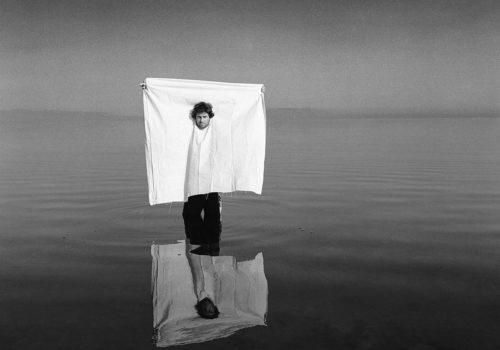
The Maison de l’Amérique latine in Paris is presenting the first French retrospective devoted to Peruvian photographer Javier Silva Meinel. A major figure in Latin American photography, his work weaves a portrait of Peru in which reality never unfolds without a touch of magic.
Born in Lima in 1949, Javier Silva Meinel defines himself as much as a traveler as a photographer. Since the mid-1970s, he has journeyed across Peru, from the Pacific coast to the Amazon rainforest and the Andes mountains, capturing the landscapes and traditions of his country. While he considers himself a “traditional photographer” because of his attachment to the particular temporality of analog photography, his images move beyond a purely documentary approach.
In Silva Meinel’s work, dream and magic are never far away. The title of the exhibition, Umbrales, meaning “thresholds” in Spanish, reflects his conception of photography, which he does not see as a mirror but rather as a threshold where a subtle balance between reality and dream is at play, a passage that invites viewers to move beyond the image.
Masks, costumes and animals appear before his lens, lending a surreal dimension to photographs whose staging reinforces their dreamlike quality. The exhibition, conceived by curator Alejandro León Cannock, reflects this approach. Without chronological order, it unfolds like a constellation or a labyrinth, where portraits, landscapes and festive scenes resonate freely, allowing viewers to immerse themselves in this singular universe.
This way of engaging with reality dates back to the 1980s, when, during a long journey through Peru’s most remote regions, the photographer became interested in rituals linked to Andean cosmovision. Working at night with a slow shutter speed to capture the intensity of bodies and the light of torches, he succeeded in making visible the magic at work in these celebrations.
From this project emerged El libro de los encantados (1988), a foundational work in Peruvian photography. Far removed from postcard-like color images, it reveals the country’s traditions from within and enabled Silva Meinel to become the first Peruvian photographer to receive a Guggenheim Fellowship from the Guggenheim Foundation. From then on, dream permeates his images not as an effect but as a natural consequence of what he observes. Costumes, masks and ritual gestures are inherently staged. Andean rites themselves embody this threshold, this invitation to move beyond reality.
Gradually, Silva Meinel began inviting villagers to step away from festivities and join him in makeshift studios he set up along his journeys. As with Martín Chambi, the great Peruvian portraitist of the early twentieth century who deeply influenced him, the studio comes to the subject rather than the other way around.
A particular sense of complicity emerges in these images, where young Maqtas pose amid laughter, one man stands proudly on his horse, while another poses regally with a pelican as a crown. This complicity lies at the heart of his work and explains the central role of portraiture: “I establish a relationship between the subjects and myself and try to make it as respectful as possible. There is nothing anthropological here. What interests me is the encounter between photographer and photographed.”
Behind these figures posing confidently before the camera, draped fabrics frequently appear. These textile backdrops are not mere decoration. They signal Silva Meinel’s awareness that the image is an artifice, something constructed and shaped with intention. This conceptual dimension, long overshadowed by an ethnographic reading of his work, is precisely what the exhibition seeks to highlight.
The exhibition concludes with a room dedicated to landscapes, notably a large photograph of María Reiche seen from behind, seated facing the vastness of the Peruvian desert. At her feet lie markings as monumental as they are mysterious, the Nazca Lines. The German archaeologist and environmentalist devoted her life to protecting these pre-Columbian geoglyphs dating from around 500 BC. Silent and almost meditative, the image encapsulates what runs through Silva Meinel’s entire body of work: some things resist all explanation, and it is precisely there that photography begins.
Zoé Isle de Beauchaine
Umbrales, Javier Silva Meinel. A poetics of the image
Maison de l’Amérique latine
217 boulevard Saint-Germain, Paris 7th
Until July 25, 2026
http://www.mal217.org