Mu isamaa
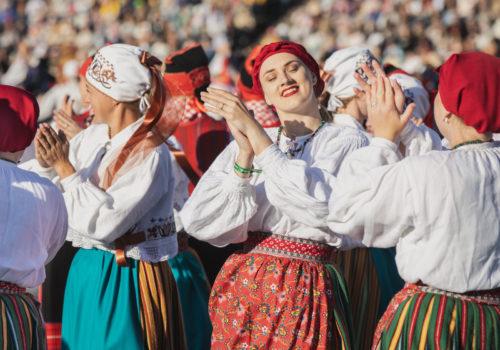
In July 2025, the Estonian Song and Dance Festival was held in Tallinn, Estonia. Every five years, tens of thousands of choir members and folk dancers gather in Tallinn for several days to celebrate Estonian culture and freedom. Laulupidu, the Song Festival, takes place at Lauluväljak, a massive stage dedicated to choral singing that can accommodate up to 15,000 singers at once. Listed by UNESCO as a Masterpiece of the Oral and Intangible Heritage of Humanity, this festival, whose tradition dates back to the 19th century, is the most important event for this small nation of 1.3 million people. With a rich musical heritage, the country boasts one of the world’s biggest repertoires of folk songs. It was also through song that their rebellion against the Soviet regime started to make itself heard. In 1988, during the Soviet era, hundreds of thousands of people gathered there to sing patriotic songs in Estonian, which were then banned, and demand independence. This event is considered the precursor to what would later be named “the Singing Revolution” and would lead to the independence of the Baltic states. This first edition, since the start of the Russian invasion of Ukraine in 2022, stands as a powerful symbol of national unity and
a deep attachment to their homeland.
At the end of each festival, the voices of the 15,000 choir members and the 100,000-strong audience blend together and rise in unison to perform the final song, “Mu isamaa on minu arm” (My homeland is in my heart), in a grand moment of poetry that seems timeless.