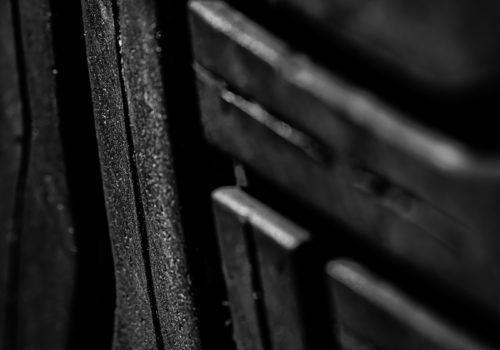
Le Bec en l’Air has published the book by Jean-Pierre Sudre, La vie silencieuse de l’industrie (The quiet life of industry). It is accompanied by this text by Sylvain Besson.
Cheville Ouvrière by Sylvain Besson
For many of our contemporaries, and often for the directors who run them, museum institutions still seem reductible to their Legacy of old Regime. The museum would be a place intended to house masterpieces for the delectation of an elite; only beauty and the material evidence of good taste would be preserved there. From then on, it seems obvious that photographers and critics eager, ever since the invention of the medium, to have photography recognised as an art object in its own right should strive to promote the creation of photography museums. Attempts have been numerous, initiatives diverse. And yet photography cannot be reduced to beauty or to the work of art. Photography is the product of technique, an object disseminated on various supports; it has commercial, social, and industrial purposes. A museum of photography therefore cannot exclude any of the components of the medium. If it wants to speak about reality, it moves away from beauty to explore the terrain of sensibility, sociology, and the human.
A museum devoted to photography must embody the different historical facets of museum institutions. It is at once the heir to the old Regime, the Enlightenment, the Industrial Revolution, and the human sciences. In Chalon-sur-Saône, the Musée Nicéphore Niépce preserves, studies, and exhibits the photographic medium in all its diversity and complexity.
Jean-Pierre Sudre himself embodies the plurality of the medium: fine-art photographer, experimenter in the possibilities offered by technique, teacher, gallerist, occasional historian, commercial photographer… Jean-Pierre Sudre is a kind of photography museum all by himself. More seriously, his long and rich career places him at the heart of the concerns that have animated the Musée Nicéphore Niépce since it opened to the public in 1974. It is therefore only natural that his archive have been kept in Chalon-sur-Saône since 2017.
The Musée de la photographie de Bièvres was founded in 1964 and the Musée Nicéphore Niépce in Chalon-sur-Saône came into being administratively in 1972 (these two institutions are still today the only ones to claim the title of a museum devoted exclusively to photography). Within this movement toward recognition of the medium and in a market still under construction, between 1968 and 1972 Jean-Pierre Sudre organised at the gallery La Demeure exhibitions that brought together contemporary photography and tributes to the early calotype practitioners. This comparative approach met with great success, fostered cross-fertilisation in ways of looking, and laid the foundations for a museological approach to the medium. It gave photography a historical depth largely absent at the time, inviting photographers of his own era to engage in dialogue with their illustrious predecessors.
When he moved to Lacoste in the Vaucluse in 1972 to devote himself to his artistic projects and to teaching photography, Jean-Pierre Sudre put an end to his first career that of illustrator and accomplished industrial photographer in order to commit fully to experimentation, precious printing, and historical processes. For Sudre the break was total and definitive. The collections of the Musée Nicéphore Niépce bear the traces of this radical change. Under its first director Paul Jay (1972–1995) the museum acquired, by purchase or donation, several of Sudre’s photographs: the portfolio Paysages matériographiques in 1975; still lifes and then other “material landscapes” in 1978 and 1980; the portfolio Nus in 1979; photographs made from diamantine and argentine in 1981; undergrowth scenes in 1983; and, in 1994, panels from the diamantine series saved from destruction during the last days of his photography school in Lacoste. Still lifes from the 1950s and experiments from the 1970s, then: both the artistic work of the beginning of his career and his most recent aesthetic research. Industrial photography was never included in these acquisitions, as if set aside by both Sudre and Paul Jay. At the same time, Sudre supported the museum in its first steps in mediation by leading workshops and training sessions, thus continuing his lifelong work of transmission. While Paul Jay was developing the museum’s programme alternating invitations to contemporary photographers and tributes to the pioneers of the medium collaboration with Jean-Pierre Sudre was a natural fit.
When the family of Jean-Pierre Sudre approached the Musée Nicéphore Niépce in the mid-2010s, after the deaths of Jean-Pierre Sudre in 1997 and Claudine Sudre in 2013, the thread, stretched thin between the Sudres and the museum, was retied. Jean-Pierre Sudre is neither modern nor contemporary: he is an essential practitioner of photography who, for nearly fifty years, accompanied the medium’s transformations. Beyond their past companionship, the central role he played in the photographic world naturally imposed him within the collections of the Musée Nicéphore Niépce, which since 2009 has acquired, studied, and showcased complete archives from photographers.
Jean-Pierre Sudre’s archive exemplifies the complexity of photographers’ trajectories; it reflects the evolution of practices and techniques and demonstrates that careers are anything but linear. Comprising flexible black-and-white negatives (mostly 6×6 cm and 24×36 mm, 1,168 rolls) kept in their original, carefully annotated crystal sleeves; glass negatives (13×18 cm); duplicate negatives and positives; slides and ektachromes (from 24×36 mm to 18×24 cm); contact sheets glued onto school paper and gathered in binders; work prints (mostly 24×30 cm); exhibition prints (in various sizes); book maquettes (24×30 cm); correspondence and notebooks, etc., the archive is heterogeneous. What first surprises the viewer is the sheer quantity of negatives and prints from his industrial period (more than 6,000 prints in a handsome 24×30 cm format), as well as the impeccable organisation of the contact sheets in binders (date, place, subject, cross-references to the corresponding negatives, meticulous indications of envisaged crops, etc.).
According to the family of Jean-Pierre Sudre, applied photography was a purely bread-and-butter activity that he did not much enjoy so much so that he would inflate his fees to dissuade potential clients, without success. As soon as he had the opportunity, he abandoned this photographic work in favour of teaching and pure creation when he moved to Lacoste. Yet his industrial photographs, and those of Bruges for the publisher Arthaud, would be his most widely seen and widely known images, if not the most highly regarded. It is true that Sudre was active during the Trente Glorieuses: this was the era of the country’s reconstruction. Supported by the state, industry was booming and photography accompanied its expansion. In images, it was a matter of making the Débâcle fade from view and promoting the renewal of French industry. Sudre made full use of this prosperous period for photographers, in the same way as André Papillon, François Kollar, Jean-Louis Swiners and many others. The list of clients noted on the contact-sheet binders leaves no doubt: Saclay, Air Liquide, Rapido, Total, Sidérurgie Lefebvre, Saint-Gobain, Isover, Orel, Maggi, Sisa, Orly, Veranit, Oxy Synthèse, EDF, Carel Fouché, SNCF, Lafarge, General Motors, Soudure Électrique Languepin, Tubauto, Simca, Peugeot, Renault, Industrie Gislong, BP, Philips, etc. France was modernising, building factories and cars, investing in nuclear power, and so on, and Sudre was part of every campaign. Corporate books, user manuals, all sorts of promotional objects: Sudre’s photographs were everywhere, even though he barely acknowledged them and many people had no idea that a cut-out image of a machine tool in a company leaflet was by the same hand as the famous panier aux œufs of 1956.
Now that the whole of Jean-Pierre Sudre’s photographic work has been reunited, it is clear that the formal qualities of his commissioned work are, in themselves, enough to justify museum interest: the rigour of his framing and recomposition, the care devoted to his prints and albums. They are less objects for study than objects for exhibition. After all, that was their first destination: fruits, rooted in their time, of commissions made for prestigious clients and destined for publication. Jean-Pierre Sudre’s photographs for industrial advertising demonstrate both his freedom of creation and his desire to meet the demands of his commissioners.
Even if museums, especially photography museums, cannot be reduced to the expression of “beauty”, everything is “beautiful” with Jean-Pierre Sudre—or rather he makes everything more “beautiful”. He magnifies the most ordinary subjects and seems to approach with the same application a basket of eggs destined for exhibition and a machine tool destined for an advertisement. While he benefited from the windfall of the Thirty Glorious Years after world war II, Sudre above all seems concerned with pursuing his formal experiments; his contact sheets for Air Liquide or Languepin at times foreshadow the future abstractions in diamantine and argentine.
The apparently singular trajectory of Jean-Pierre Sudre is in fact a common one among his contemporaries. Like many of them, he navigated economically between personal creation and bread-and-butter work, while also engaging in teaching and promoting photography. It turns out, however, that more than most he managed (sometimes despite himself) to reconcile these seemingly opposed paths, making them speak to one another, each feeding into the other and vice versa. By bringing his entire archive together in its collections, the Musée Nicéphore Niépce restores full coherence to his work and thereby underscores the exemplary nature of the career of a major figure in photography in the second half of the twentieth century.
Sylvain Besson
Jean-Pierre Sudre : La vie silencieuse de l’industrie
Texts by Jean Deilhes, Sylvain Besson, Fred Boucher
The Trente Glorieuses or the hidden side of the work of a master of twentieth-century photography
23 × 28.5 cm
144 pages
Hardcover
120 black-and-white and colour photographs
ISBN 978-2-36744-198-6
45 €
www.becair.com