The Jeu de Paume is presenting an exhibition exploring the links between artificial intelligence and contemporary art until September 21st. It is the first in the world of this scale.
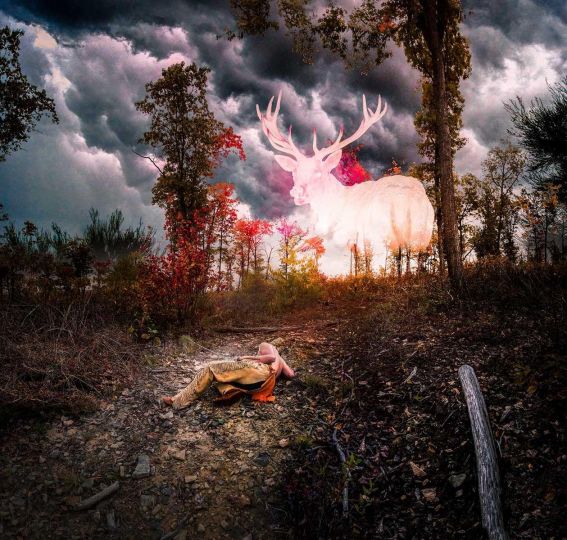
The major exhibition dedicated to AI at the Jeu de Paume in Paris reveals the extent to which it is possible to invent forms, figures, and potential lives. A stroll through the works of some forty contemporary artists, all of whom have worked with or based on AI.
What lies behind AI? This entity that we still struggle to define and circumscribe very clearly… Ally or enemy of human beings? The question is not really posed in the exhibition, but the latter has the immediate merit of showing what we do not see, in particular, from the first room, a vast diagram produced by researcher Kate Crawford and graphic designer Vladan Joler which maps the entire network necessary for the development of AI. We thus become aware of what AI requires in terms of natural resources and the problem of energy consumption of data centers located all over the world.
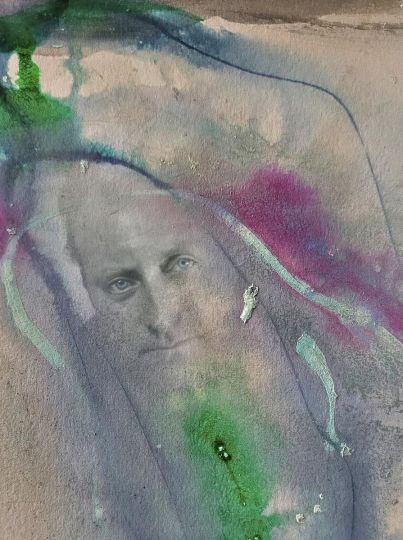
Other limitations of AI highlighted in the first part of the exhibition include facial recognition and the exploitation of thousands of click workers, often poorly paid individuals who must moderate social media posts, sometimes encountering images of abuse or violence. A video by Hito Steyerl showcases these workers, giving them a voice, while photographs by Trevor Paglen warn of the dangers of facial recognition, particularly through a striking portrait of Simone de Beauvoir. A display case reminds us that this issue is not new. Discussions on facial recognition and artificial vision were conducted even before the advent of AI, notably by the philosopher Paul Virilio and by the filmmaker Jean Epstein in his book The Intelligence of a Machine, written in 1946.
Prehistoric Drawings
After revealing this hidden face of AI, here are the works that emerge thanks to AI. A space first recalls that there was a whole “generative art” in the 1960s and 1990s that already used the properties of computers, without obviously being able to go as far as AI allows, particularly generative AI, the kind that has been on our minds since the early 2020s. Many artists are using it to create images and forms that could not exist without it. Examples include the works of Egor Kraft, who works to reconstruct faces from damaged ancient sculptures, or the video by Justine Emard, who produces new drawings based on those in the Chauvet Pont d’Arc cave, generating possible prehistoric drawings that never existed.
A little further on, the same process is used by the artist Joan Fontcuberta. He had fun completely reusing the aesthetics of the plants photographed by Karl Blossfeldt at the beginning of the 20th century to create new plants entirely invented by AI from organic fragments and industrial waste, questioning our own relationship with nature and artifacts. Alongside this, the filmmaker, researcher, and writer Érik Bullot offers images created by AI to bear witness to an “imaginary cinema” at the crossroads of literature and parapsychology. He draws in particular on the book Cinéma vivant by the symbolist poet Saint-Pol-Roux, written in the 1920s and 1930s.
A 3D-printed recumbent figure
Images that then become mobile with the projection of six videos made entirely with AI. These disturbing images blur ordinary human perception and profoundly question our way of seeing the world, reshaped by the new possibilities of AI. This is further extended with Samuel Bianchini’s work, which invites us to look at an image broken down into thousands of pixels in order to reveal the artificial life of digital images and highlight their fragility.
A little further on, a vast space is dedicated to the work of Grégory Chatonsky. The artist imagined his “tomb,” in which he placed a 3D-printed recumbent statue, around which AI-generated images and sounds gravitate. “These are possible lives that I haven’t lived,” explains Chatonsky, who displays this autobiographical work and questions death in a digital society, particularly what remains of us on the internet.
Calligraphy
The final part of the exhibition focuses on AI’s intervention in the written word. The Barcelona-based collective Estampa aims to highlight AI’s “hallucinations,” that is, its errors, by creating a repetition of sentences that borders on delirium. Nearby, artists invent new languages, an alphabet, and even calligraphy. Automatic writings are displayed, sometimes reworked directly by the writer, as is the case with Canadian poet David Jhave Johnston’s work ReRites, or even much earlier literary references, notably Jonathan Swift’s Gulliver’s Travels, where the author invented a machine to generate random writing in the 18th century.
The final work of this exhibition was created by Christian Marclay in collaboration with the social network Snapchat, a partner of the event. An electric piano is placed in a pitch-black room. When the keys of the musical instrument are pressed, a thunderous sound emerges from hidden speakers, and above all, a screen appears on which dozens and dozens of videos of all kinds scroll by. They all come from the Snapchat app. Enough to make your head spin a little more, reminding us of the gargantuan production of images in the world, a production that AI will do nothing to diminish.
Jean-Baptiste Gauvin
Le monde selon l’IA
From April 11 to September 21, 2025
Jeu de Paume
1 Pl. de la Concorde
75008 Paris, France
www.jeudepaume.org