Thierry Maindrault’s Monthly Cogitations
Loneliness is a very particular state that we often experience in contradiction to our aspirations at a given moment. We ardently desire it as a refuge when we are overwhelmed by the consequences of all kinds of poorly controlled social gatherings. We rage at being prisoners of it as soon as we aspire to a minimum of interaction with our fellow human beings. In a nutshell, this state, whether sought or fled, frequently remains a source of discontent when we are immersed in it. In any case, loneliness is never, unless expressly desired by the solitary individual, a permanent situation. Only hermits revel in lasting and complete solitude. It goes without saying that each of us has our own individual position on a very broad scale, proportional to the amount of time we spend in isolation. The question remains whether the place that life assigns us on this scale corresponds to our actual aspirations, which does not always seem to be the case.
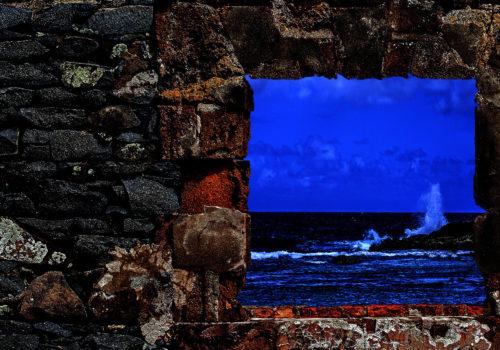
For many obvious reasons, the work of photographers often brings them close to a very pronounced solitude.
It begins with the use of technology to create a photographic artwork. From the moment the picture is taken, the photographer, even if they are well assisted or surrounded by a crowd, is always isolated at the fateful moment. The moment when they must press the shutter button, neither too early nor too late. Next comes post-production, whether analog (in its multitude of processes) or digital. This is the moment of choice for the author of a work, their reflection on the value of the photograph captured. Discernment among their photographs to extract the one that will become the Image. Finally, after a magical work, which is always essential no matter what some people say, comes the time for realization (printing) and questioning the proofs. An image is born, and the future will determine whether you were an author or one of the many users of various cameras. Then you can claim to be the author of this accomplished photographic work.
Due to the nature of the technique, photography involves a certain isolation for its enthusiasts, but that’s not all!
As you can see, intellectual solitude is essential to our entire process of designing, creating, and producing a photographic image. But it is not the only kind of solitude; creative solitude manifests itself in a way that is less visible, but much more insidious. All photographers—war photographers, fashion photographers, scientific photographers, all photographic artists—know this. They endure this isolation of the mind, this doubt of the soul. This stress, impossible to share, settles in from the birth of the project until the readers’ comments. This future creation turns and twists in the skull, searching for an escape route called feasibility. This gamble to push beyond common limits to inspire wonder without tipping into vulgarity. This forbidden sharing with others to allow as many people as possible to enjoy, cry, or marvel at the pictorial artwork. It is this whole, often hidden by the “little black veil”, that no one ever mentions, out of noble modesty or shameful confusion, that is the concrete boundary of the solitude of photographic image makers.
It remains to mention the loneliness of the profession, an unbelievable situation in many respects. How can a skill that is involved in all economic, sporting, social, cultural, scientific and other activities be so easily dismissed and robbed? I have heard all kinds of excuses, both thoughtful and grotesque. But to this day, no one has been able to explain to me why Music and other fields have been able to protect their own, while photography has seen its faithful followers disappear.
Our fierce individualism, which is almost hereditary among photographers, is certainly not unrelated to this observation. As I just mentioned, the nature of the work means that there is little physical interaction between photographers, who meet, more or less politely, at a photo shoot or an exhibition opening. The fear of plagiarism is always underlying. This feeling is exacerbated by the popular explosion of technology and the comments heard a thousand times from the average citizen: “… I did the same ones …”. It is certain that these deluded surveyors are deluding themselves, but the fact remains that these comments sow doubt. I have never heard a very good, passionate painter say, “I did the same ones” in front of Van Gogh’s sunflowers. I am not talking about those books and exhibitions that lend credence to these comments through the absolute vacuity of the works they present. As the foundations of solidarity have never been laid, as was the case in other disciplines, it has become very difficult to break out of this somewhat vicious circle that confuses everything and anything. To make people believe that technique and form give birth to Art completely distorts the collective appreciation of a true image. The absence of powerful and unquestionable solidarity prevents any collective rescue effort. Yet the solitude of creation does not require living in seclusion from economic and social communities.
The worst comes when it becomes essential to set up categorical structures for protesting (unions), economic structures (recovery of rights), or other structures. In urgent request, the community of photographers breaks down into structures that are more concerned with defending their own interests than those of their constituents. None of them has the size or the support of the community to be effective, which leads to fragmented management with no real impact. There is no single powerful voice representing the general interest to ensure, at the very least, the defense of our work. While the solitude of photography takes a heavy toll on each of us individually, it also weighs heavily on our entire community.
The globalism of communication raises questions about the social evolution of humanity, which is losing all form of value with the loss of control over its educational systems. Photographers are still not concerned about the disastrous consequences of the loss of their knowledge. I am well aware of the reflections of many disillusioned colleagues, which a few years ago were dismayed, then horrified, and have now become overwhelmed. Photography is an art form (in the sense of technical mastery) that is learned through apprenticeships, mentoring, and interaction with others. Excellence cannot be taught by civil servants who are incapable of achieving what they teach. This remark may not apply to the few who are aware of their limitations and take care to expose their students to the realities of the profession. Photography cannot be learned; it is lived as a passion. We have been a little too quick to forget that passion must be shared if we want it to endure. Is not that the common denominator for the survival of our own images?
Thierry Maindrault, March 13, 2026
your comments about this chronicle and its photography are always welcome at
[email protected]