Bus Stops at Jodhpur Road
Rajasthan is one of the most attractive travel destinations in India. The gigantic forts and palaces as well as the unique havelis (manorial residences of wealthy merchants) contribute significantly to this, but certainly not the bus stops. As is the case almost everywhere in the world, they are hardly given a second glance, their only purpose being to protect those waiting from the wind, rain and sun and, at best, to offer them a place to sit (The bus stops dating from the former Soviet Union are an exception, see Ch. Herwig “Soviet Bus Stops”, Fuel 2015).
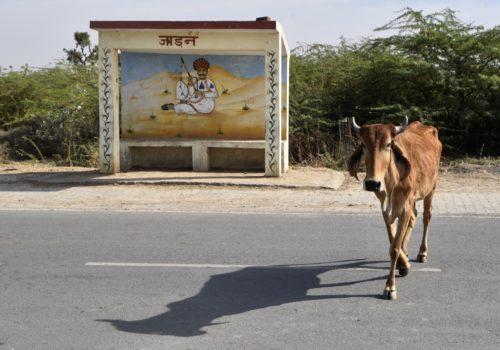
However, the bus stops that appear every few kilometers on both sides of the Jodhpur Road towards Udaipur attract our attention, not because of their simple concrete architecture, but because each one has a mural on the wall behind the bench. The colorful paintings depict a variety of themes from Hindu mythology, traditional ceremonies, folklore, everyday life and nature. They are painted by various artists in the style typical of Rajasthan, which originated in the 18th and 19th centuries when, during a period of prosperous trade and economic prosperity, merchants decorated the interior and exterior walls of their havelis with elaborate murals to demonstrate their wealth and cultural affinity.
This tradition of mural painting lives on to this day and can be found in the streets of Udaipur or Jodhpur and also here on the bus line that connects the two cities. Thanks to the murals, the architecturally indistinguishable bus stops are given an individual identity, also to the delight of tourists.