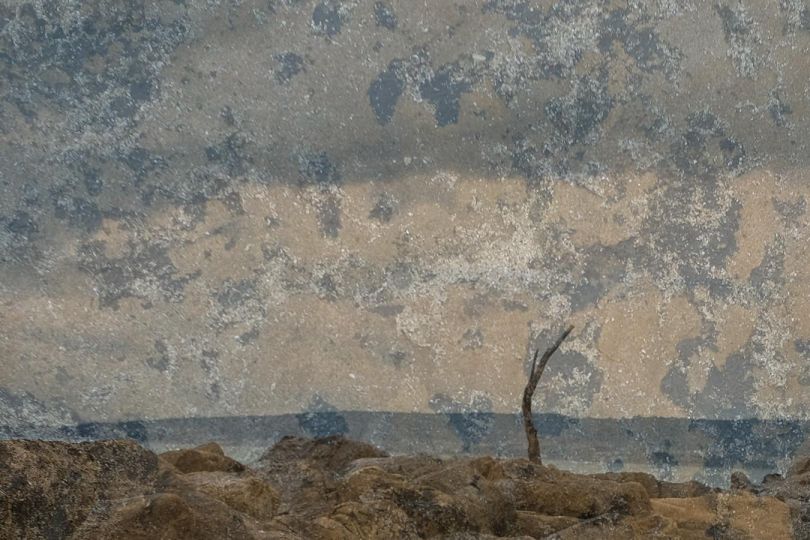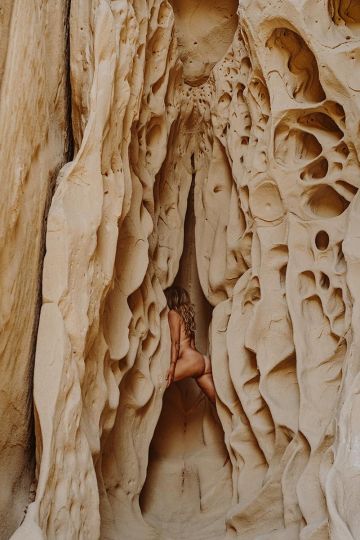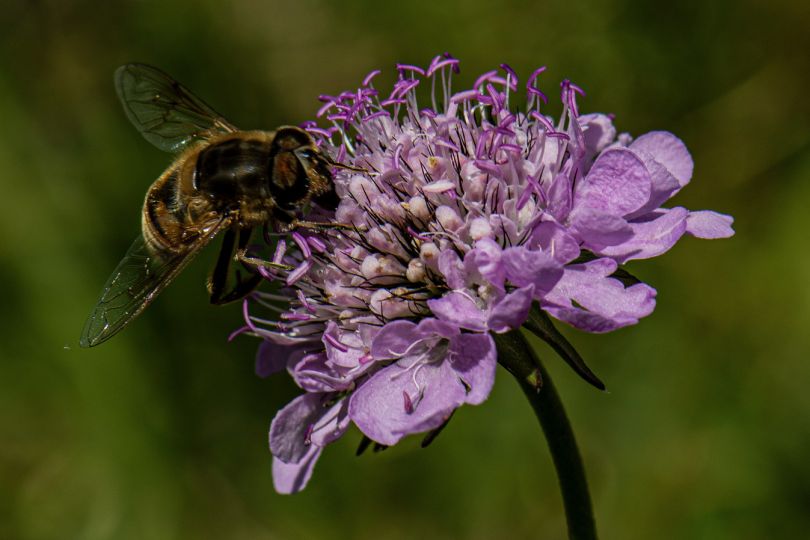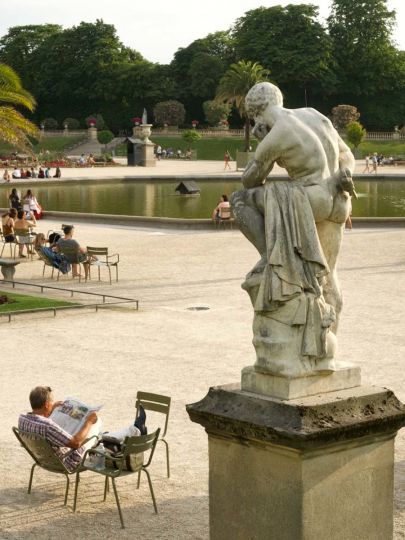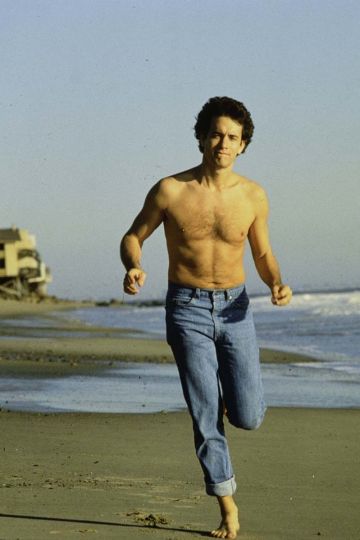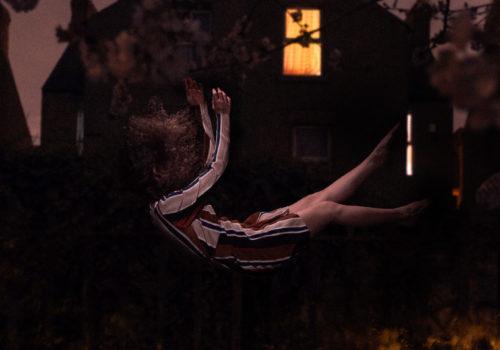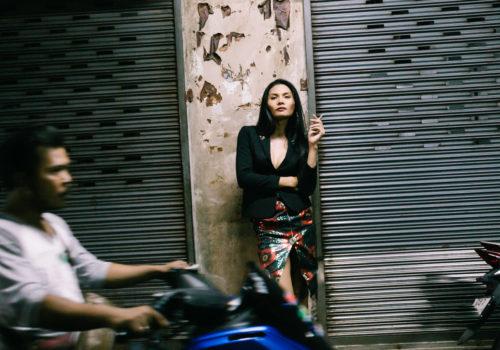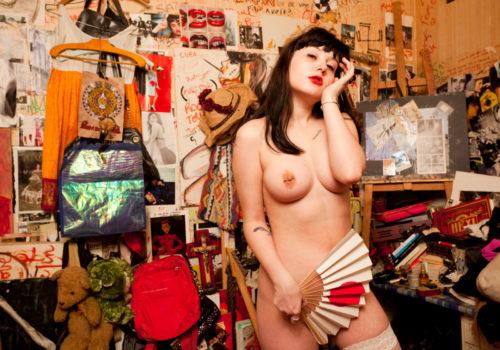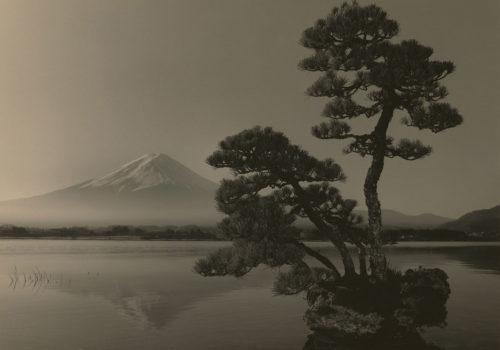
Back to Lectoure, whose 2026 program we previously announced (1), to find on the walls of the art center the artfully pinned images of Yamamoto Masao (1957, Gamagōri, Japan), representing a fairly broad range of his work. First drawn to painting, he turned in the early 1980s to photography and above all to photographic processing and its various technical possibilities: developing, dyeing, toning, or even painting by hand. Yamamoto makes small-format prints, evocative of family photographs, which often express the melancholy born of the ephemeral nature of things. We spoke with him.
JJA: Your images often look like souvenir photographs, but it is hard to say whether they are yours or ours?
MY: That’s true I am not at all trying to show autobiographical things, or lived moments. I am very happy if the viewer projects themselves into what I am trying to evoke. That is also why I work on the format of the prints, why I age them, notably with different toning processes, in a way that also expresses the passage of time. It is also a way of giving form to a certain nostalgia, without it being negative, so that everyone can immerse themselves in the time contained within the images.
JJA: You put no title or date on your photos, what would change if you did?
MY: For me, if you give a date or a place, there is no longer any story possible. Giving no indication is a way of letting visitors enter the images, of not constraining them, and let them be free to perceive whatever they want..
JJA: The small format of your photos can bring to mind old photographs, the kind one might find in a forgotten box.
MY: Yes, the question of small format is important to me; it is tied to memory. Most people rarely have large-format photos at home. Identification is therefore easier small formats are more familiar and it is also important to have photos that fit in the palm of the hand. I moved away from the idea that a photograph is a surface, preferring to make it an object; that is what guided me at the beginning of my installations.
JJA: Is that why you let visitors to an exhibition touch your photos?
MY: That is something I did in my early days. There was generally a box filled with photos, yes, but I no longer do that, in agreement with the galleries and museums.
JJA: You photograph simple things — a bird, a landscape, stones; at what moment do you tell yourself there is an image worth taking?
MY: Chance plays a large part. It is very much tied to walks; I don’t set out in the morning with the idea of photographing this or that. I always have a camera with me, of course, but everything depends on what I encounter. It is also about the way of taking images. Photography is the medium that best corresponds to what I want to do. I like to reduce the amount of visual information; I can remove colors and pare things down as much as possible to reach the essence of the subject and, I hope, attain its beauty. There is a share of intuition that is important in my work, I think. This intuitive approach, I am nonetheless beginning to grasp it over the years, and in fact my approach is probably about putting human beings back in their place, reminding us that we are only one part of this great whole that surrounds us. We live in very busy societies, with full days and goals to reach; I believe it is positive to show that one can also do things without a purpose, to pause and reflect, or simply to cast a contemplative gaze at one’s surroundings.
JJA: Millions of digital photos are now taken every day, transmitted through social networks and quickly replaced by new images; isn’t this a danger for “real” photography?
MY: It is not only a question of speed or technical progress. If the long time of the analogue image matters to me the developing, the printing, the dyeing it is a time of maturation granted to the images. A photo taken on a phone is quickly made but also quickly forgotten. I prefer to work more slowly and for my images to endure, while still being passed on. There is also a question of language. All these digital images we exchange are often accompanied by messages, whereas my work is tied to this search for beauty, present all around me, which takes the place of words.
Text and Interview by Jean-Jacques Ader
(1) https://loeildelaphotographie.com/fr/lete-photographique-de-lectoure-2/
With thanks to Lilian Froger, curator of the exhibition, who made possible the translation of the conversation with the artist.
L’Été photographique de Lectoure “Au ras du Réel” from July 11 to September 20, 2026. Every day, 2 pm to 7 pm – Information: https://centre-photo-lectoure.fr/festival/