A Critical analyse of Modern French Photography
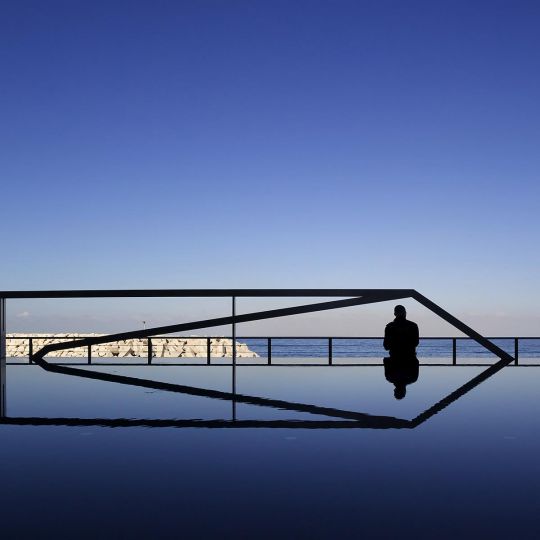
The Galerie Roger-Viollet presents a major retrospective dedicated to Gaston Paris (1903–1964), a French photographer whose remarkable career and enduring influence on modern photography have long been overlooked. Titled « L’Équilibre du Carré » (The Balance of the Square), the exhibition features 58 black-and-white prints that illuminate his systematic use of the square format and the geometric rigor of his vision, revealing a unique capacity to blend formal precision with poetic imagery.
This retrospective is part of the 14th edition of the Photo Saint-Germain festival ( from November 6 to 30th 2025) and continues the rediscovery of Gaston Paris initiated by historian Michel Frizot, who observes: “Gaston Paris is a virtuoso of difficult, insufficient, or overly contrasted lighting, and of backlighting; he knows exactly where to position himself to capture the most impressive view, one that is beyond the ordinary spectator. His photography becomes a spectacle in itself, a substitute performance made accessible to all readers.”
Trained in journalism and active from the 1930s, Paris contributed to leading publications such as Vu, where he was the magazine’s sole staff photographer, as well as Regards and Art et Médecine. As a member of the group Le Rectangle, alongside Pierre Jahan and Emmanuel Sougez, he developed a singular visual language in which rigorous composition and formal audacity transform each image into an aesthetic and intellectual experience. His work oscillates between social reportage and formal experimentation, capturing everything from the ocean liner Normandie and the aeronautical wind tunnel at Chalais-Meudon to railway workshops, construction sites, and the urban and industrial landscapes of Paris, from the Eiffel Tower to the backstage of the Opéra Garnier. Each square frame is meticulously constructed, turning everyday scenes into balanced and compelling visual narratives.
While less widely known than some of his contemporaries, Paris remains an essential witness to both the interwar and postwar periods. His photography aligns with aesthetics associated with surrealism and the so-called “social fantastic,” exploring the fringes of society and capturing gestures, glances, and atmospheres with near-cinematic precision. From the backstage of Parisian cabarets to fairgrounds, from working-class neighborhoods to major public events, he seizes fleeting moments with rare sensitivity. Collaborating with Man Ray, Robert Capa, and Germaine Krull for Vu, he produced reports on cinema, theater, music, and political events, combining social curiosity with formal rigor to create images that are both living documents and works of art. Blind Magazine notes that “the photographer’s composition, lighting, and original viewpoint were convincing,” highlighting the distinctive originality of his vision and framing.
“A Photographic Practice Between Reportage and Abstraction”
Certain iconic compositions exemplify his approach: the aeronautical wind tunnel at Chalais-Meudon, transformed into a photographic sculpture through repeated structural lines and vanishing points; the illuminated Eiffel Tower during the 1937 World’s Fair, where monument and light converge into a graphic motif; and portraits of Simenon, Cocteau, Piaf, and Jouvet, where each square frame conveys a rare intimacy and subtle psychological depth. These works demonstrate Paris’s ability to capture the essence of his subjects within a rigorously constructed aesthetic that balances documentation with abstraction.
Compared with his contemporaries, he is distinguished by the equilibrium he achieves between reportage and graphic composition. Whereas Robert Capa favors the decisive moment and Man Ray pursues surrealist experimentation, Paris combines these dimensions, producing images that function simultaneously as historical documents and aesthetic objects. His ability to integrate human and poetic qualities into industrial or urban landscapes further differentiates him from Germaine Krull, who focused more exclusively on architectural abstraction.
Following his death in 1964, the Roger-Viollet Agency acquired his entire archive—nearly 15,000 negatives, now preserved at the Bibliothèque Historique de la Ville de Paris. The 2022 retrospective at the Centre Pompidou initiated recognition of his influence, while the current exhibition at the Galerie Roger-Viollet offers a rigorous, critical exploration of his methodology, highlighting his contribution to the formal structuring of modern photography and his ability to transform reality into graphic and poetic composition.
The Balance of the Square invites the public to rediscover Gaston Paris as a major twentieth-century photographer, whose mastery of framing and geometry reveals the poetic intensity of each image, making his work an unparalleled social and historical chronicle of a changing French society.
Practical informations: Galerie Roger-Viollet, 6 rue de Seine, 75006 Paris. Dates: 2 October 2025 – 17 January 2026. Opening hours: Monday–Saturday, 11 a.m.–7 p.m.