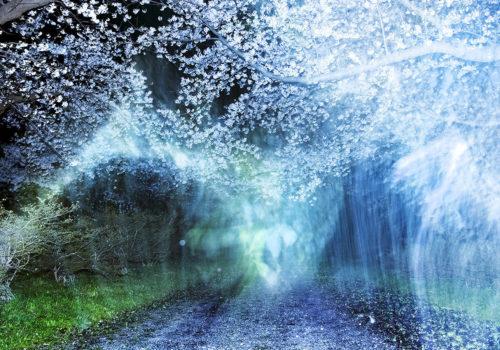
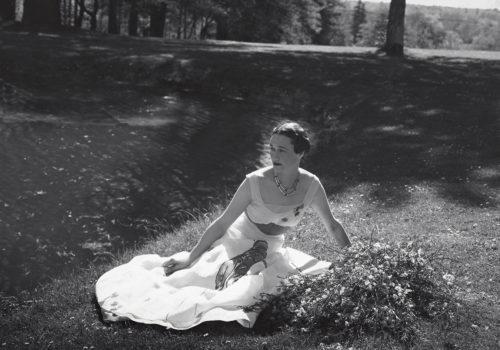
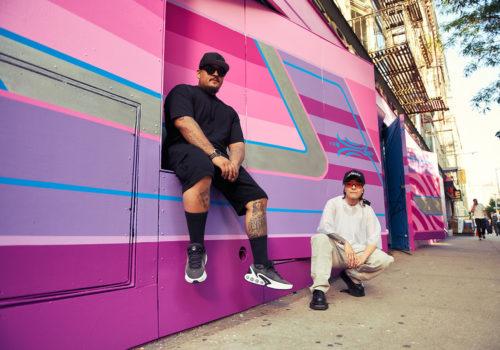
Galerie écho 119 presents Japanese photographer Kazuo Kitai for the first time, with a special focus on his latest series, Iroha. This exhibition, “i.ro.ha — 1, 2, 3 !” accompanies the major retrospective to be held at the Maison de la Culture du Japon in Paris from April 30 to July 25, 2026.
Kazuo Kitai, still too little known in Europe, is nevertheless one of the essential figures of Japanese documentary photography and is recognized in Japan as one of the great masters of his generation. For more than 60 years, he has documented the movements
social movements of his country — from the student demonstrations of the 1960s to the farmers’ struggles against Narita International Airport, the transformations of the Japanese countryside, and daily life in working-class neighborhoods. His deeply humanist gaze forms a broad panorama of the transformations of Japanese society since the 1960s.
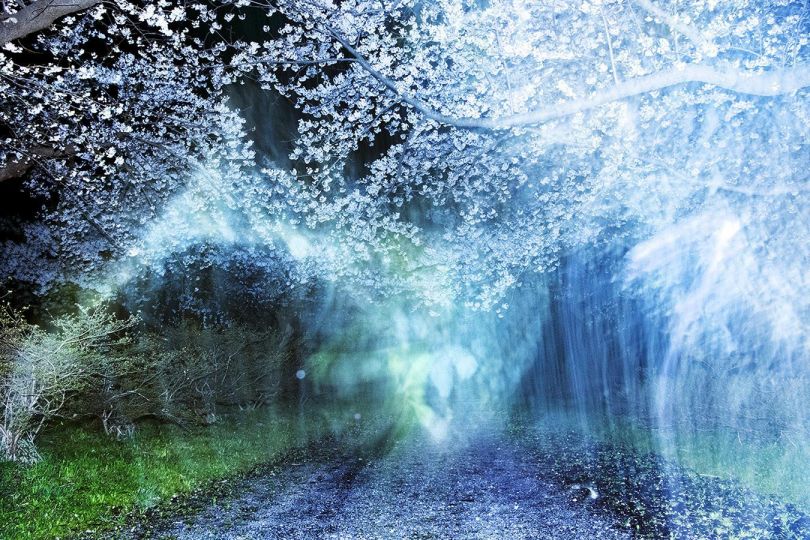
Iroha, which can be translated as “a, b, c,” marks a decisive turning point in his career. While this photographer has always identified with the struggles of those he photographed, participating in rebellions as much as documenting them, at over 80, he revisits his own archives with a gesture just as radical: tearing, then mending, and finally covering with paint the prints from his beginnings — those made when he was 20, at the time of the student protest movements — it is now against his own photography that he rebels.
As he recounts: “Taking photographs had become somewhat painful for me. Not knowing what to do anymore, I decided to tear up old original prints. I thought that by tearing them up, I would feel lighter and could then envision new images.” These radical gestures of destruction and covering, which come close to a palimpsest, explore his own rebellion — no longer political, but personal.
Drawing simple lines, numbers (1, 2, 3), letters (i, ro, ha), and basic geometric shapes (squares, circles, triangles), he establishes a connection between his first steps in photography, the acts of protest of his youth, and his intact capacity for renewal.
“Sixty years have passed since I began taking photographs. I don’t know why I was able to continue for so long, but I believe it is partly because it has always amused me.” iroha illustrates this freedom and renewed energy, where memory, color, and gesture come together to offer a new perspective on his documentary work. The series is a true invitation to reinvention, an ode to joyful and rebellious creation.
So, ready?! 1, 2, 3… !!!
Kazuo Kitai was born in 1944 in Manchuria (then under Japanese occupation).
Quickly abandoning his photography studies at Nihon University College of Art, he established himself in documentary photography at the end of the 1960s by following the protest movements shaking Japanese society: student demonstrations, mobilizations of the radical left, and farmers’ struggles against the construction of Narita Airport.
The book very early became a central means of disseminating his work. In 1965, he self-published his first collection, Teikō (Resistance), which would become the first book in an abundant publishing career.
In the mid-1970s, Kitai moved away from explicitly political subjects to turn his gaze toward the rural world. With To the Village and Somehow Familiar Places, he observed the silent transformations of the countryside — work that earned him the distinction of being the first recipient of the prestigious Kimura Ihei Award in 1975. This attention to everyday life continued in later series such as Shinse-kai Monogatari and Funabashi Story, and later, Walking with Leica.
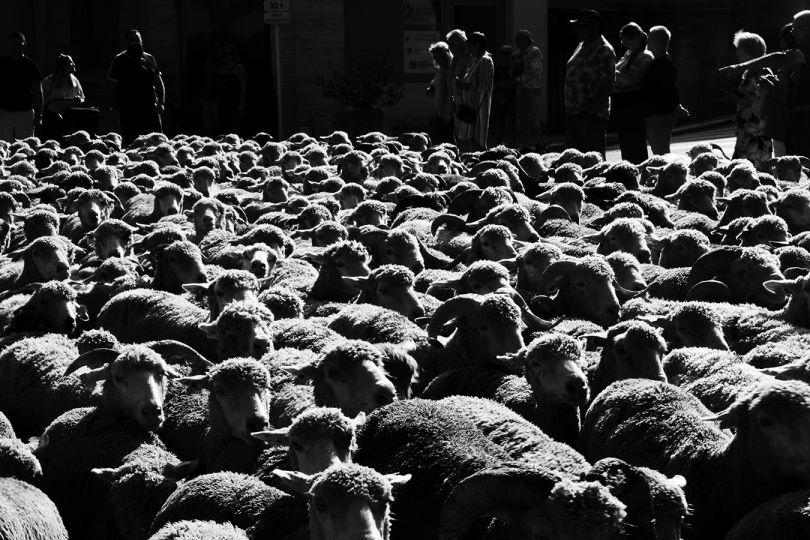
Although the aesthetic of his images — often blurred snapshots, pronounced grain, strong contrasts — evokes that of the young generation of Japanese photographers of the late 1960s, notably Provoke, Kitai has always cultivated his independence, joining no group.
With his recent series Iroha, he makes a genuine shift from his initial documentary approach, testifying to a radical renewal at over 80.
Honored several times by the Photographic Society of Japan, he received the Kazuemon Hidano Award in 2024 during the Higashikawa International Photo Festival. His works are included in the collections of the Tokyo Photographic Art Museum, the National Museum of Modern Art, Tokyo, as well as the San Francisco Museum of Modern Art, the Museum of Fine Arts, Houston, and the Art Institute of Chicago.
The Maison de la Culture du Japon in Paris will host a major retrospective of his work in 2026.
Kazuo Kitai : i.ro.ha — 1, 2, 3 !
April 28 – July 11, 2026
Galerie écho 119
1 rue des Minimes
75003 Paris
www.galerieecho119.com