Located within the Labruguière Cultural Center, fifteen minutes from Castres (Tarn), the Espace Arthur Batut regularly programs and produces exhibitions of regional photographers, and occasionally heritage works, as seen here with André Kertész (1912-1984). Dominique Blanc, who manages the space, tells us more about it.
Jean-Jacques Ader: Is this a turnkey exhibition you’re hosting?
Dominique Blanc: Yes, this is unusual. It comes from the collection of the Médiathèque du Patrimoine et de la Photographie. Kertész is fairly well-known in the photography world, but not so well-known by the general public, and he’s still a major figure of the interwar period. He dabbled in a variety of styles, but this series brings together all his publications from 1931 to 1936 for the journal Art et Médecine, published by a laboratory in Saint-Cloud.
JJA: It was a rather luxurious magazine with a rather modern layout.
DB: Indeed; it was free, although it was produced using rotogravure printing, which ensured good print quality, and it was distributed to doctors. The articles were generally general, covering current events, cultural life, etc. Other great photographers of the 1930s were published there, such as Germaine Krull and Emmanuel Sougez.
JJA: Where does the title of this exhibition come from?
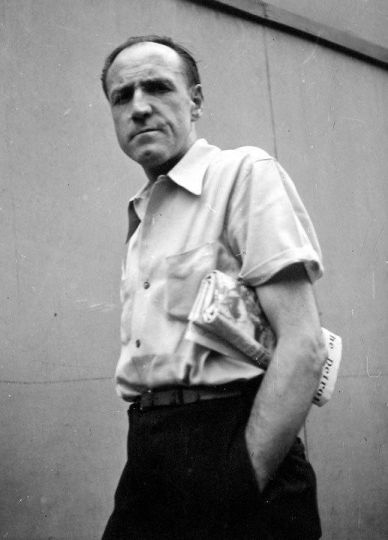
DB: Well, it’s not the original title, it’s an excerpt from a poem by Paul Dermée, written as a preface to Kertész’s exhibition at the Au sacre du Printemps gallery in Paris in 1928. « Kertész, des yeux d’enfant dont chaque regard est le premier …/… Kertész est un frère voyant » “Kertész, with the eyes of a child whose every glance is the first…/… Kertész is a seeing brother.” I liked the term. So we gathered these images—landscapes, still lifes, portraits of unknown people or famous people—because he was well connected to the artistic milieu of the time, like this beautiful photo of Paul Arma’s hands holding his glasses, a French composer of Hungarian origin.
JJA: This period also reflects the beginnings of Kertész’s professionalism.
DB: It was his French period, yes; he began a regular practice upon arriving in Paris, for only about fifteen years. Taking advantage of a contract with Keystone, he left for the United States because he was of Jewish origin, and the war was coming. He remained there while maintaining contact with France, and in fact, his most creative period was achieved there. He never really belonged to a movement, but he was very close to the Surrealists, he integrated the new vision, and he also had ties to humanism, of which he was somewhat of a precursor.
JJA: Here, we discover many images we didn’t know about.
DB: Absolutely. He was also a press photographer, like many others, which allowed him to work regularly. In this exhibition, we see him developing this practice, with its editorial constraints, and, nonetheless, some visual and compositional research close to the new vision. Photography wasn’t yet valued at its true worth, and it must have been difficult to make a living from it without publication in print or the press. The fact that photographers numbered their prints is fairly recent. For the magazine Art & Médecine, he traveled throughout France and its regions, meeting cultural figures, and the magazine also published his personal work. He did a fair amount of night photography, less assiduously than Brassaï, but still, we find some of it here with its particular atmospheres.
Text and interview by Jean-Jacques Ader
« Le frère voyant », an exhibition of photographs by André Kertész, at the Espace Photographie of the Arthur Batut Museum in Labruguière (Tarn), from March 6th to June 14th, 2025. Admission Free.
Information: https://arthurbatut.fr/