A member of the Vu agency, Frank Loriou became a photographer through music. Head of the graphic design department for the Virgin label, he designed record covers for several years before picking up a camera. For a long time, Jean-Louis Murat refused to be photographed, until he met Frank Loriou. The latter would go on to create around ten album covers for him, up until Baby Love in 2020. The shots generally took place in Auvergne, the musician’s hometown. It was always a “picturesque” experience, the photographer recalls, fondly recalling Murat’s antics during the sessions.
From these two decades of collaboration, Frank Loriou has kept several hundred images. He has selected 150 of them, most of them previously unpublished, which he publishes in Photorama. Beyond the intimate portrait of Jean-Louis Murat, these photographs also have an educational value: for each album, Frank Loriou has chosen to preserve all the shots taken, in order to show the public how a record cover is created. He creates a dialogue between his images and a text reflecting on their collaboration and their friendship. The Eye of Photography offers you an excerpt.
TOBOGGAN
Summer 2012. I had acquired a taste for stopovers in Douharesse, and I returned again in the nicer weather the following summer. To get Jean-Louis’s opinion on the world’s problems and to drink some chilled rosé. His intellectual freedom, his bold approaches and theories, documented by his extensive reading, were of a rare quality, and I took great pleasure and interest in them. Listening to him in the evenings under the large beech tree, I often felt I was dealing with an exceptional person, and realized how lucky I was to be there.
One morning, through the curtain of the bay window, I saw Jean-Louis pass by from my bed, on his Decathlon bike. With his straw hat and a pitchfork, he was going from the lower garden to the upper garden, already up at that early hour. I had my camera equipment in the car. I jumped into a pair of pants and stopped him on the road. I want to photograph you on your bike. There. Now. Without changing anything, but relieved of the pitchfork, Jean-Louis went back and forth, placid, with a detached air, seeming to be thinking of something else. And full of good will. Under the burning sun of that mid-morning, the cowboy Murat, whom we would later see again as Buck John, played me the strangest and funniest of westerns. Gentle, simple, natural, full of humor and self-mockery. I had long wanted to present him in this way, he who deserved so much to be known for his poetry of the moment, rather than as a good customer of talk shows.
If he greedily played the television sniper, he also caused a fair amount of collateral damage, and many turned away from his music, who would have loved it so much anyway… This visceral insubordination to the rules of wooden language, in a wise and disciplined world, was an undeniable part of his charm. Its incandescence. Its singularity. Whoever rubbed shoulders with it was stung, burned, and taken a beating. His interviews in the written press were the most truculent on the market. A sally in every sentence. An acid rain of intelligence and humor. In Magic, in 2003, when Franck Vergeade asked him what he thought of the free and open distribution of music on the Internet, in other words, piracy, he declared, clairvoyantly: “I am scandalized. Everyone is stealing our songs, Internet users are terrible chicken thieves. We should hang one of them by the balls every day, Place de la Concorde.” While at the same time, many artists were signing petitions against criminalization, in the name of the prohibition of prohibition. Sawing off at the same time the branch of their copyright, on which they were sitting. A fable by La Fontaine.
We did the entire session with the hat on. We returned to Émile’s house. Open the same window. Lean against the same wall. Dig the same furrow. Repeat the same gestures. Similar and different. The gestures of craftsmen. Who return to the work every day. And load, reload, again and again, the Hasselblad camera. I have only ever photographed Jean-Louis Murat on film. And always in July. Then go down to the cellar, by the light of a bulb, without flash, without assistant. Then I no longer know why or how, find myself in the office. A secret temple, where I had never entered, whose existence I didn’t even know. Where he writes, composes, disappears, loses himself and finds himself again. The cave, the alcove. Kneeling on the floor, I photograph. Guitar in hand, Jean-Louis has forgotten me.
Back in my studio, an image quickly came to me, then to us, for the cover. A painting. Jean-Louis on his bike, in the middle of the road. He asked for more grain, more substance, as if he no longer wanted us to see his face, but only to guess it. He liked the typography I suggested. The cover of Toboggan is there, and very much there, which will later be released in a blue version for a special edition. I didn’t know the album’s future title when we took these images, on this road plunging towards the valley.
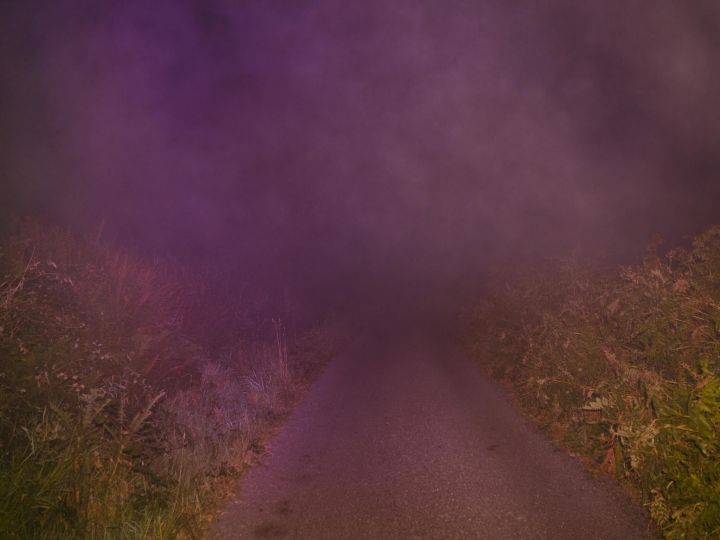
A few days earlier, on the evening of my arrival, while driving in the night a few kilometers from home, an animal appeared. There was a loud thud, bones, hair, and flesh against metal. After a moment of stupor, I turned around on the small winding road. In the headlights, an enormous badger lay, thick blood flowing from its skull, like lava from a volcano. Its body was heavy, its teeth sharp. I was afraid to approach it. Its eye was closing, slowly. The light was so beautiful. I photographed it.
I told the story to Jean-Louis, who took it very seriously. He had been surrounded one night in the mountains, sleeping under the stars with his family, by a pack of badgers. All night long, he had kept them at bay by waving fire. Later, when I showed him the booklet for Toboggan, he discovered the image of the dying badger in the car headlights. I had slipped it there, without warning. It stayed there. We never spoke about it. Badgers are serious business.
The album Toboggan was released on March 25, 2013.
Frank Loriou : Photorama
éditions le BOULON
204 pages
09/10/2025
https://leboulon.net/murat-photorama/