Photography has been woven so thoroughly into the contours of our lives that we rarely stop to feel its texture. Evan Roth does. In A Hundred Thousand Years of Light, his solo exhibition at Dorothée Nilsson, Berlin, photographic images are digitally printed onto fabric and stitched with a domestic sewing machine, thread tracing a path that wanders without destination. What happens when a contemporary artist chooses quilting as the primary medium through which photographic images circulate? Against the accelerated cycles of contemporary image culture, the work proposes an alternative grounded in duration, accumulation, and the materialization of light.
Looking at the Sun is one of the oldest human impulses: to track it, map it, build systems of meaning around it. From medieval books of hours to ancient observatories, the sky has always been a way of making sense of time. Roth’s turn toward the Sun continues that lineage. It is also a turn toward the present, toward concerns about energy, climate, and the environmental cost of the digital systems that now organise our lives, and a turn toward light itself. Photons, particles of light, travel at the fastest speed in the universe, and yet those born in the Sun’s core take, on average, one hundred thousand years to reach its surface. Slowness and speed coexist in the same particle. This paradox is what draws Roth to the Sun.
For over two decades, Roth has sought to render invisible systems perceptible, giving material form to the hidden infrastructures that shape how we see and how we live. In earlier works such as Since You Were Born (2016, ongoing) and Internet Landscapes (2014, ongoing), that inquiry focused on the internet: the data flows through submarine optic cables, cached images, and digital traces that silently organise contemporary life and shape our networked self-image. He has described his practice in two chapters: the first moved in sync with the rapid expansion of the early web, playful and restless; the second turned toward duration and attention, almost as a form of resistance to the acceleration it had once embraced. Running through both is an archival impulse, a desire to catch a system mid-transformation. With A Hundred Thousand Years of Light, that system is the Sun: the infrastructure whose light makes vision and image-making possible in the first place, and whose ancient photons stand as counterpoint to the infant photons emitted by our screens.
The four large textile works at the heart of the show form a new series titled Heliographs, meaning sun-writing. The title reaches back to photography’s origins, to photograms, to Fox Talbot’s early experiments with light falling directly onto sensitised surfaces, to the idea of the sun itself as author and medium. These are indexical images in the oldest sense: direct traces of light on surface, the Sun writing itself. For Roth, the act of imaging the Sun is less about seeing than pointing: directing attention toward something so vast and so present that we rarely stop to look. He recorded clouds passing across its face. In our current moment, clouds are two things at once: a meteorological phenomenon and the invisible archive that stores and organises our collective visual memory.
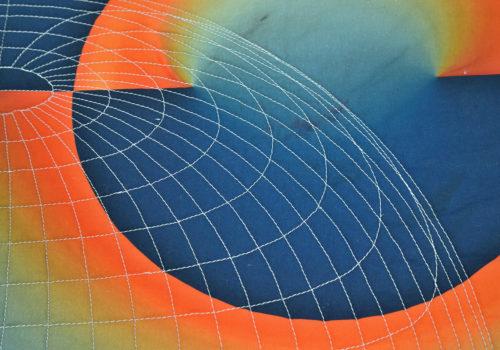
During a residency at the Astronomical Observatory of the University of Namur, Belgium, Roth worked with astronomers imaging the surface of the Sun through a telescope fitted with an infrared camera, a lens that registers wavelengths beyond human vision, revealing what remains otherwise invisible to the naked eye. The camera produces greyscale images, which Roth then colourises intuitively, treating colour as a painterly choice. The result is a hybrid: photograph, quilt, astronomical data, and painting at once.
These solar photographs are digitally printed onto fabric and stitched with a sewing machine following a pattern known as a random walk: a phenomenon in astrophysics in which a photon born in the Sun’s core takes, on average, one hundred thousand years to reach its surface, drifting through solar plasma in a slow, unpredictable arc, before crossing the distance to Earth in 8 minutes and 20 seconds. For Roth, it is both concept and method: a way of reanimating the photon’s journey in thread, and of enacting the wandering, drifting attention that slow transformation requires
He builds a simple compass app on his phone, set to a timer that fires a new random direction every two seconds, and duct-tapes it to the sewing machine. Stitch by stitch, for a day or two at a time. The rhythm is meditative. As Roth puts it, he is living the random walk.
The exhibition also includes works from Roth’s Sky Quilting series: photographs of the sky warped using cartographic mathematics, printed onto fabric, and stitched along the grid lines of latitude and longitude, mapping the sky by referencing the ground. Soft, tactile, and immersive, they began as a personal search for light in the gray overcast of Berlin winters, continuing a centuries-old tradition of bringing the celestial indoors.
Roth has long worked with the relational tension between the speed of contemporary culture and the stillness of the gallery space, a tension this exhibition makes palpable. A solar-powered music box plays Roy Ayers’ 1976 classic Everybody Loves the Sunshine, slowed to 8 minutes and 20 seconds, the exact travel time of sunlight from Sun to Earth. To hear the song in full is to stay, and the gallery becomes a space of sustained attention.
What does it mean to live among images that arrive faster than thought, when the sunlight on our skin has been travelling toward us for a hundred thousand years, leaving its marks as it goes? How do light and time relate to the body, to shared experience, to the social world? These are not new questions, but they grow more urgent. Roth’s response is to translate his encounter with the Sun into the exhibition space, inviting viewers, as they move through it, to share in it.
The Sun has been radiating light in all directions for billions of years: an infinite field of possible images. Photography begins with everything and proceeds by choosing. To point a telescope at the Sun, to record this specific cloud crossing its face at this specific moment, is to collapse all of that into one frame. To print it onto fabric, to stitch it, is to collapse it further still, into something you can hold.
Exhibition text by Dr. Yonit Aronowicz
Evan Roth : A Hundred Thousand Years of Light
4 July – 22 August 2026
Dorothée Nilsson Gallery
Potsdamerstrasse 65
10785 Berlin, Germany
www.dorotheenilsson.com