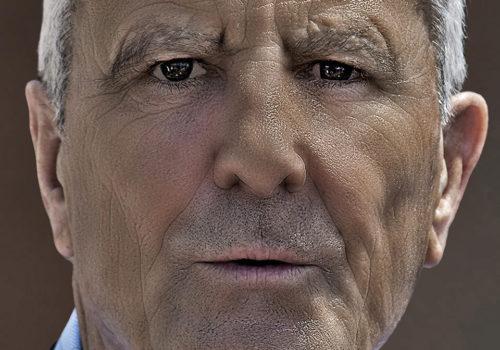
Thierry Maindrault’s Monthly Cogitations
The summer months were the months of harvest , when hard work secured the economic future until the next cycle provided that everyone’s prayers to their gods brought favorable weather. Starting in the middle of the previous century, the story changed. Summer months were eagerly awaited to guarantee a well-deserved rest at least in theory and became a demand for time off during which the sun’s tanning rays became the common God. The future horizon, with its very material warnings, forces us to seriously reevaluate our intellectual approach. This imposes certain realities upon us that transform lazy lethargy into surges of stress, or even total anxiety for some. Thus, grueling labor has made a comeback—not to ensure bountiful harvests, but to limit all these unwelcome disasters.
What harrowing times our planet is presenting to us, a sort of wake-up call for our human “anthills.” All our modest plantations, our Pharaonic buildings, our defaced natural landscapes, are being swept away in a matter of seconds by water, fire, or wind. A return to a modicum of humility is in order by all those decision-makers whose supposedly great abilities have, unfortunately, worn out prematurely (to the very end) on the benches of prestigious schools for the elite.
Everything is catastrophic like the loss of a life that will remain etched in our memory. The material loss representing years of hard work will be a new challenge. The loss of memory forces us into a kind of wandering through our personal heritage.
None of us is immune to such an ordeal. I experienced the instant disappearance of my photographic artworks (several thousand photos) under a wave of mud in September 1992 (Vaison-la-Romaine). Such is the story of the universe, with its small human twist.
What truly struck me in the voyeuristic interviews of all the people who discovered their homes completely destroyed was the despair of those who, even though they had lost everything, clung to their photo albums. I was moved by the sense of relief expressed by those who said they had managed to save their photo albums. Everything was lost except the family’s soul this guiding thread of their heritage, preserved through a few photographs. This stood in stark contrast to those who were utterly devastated by the loss of their treasure trove of images. In every case, nothing remained of years of hard work and life; the very tangible difference in their suffering came down to a single photo album or box of photographs. Every lost or destroyed object causes dismay; a vanished image wounds the memory. Photography is the true witness that is passed down through the long generational relay.
It has been proven that photography has indeed become, through the intangible nature it expresses, the medium for heritage stories. It has become the legitimate descendant of cave engravings, ancient frescoes, and commissioned paintings. What matters is not the representation conveyed by the image; the essence lies in the spirit that springs from the album or escapes when the lid of the metal box is lifted. The emotional content is essential, given that the physical container is not always in great shape or is often quite worn out.
Since I’m on the subject of physical photography, I’ve noticed that when people talk about their treasures, in almost every case, they’re referring to photographs printed on paper. This makes sense for all photos taken before the advent of the multifunction smartphone. The phone stays in the pocket, the photos stay on the phone, and the risk of losing memories is close to zero. Yet, when a young intern journalist tried to reassure a young disaster victim that he’d been able to save many of his digital photos, he received this scathing response: “It’s not the same thing at all.” Let’s not confuse apples with oranges.
It seems clear that, for a few more years at least, authentic family photographs will be printed on paper. Whether they’re magnetized on the refrigerator, framed on the desk, or hung on a picture rail, these family images can be touched, carried around, and protected within the family’s cocoon. Certainly not in a phone, no matter how sophisticated it may be!
The final point we can address is the future of these images. Whether they remain within the family circle or scatter into other environments, their fate is often the same.
Firstly, it is not only disasters whether natural or accidental that can permanently erase an image, its context, its message, and the emotions it evokes. Stupidity, ignorance, fanaticism, and human anger are capable of destroying memories, shared experiences, and personal accounts. It is a fact, without comment: the past and future become invisible, just like most brains.
At the other extreme, the photographic image stands as one of the major assets of memory to be passed on to enrich our evolution. Our evolution, which is supposed to grow richer from one generation to the next. However, this choice to preserve requires a minimum organization to ensure the safekeeping and accessibility of the images. While there is no such thing as zero risk for a photograph any more than for anything else, basic precautions must be taken depending on the medium. Furthermore, being able to find the desired image in the right place at the right time remains a determining factor for the survival and transmission of this photographic memory.
Finally, there is the option of adding a personal modern twist to the memory of our ancestors. Generally, a paintbrush or pen is used, along with paint or ink, to make its mark on the weathered image. While the limited imagination of our pseudo-creatives may be interesting in theory, the reality is quite another matter. In far too many cases, our small-time “Leonardo da Vinci” feel compelled to butcher unique originals to satisfy their artistic urges. When it comes to destruction, landslides, fires, and floods have the merit of being real not exaggerated by a perverse ego. Nevertheless, for a creator who lacks technical mastery of photography but wishes to build upon the legacy of the past, the temptation to make a contribution may be justified. But in such cases, let’s respect the original work. It’s so easy to rework copies, especially since the message and its emotional impact will change if the “makeover” is successful. Why not add a literary touch to a photo of the grandparents’ wedding or a splash of acrylic paint to a photo of the Chinese exodus? But let’s preserve our originals and their credit (if it still exists).
What we call, somewhat pejoratively, the “family photo” is an important pillar of our photographic world. I would even go so far as to say that it is the one that generates the most emotion and sensuality even if the photograph is botched or poor.
It goes without saying that the involuntary loss of these photographic traces is always a form of intellectual and psychological heartbreak. The feeling of rage that grips every professional photographer upon the accidental loss of a work turns into despair when the destroyed image contains a part of the soul.
Thierry Maindrault – August 14, 2026
your comments about this chronicle and its photography are always welcome at
[email protected]