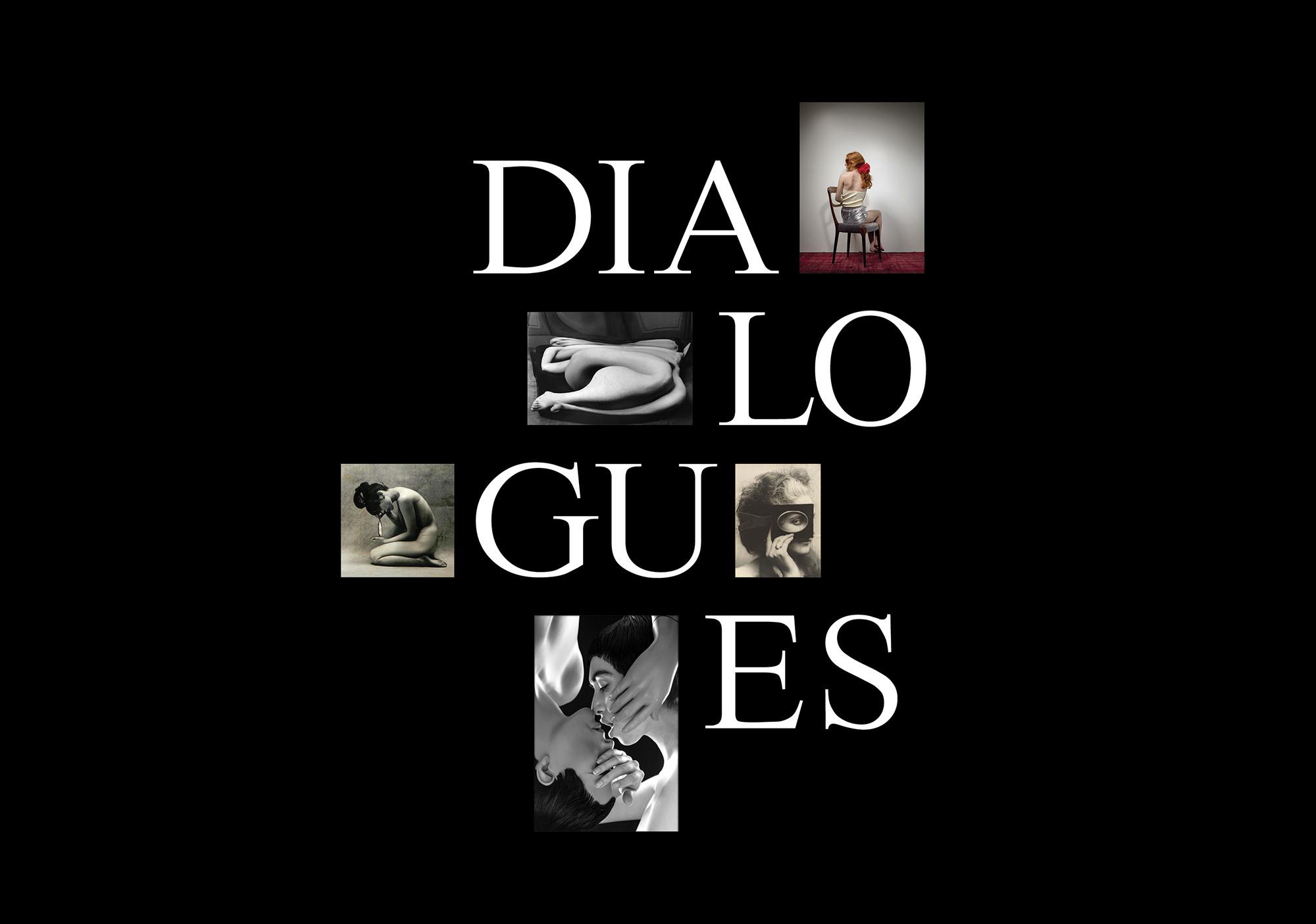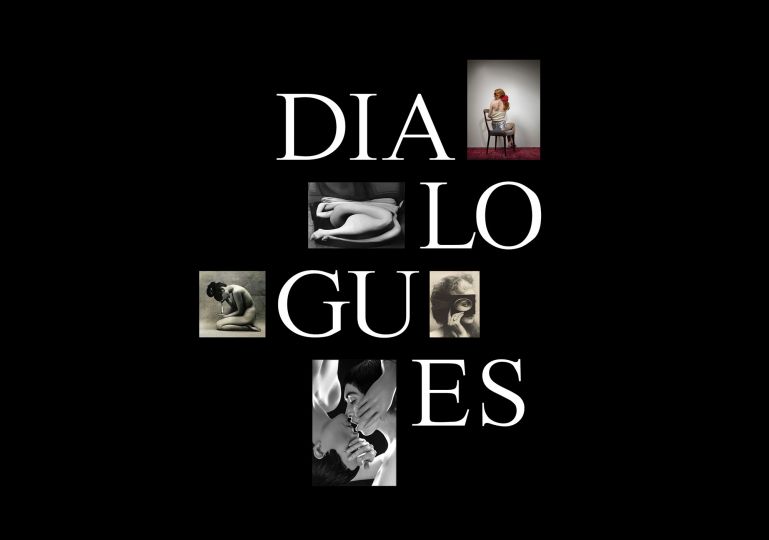


In a collection, works are not simply “objects”. They have something alive within them, with references and connections. They are interwined, as is the case in the Ettore Molinario Collection, which has recently reached the milestone of fifty Dialogues between its photographs. And #50 is a very special Dialogue, beautiful and sad at the same time, dedicated to Jean-Jacques Naudet, to whom, Ettore Molinario says, “goes my infinite thanks for having initiated in all of us the most profound, original and exciting dialogue with photography”, allowing us to “see things never seen before”.
Words are always crucial. We often use the word dialogue without thinking too much about it, but its etymology, from Ancient Greek, means a constructive and dialectical verbal exchange, which, since the time of Socrates, has served to get to the heart of the human soul. Applied to photography, it can open up new insights, always supported by facts and documentation. The Dialogues highlight the relationships between the great masters and those anonymous or relatively unknown authors who often anticipated and shaped the vision of contemporary photographers. In doing so, Ettore has brought to light details inherent in a hundred photographs, sharing them with readers and allowing them to create new and unique connections.
The Dialogues revisit the themes most dear to Ettore’s reflections: the search for oneself, gender identity, desire and melancholy (a state of mind that may seem like a relic of the past but is actually very relevant today).
Dialogue #50, in a certain sense, concludes a journey that has lasted over five years. From Louise to Louise, we might say: the first and last image of a perfect circle. Between the first and fiftieth Dialogues, photographs representing over 180 years of the history of this art have passed, narrated in such a way as to transform the collection into a theatre of many voices, where each pair of photos that look at and talk to each other (figuratively speaking, of course) becomes a mirror reflecting the sensitivity, culture and psyche of the collector.
Louise (daguerreotype from 1845 by an anonymous photographer) is the oldest image in the collection and perfectly represents its fluid nature, addressing the issue of gender identity not as a contemporary trend, but as an intrinsic need of the individual. Louise asks the early photography to be a mirror that confirms her, in front of herself and others. But this image is also indicative of an internal dialogue: Ettore dialogues first and foremost between his masculine nature and a feminine component, which, although represented externally in the images, is authentically internal to him.
This is also expressed in images depicting a more vulnerable or wounded femininity, as in the case of the Inconnue de la Seine (photograph by Albert Leduc, 1927), whose deadly beauty, captured in the cast of her face, fascinated Rodin and the Surrealist Breton. It is seductive death: a mortal but serene face, an ‘imaginary femininity’ that no longer exists, and is juxtaposed with an image by Pierre Molinier, about whom a ‘terrible’ episode is recounted, at the darkest limits of desire.
Another example is Marilyn Monroe, portrayed by Earl Moran in 1948, when she was still an unknown Norma Jeane Mortenson, before becoming a star. This image dialogues with John Franklin-Adams’ Nebula (1905), “connecting the timeless, seductive power of the actress and the vertical vertigo of infinite space”, explains Ettore Molinario, placing her on a path that goes from the depths of inner darkness to the ecstatic contemplation of the starry sky.
And, staying on the theme of space and celestial bodies, we mention a solar eclipse and a moon with strong symbolic meanings, both images by an anonymous artist. Symbols from the dawn of humanity, representing rebirth and death, the passing of time, they interact with Scherzo di Follia (The Countess of Castiglione) by Pierre-Louis Pierson (1863, enlarged in 1930 by Braun & Cie) and with the portrait of the Marchesa Casati by Baron Adolph De Meyer (1912).
The Countess of Castiglione, a woman of extraordinary awareness and narcissism, experimented with female imagery as early as 1860, using photography and entrusting a photographer with the task of recording her transformations, thus anticipating by about a century the approach of Cindy Sherman, who would use her own body and disguise to deconstruct female stereotypes. The Countess “spoke about herself” through a multiplicity of identities (she was a spy, ambassador, lover, and much more), revealing the “ghosts” that inhabited her personality, and positioning herself as a forerunner of photographic research on identity and self-staging.
In response to Castiglione’s solar eclipse, Marchesa Luisa Casati is associated with a “recomposed moon”, which reflects the nature of the Marchesa, described as a lunar and nocturnal woman, contrasting with the source of sunlight of her muse.
The collection is structured around a dual cognitive tension, representing Ettore’s way of being as a collector, capable both of immersing himself in his own darkness, in the depths of the Earth and human interiority, and of experiencing a tension towards the infinite, towards the vertigo of the starry sky.
This is evident, for example, in the dialogue between a trench from the First World War (S.Lt Ioanid, 1917) and Vulva (2004) by Paolo Gioli. In a sort of exploration of universal archetypes, a reflection on the concept of Mother Earth emerges, combining erotic death with physical death in an ancestral return to the darkness of the female womb.
The Collection is characterised by a rich and complex philosophical discourse, of which these written ideas are but a few. Ettore defines it as “a romantic collection that reflects me, due to the strong desire for possession typical of collectors, combined with melancholy and awareness of human finitude”. But there are also ecstatic contemplations of the heavens, and the ability to tune into a greatness that does not belong to man (the contemplation of the sublime), and the suffering of infinity (there is an awareness that it exists, alongside the impossibility of measuring it).
Romanticism is evident in these elements, with a strong vein of Surrealism, too. Alongside this is a search for awareness, to transform the wonder one feels when faced with an image into a deep understanding of the ghosts and structures that inhabit it, so that everything the image contains is revealed.
At this point, all that remains to do is to immerse oneself in Warburg’s universe of The Collection and Dialogues, among works for which chronological conventions have been abolished, in order to identify new visions, suggested through paths (which can be varied at will) by the collector himself, Ettore Molinario. An invitation to experience abysses and vertigo, in search of history, the contemporary, and one’s own self.
Paola Sammartano
Collezione Ettore Molinario