C/O Berlin : Close Enough : Perspectives by Women Photographers of Magnum
For its twenty-fifth anniversary, the Berlin space devoted to photography is hosting this exhibition bringing together twelve photographers from the Magnum agency around the theme of closeness—what links an author to their subject: what is the nature of the relationship? what distance? how does a subject tell their photographer? An urgent and compelling reflection on contemporary photography.
The title of the exhibition echoes a maxim from Magnum’s founder, Robert Capa, who said: « If your pictures aren’t good enough, you’re not close enough ». Which can ultimately be true for anything: how can you do things properly—in the practical and ethical sense of the term—if you are not close enough—in the sense of being connected—to your subject? In photography, beyond the purely visual aspect of expression (which, moreover, can stand on its own), this is a fundamental question, especially in an era when anyone has the power to show anything through a lens. To address this notion of ethics—or even before that, the question of legitimacy—the long-term bodies of work presented in this exhibition help to sustain the dialogue.
The photographic object as a space for exchange
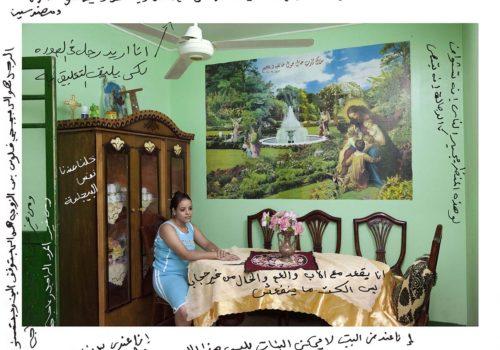
Among the works presented is this series by Bieke Depoorter made in Egypt from 2011 during the Arab Spring, in which we are immersed in the intimacy of people’s homes. A body of work that was to become a book, which the Belgian-born photographer decided to postpone and rethink, prompted by a feeling of Western voyeurism and by the desire to give voice to those most concerned—namely, Egyptians. She therefore returned to Egypt in 2017 and asked ordinary people to write their comments directly on the photographs in question: we then find a great deal of nuance and gain access to elements that help us understand Egyptian society, without any external filter distorting them. A relevant, demanding but necessary way of addressing the Western discomfort that exists within documentary photography.
More than forty years earlier, Susan Meiselas was among the pioneers of these reflections: in 1971, when she made « 44 Irving Street » in Cambridge, Massachusetts, she asked her subjects to comment in writing on their perception of these images. This idea of photography as a space of exchange runs through her entire œuvre, from her famous series on American fairground dancers to her coverage of the Nicaraguan insurrection, shown in this exhibition. This idea of photography as a space for exchange and critique runs through all of her work, from her series on American carnival striptease dancers to her coverage of the Nicaraguan insurrection. Here, she presents her work from the late 1980s focusing on the Dani indigenous community in Papua, Indonesia, directly addressing these issues of representation.
Collaboration as a method
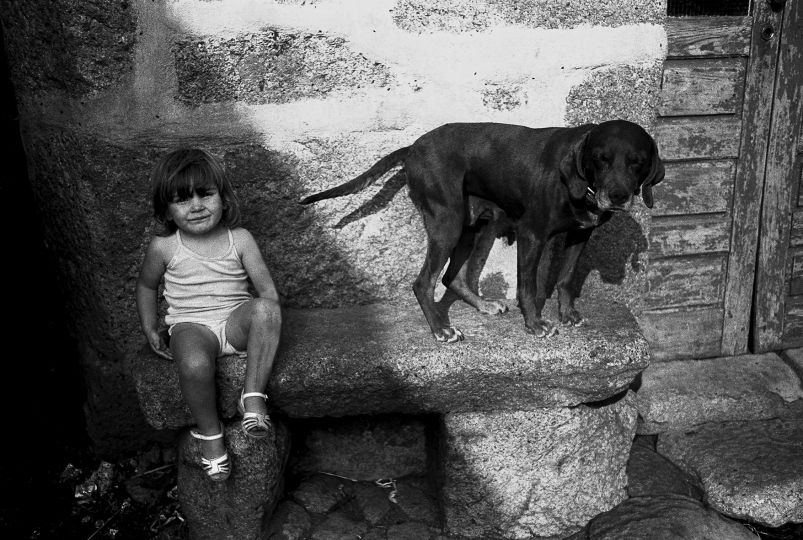
Another series that has resonated particularly strongly in recent years is that of Alessandra Sanguinetti, who, in a long-term project, followed the evolution of two cousins, Guillermina and Belinda, on a farm near Buenos Aires. While many people know these images—oscillating between spontaneous moments of life and true staging—few know that the project was originally a side endeavor, a way to escape overly constrained professional photographic assignments. Woven by three pairs of hands, this series was above all a space of freedom for its author, who cast aside ready-made ideas in favor of a vast creative exploration. To better understand the relationship—the distance—that links the American photographer to these two girls, now mothers, the small book « Over time/Au fil du temps », in which all three are in conversation, is particularly fascinating. Ultimately, beyond the intoxicating images, the power of this series lies in the agency given to these women to tell their own story—starting from the very earliest age, when the boundaries between reality and imagination are still blurred.
Subjects as mirrors of one’s own reality.
The photographs of Myriam Boulos have now largely crossed Lebanon’s borders for what they tell, from the gut, about the country. Showing her world through intimacy is Boulos’s approach. Her series « What’s Ours » speaks of Lebanon over the past ten years and offers an electric reading of the thawra [revolution], which began in Lebanon on 17 October 2019, following protests against government corruption and the freezing of savings in banks, culminating in the explosion at the port of Beirut in August 2020. Armed with her flash, she photographs her friends and family with striking energy, in states of pleasure and revolt. In her work, Myriam Boulos restores the body to its place in public space—a body viscerally alive and vulnerable in the face of state negligence and intrinsic violence. Here, closeness is a condition: it is because she is directly involved in her subjects’ anger and hope that her gaze carries its full force.
For Newsha Tavakolian, too, photographing her country is a way of exploring herself. She presents images and video excerpts from “Look” (2010) and “For the Sake of Calmness” (2020). These works feature portraits of Iranian women taken in her apartment, offering her own intimate space as a reflection of a society marked by isolation and anxiety, alongside her metaphorical work that interprets Iran as a female body in a perpetual state of premenstrual syndrome: a state of tension that never subsides.
In the same vein, Sabiha Çimen presents « Hafiz », begun in the late 2010s, on the daily lives of girls enrolled in Turkish Qur’anic schools. A project that blends strength and tenderness and echoes her own experience, as she attended these schools herself. Her approach relies on a memorial process in which she documents these teenagers when they are not studying the Qur’an—notably to move away from clichéd representations of schoolgirls and Muslim girls—capturing what she calls an « art of rebellion ». « I was one of them », she said during the press preview. This closeness is what made collaboration possible: the girls have absorbed her visual language, as shown by the photograph of the melon—when they sensed that Çimen would find it interesting as an image.
Reverse the perspectives
The series « City of Brotherly Love » by Hannah Price literally reverses the gaze: after moving to Philadelphia, she photographs the men who harass her in the street, making them objects of the gaze rather than subjects. Cristina de Middel applies this logic to sex work with « Gentlemen’s Club »: by placing an ad in Rio in 2015 asking clients of prostitution to pose for her, she brings to light stories that testify to an invisible reality.
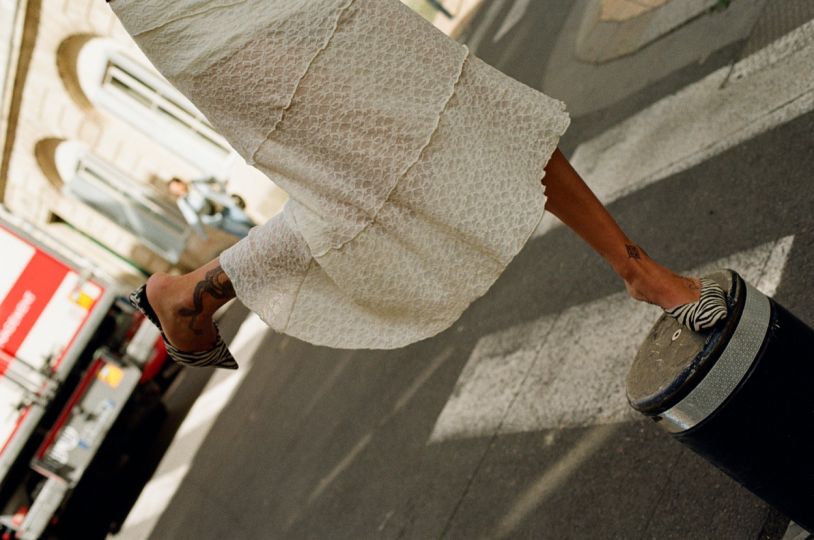
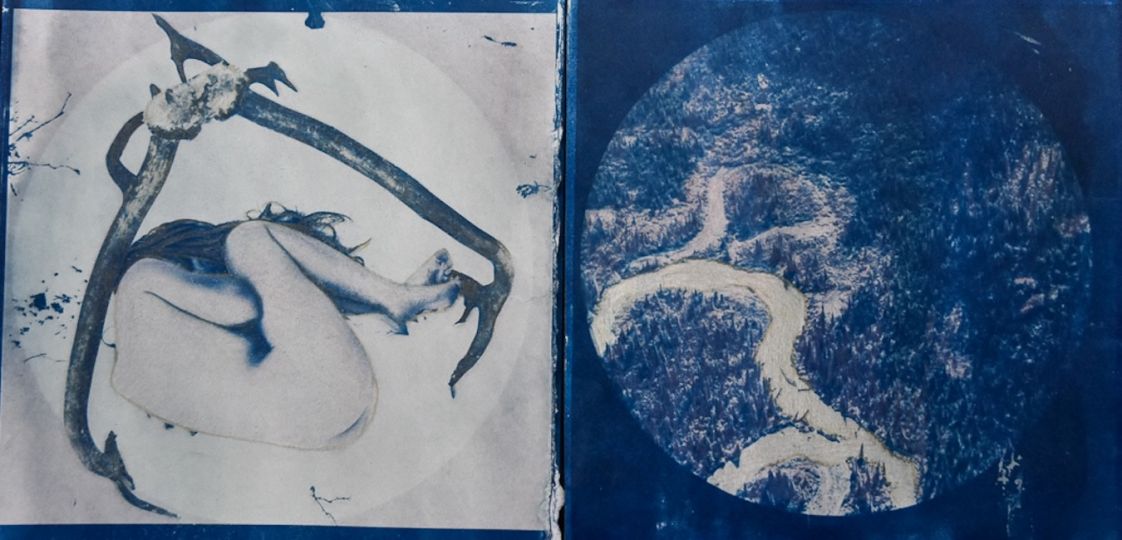
The exhibition also presents the works of Olivia Arthur with a tactile exploration of the body, those of Nanna Heitmann in Russia while everyone is in Ukraine, and Carolyn Drake with her project « Men Untitled », as well as Lúa Ribeira with « Agony in the Garden ». Each with her own method, these approaches speak to and coexist with one another: closeness is not a matter of physical distance or journalistic immersion, but a relational process that defines the bond between the photographer and her subject.
Close Enough can be seen at C/O Berlin until 28 January 2026.
C/O Berlin
Hardenbergstraße 22-24,
10623 Berlin
https://co-berlin.org